
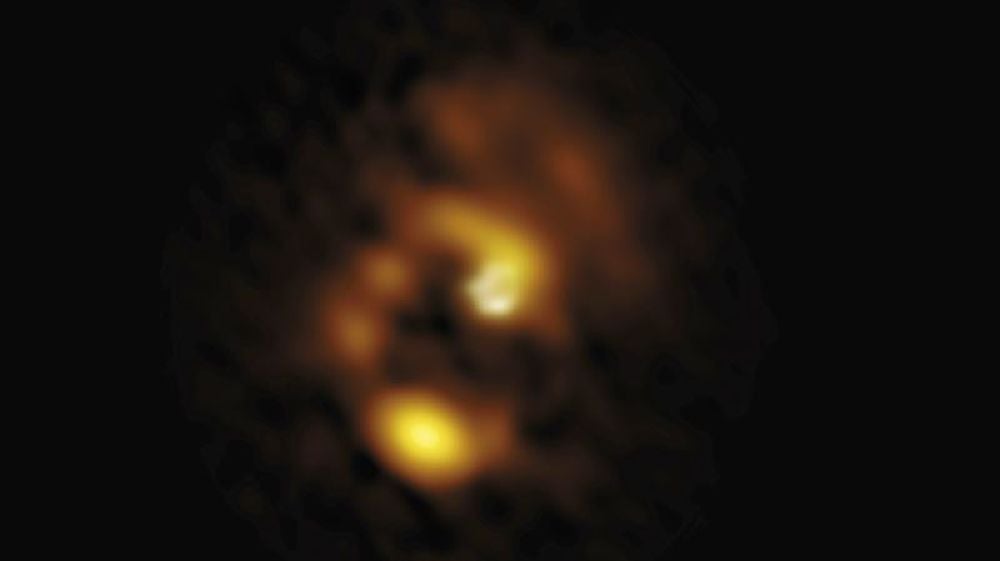
Highly-evolved stars spread the material for new planets and stars into space with their stellar winds. These stars are called aysmptotic giant branch (AGB) stars, and they're cool, luminous stars that are running out of hydrogen and leaving the main sequence behind. As they age, they can shed as much as 30 Earth masses of material per year into the interstellar medium (ISM). The material is first emitted in pulses of gas, and eventually that gas cools into dust and the star's radiation pressure pushes it away with its stellar wind. Carbon and silica are important parts of what's emitted, and silica is the main building block for rocky planets, while carbon feeds into organic particles. So these stellar winds from AGB stars clearly play an important role in the formation of planets, other stars, and even potential life. Researchers at Chalmers University in Sweden have been observing Mira, an AGB star about 300 light years away. It's the prototype and namesake of what are called Mira variables, pulsating AGB stars that are oxygen-rich. Their results are challenging the long-held understanding that stellar winds driven by radiation pressure are what spread heavy elements into the interstellar medium (ISM). The research is "A giant magnetic eruption from the asymptotic-giant-branch star Mira A," and it's published in Astronomy and Astrophysics. The lead author is Wouter Vlemmings, Professor in the department of Physics and Astronomy at Chalmers University of Technology in Gothenburg, Sweden. "Mass loss during the advanced evolutionary stages of low- and intermediate-mass stars is traditionally attributed to dust-driven winds, whereas the influence of magnetic fields remains poorly constrained," the authors write. "This mass-loss process is crucial for the chemical enrichment of the Universe." Since this type of mass-loss is so fundamental, it's attracted a lot of attention and is the subject of a huge amount of research. In this work, the researchers used the Atacama Large Millimeter/submillimeter Array (ALMA) observations to study how Mira's magnetic fields might shape its mass loss. ALMA can't directly observe magnetic fields; instead it observes them indirectly through their polarizing effect on radio emissions. “For decades, astronomers have believed that the winds from stars like this must be powered by starlight. Light from the star shines on grains of dust in the star’s outer atmosphere, and that gives them a push. But this star is showing us something different: that strong magnetic fields can also shape and power stellar winds. That changes a fundamental part of the origin story of the atoms we ourselves are made of," lead author Vlemmings explained in a press release. This schematic shows the structure of an AGB star, from its degenerate core to its circumstellar envelope. It shows it during its thermal pulse stage, when pulses drive gas outward, where it cools and forms dust in the envelope. Radiation pressure generates the stellar wind that drives the dust away into the ISM. Image Credit: Lu et al. Front. Astron. Space Sci., 23 July 2025. Sec. Astrostatistics Astrophysicists have detected strong magnetic fields in the circumstellar envelopes of AGB stars like Mira, and researchers have suggested that they may play a role in driving their mass loss. But the researchers explain that there's been no empirical evidence of the role magnetic fields play in the process, and that wind-driven mass loss models don't include magnetic fields. Recent observations, however, are challenging the overall understanding of the wind-driven mass loss scenario. Some AGB stars show mass-loss but also show insufficient dust to explain it. These stars are oxygen-rich AGB stars like Mira. Since Mira is the nearest of its type of dusty, pulsation-driven O-rich AGB stars, it makes sense to study it. Both ALMA and the Very Large Array recently observed Mira A, the AGB star, and its companion Mira B, a white dwarf, in August 2025. But observations go back ten years, and both sets of data combine to reveal dramatic changes on Mira A's surface. "During the past decade, high-angular-resolution observations of Mira A at visible, millimetre, and submillimetre wavelengths have revealed several unexpected phenomena related to the stellar atmosphere and mass-loss process," the authors write. This ten-year study of Mira's surface is the longest study of any star other than the Sun. This time-lapse shows ten years of changes on the surface of Mira A. Credit: W. Vlemmings et al. 2026. Astronomy and Astrophysics. “We were astonished to see how the star’s surface is constantly changing. The brightest areas were different every time we looked, and the brightest patches are amazingly bright. We realised that star is flaring, releasing vast amounts of energy each time," said study co-author Miora Andriantsaralaza, a postdoctoral researcher in the department of Physics and Astronomy at Chalmers University of Technology. Some of the hotspots in the video have brightness temperatures of 8,000 Kelvin. That's far higher than the average 2,000 K brightness temperature. But the main finding is what researchers call SiO (silicon monoxide) masers. They're often found in the circumstellar envelopes of AGB stars, just inside the dust formation zone. But Mira A's masers are at a much greater distance, where the gas is too thin for a strong SiO maser to form. So the researchers say the masers trace a shock moving outward, and that it has much higher density than expected. In short, a flare that expanded into a huge loop of expelled material. “In 2023, we saw one of these flares appear on the star’s surface, but it didn’t stop there. Over the next two years, this eruption on the surface created a vast, expanding loop of gas around the star, which we captured in an image in 2025. The loop was much bigger than the star, extending as far out as the distance of Saturn from the Sun. We hadn’t seen anything like that before," said co-author Behzad Bojnordi Arbab, a doctoral student at Chalmers University. Masers aren't always polarised, but these ones are linearly and circularly polarized. Linearly polarised means its polarisation is organized, and the polarising is shaping it. Circular means it rotates in a corkscrew pattern. Taken together, the astronomers used those features to map Mira's magnetic field geometry. That in turn let them understand how the magnetism is shaping its wind and its mass loss. The loop and its polarisation is the key in this work. “In the loop, there’s a strong magnetic field, which must also influence the star’s wind. That showed us a connection between the flare and the loop, and reminded us also of phenomena we can see on our Sun," said Vlemmings. This figure from the research shows a three-dimensional representation of the adopted magnetic-loop ejection model anchored to the surface of Mira. The structure is colour coded according to line-of-sight velocity. Image Credit: W. Vlemmings et al. 2026. Astronomy and Astrophysics. For now, the source of these magnetic fields isn't entirely clear. "The origin of the magnetic fields responsible for the observed ejections remains uncertain, although several mechanisms have been proposed," the authors write. A turbulent dynamo deep in Mira's convective envelope could be responsible, or differential rotation between the star's core and envelope could be behind them. Making progress understanding how the magnetic fields drive mass loss will depend on understanding how they're generated. The flares and magnetic fields are evidence of a new element in mass-loss. On our Sun, flares are generated by magnetic fields, and they're associated with coronal mass ejections, where material is sent speeding away from the Sun. But our Sun is young, and isn't an aged AGB star experiencing the same level of mass loss. Still, these findings draw a parallel between the two. “Now we see that magnetic storms on Mira’s surface are continually creating bright flares. Even more surprisingly, each of these is strong enough to lift parts of the star’s outer layers and launch them into interstellar space,” said Andriantsaralaza. This research shows that our understanding of AGB mass-loss has to take into account magnetic fields, not just radiation-driven stellar winds. "The discovery of coronal-mass-ejection-style eruptions from an AGB star redefines our understanding of late-stage stellar evolution," the authors write. They can help explain some of the features of AGB mass-loss, like clumpiness, asymmetry, and time variability. They can also help explain some of the morphologies of planetary nebulae, the beautiful shells of ionized gas ejected by aged stars. "Consequently, magnetic activity must be integrated into models as a dynamically dominant force in initiating mass loss and shaping circumstellar environments," the authors conclude in their study. And since AGB mass loss spreads the stuff of planets into the ISM, that could explain, at least partly, why we're here. “Our study has consequences for our understanding of the whole of the galaxy’s ecosystem. Perhaps, Earth wouldn’t be here if it wasn’t for magnetic storms on a red giant star, billions of years ago before the Sun was born," said Vlemmings.
A Gigantic Stellar Eruption Spreads Planetary Material Into Space
Full Article
Original Source
Read the full article at Universetoday →KhanList aggregates and links to publicly available news content. We do not host full articles from third-party sources. Always verify important information with original sources.