
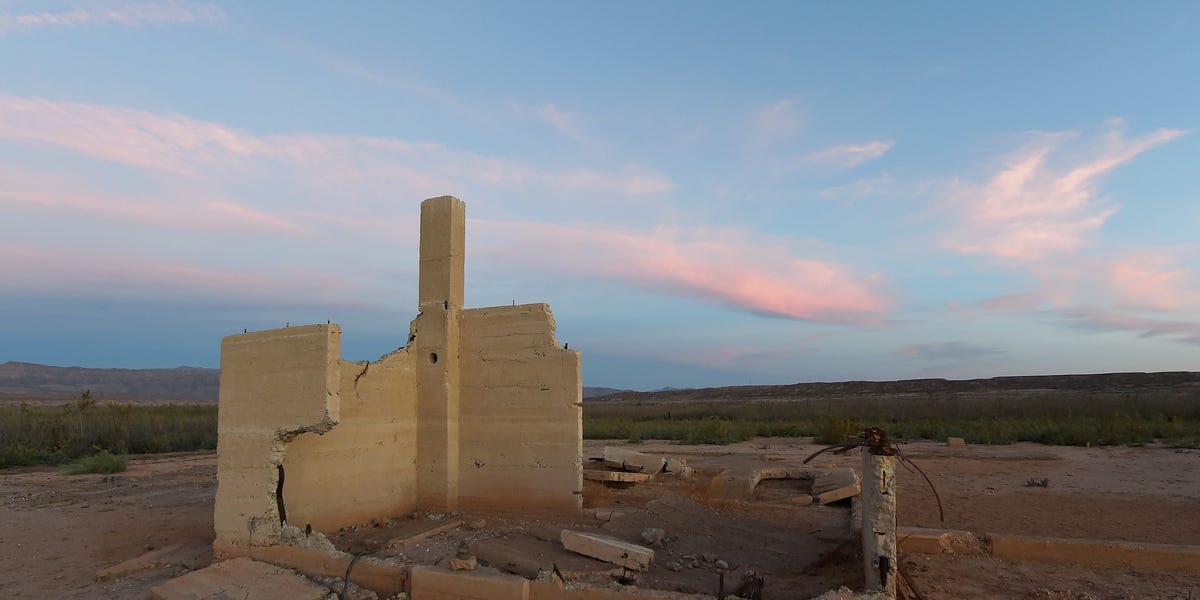
3 min readHere’s what you’ll learn when you read this story:During the creation of Hoover Dam and Lake Mead in the 1930s, the town of St. Thomas was evacuated due to its location in the new lake’s footprint. Now, because of a decades-long megadrought gripping the southwestern U.S., the town has remerged from its watery grave. The basin will remain dry, so visitors can walk among the ruins, which include a school, a hotel, a post office, and even an ice cream parlor.For millions of years, the Colorado River has flowed 1,450 miles from its headwaters in north-central Colorado to the delta where it empties into the Gulf of California. Then western settlers arrived and built the first dam on the river in 1909. Today, 15 dams dot the main stem of the Colorado River, and none are more important than Hoover Dam, which forms Lake Mead and supplies water to major cities and millions of acres of farmland across the arid Southwest.In the rush to build these reservoirs as a way to store up runoff and snowpack for the drier months of the year, some important things were overlooked. Beneath Lake Powell, for example, near the Arizona-Utah border, there’s a “lost canyon” inundated by waters held back by the Glen Canyon Dam, which was completed in 1963. But the construction of the most famous dam on the Colorado, the Hoover Dam, wiped an entire town off the map—one that has risen from the grave due to persistent drought throughout the region.Founded by Mormon settlers in 1865, who believed it lay within the Utah and Arizona region (it’s actually in Nevada), the town of St. Thomas sat on land initially inhabited by Pueblo and Basketmaker cultures. According to Mental Floss, the town likely experienced flooding of the natural Colorado River for millennia. But in 1928, then-President Calvin Coolidge signed the Boulder Canyon Project Act into law, kickstarting the construction of the Boulder (later named Hoover) Dam.Of course, the entire purpose of the dam was to create an artificial lake in its shadow, and St. Thomas lies directly in that lake’s current footprint. By 1935, floodwaters created by the dam started slowly filling the town, but the last resident—a man named Hugh Lord—didn’t row away from his doomed house until July 11, 1938.Earlier this year, old relics known as “hunger stones”—which were historically used to measure drought levels and memorialize tough times—emerged from major riverbeds in drought-stricken Central Europe. Today, St. Thomas fulfills a similar-if-unofficial purpose. During the Southwest’s extended megadrought, which dates back to at least the year 2000, the inundated remains of St. Thomas have been slowly revealed. In 2002, the very top of the Hannig Ice Cream Parlor poked out from the water until eventually the entire town, including the foundations of a school, a hotel, and a post office, also emerged. Because the water hasn’t returned, visitors can now explore the ruins of St. Thomas in their entirety.“Its first residents came to this desolate desert location 150 years ago this year because of a rare water source and its connectivity to the Colorado River,” Christie Vanover, a public affairs officer for the National Park Service, told the Water Environment Federation back in 2015. “In the end, it was water that forced residents to flee.” According to Vanover, the remnants of the town appear once Lake Mead’s water levels fall below roughly 1,165 feet above sea level. Today, the water level is around 1,039 feet, the lowest it’s ever been since the artificial lake formed back in the 1930s. In fact, water levels in the region are so low that they’re threatening dam operations all along the Colorado River.Today, St. Thomas is just another parched memory nestled in the Mojave Desert, but with the unrelenting challenges presented by the ongoing megadrought and climate change, it may not be the last.Darren lives in Portland, has a cat, and writes/edits about sci-fi and how our world works. You can find his previous stuff at Gizmodo and Paste if you look hard enough.
A Ghost Town Drowned 88 Years Ago. Now, It’s Rising Again.
Full Article
Original Source
Read the full article at Popularmechanics →KhanList aggregates and links to publicly available news content. We do not host full articles from third-party sources. Always verify important information with original sources.