
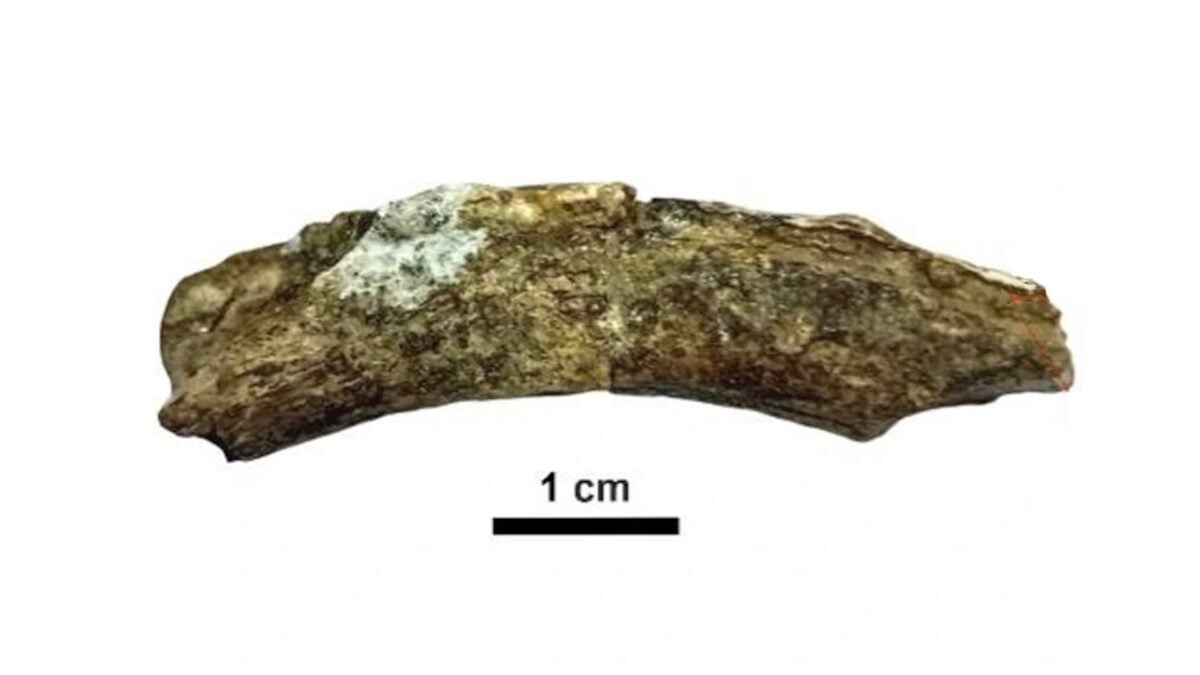
In 2004, geologist Pannipa Tian noticed something unusually cream-colored standing out from the dark veins of coal marbled through Bang Mark Pit, a coal mine in southern Thailand’s Krabi province. Initially, Tian “thought it was a bone,” as she told Agence France-Presse last Thursday. It was exactly the kind of find that the Thai–French Paleontological Expedition on Fossil Mammals in Thailand hoped to rescue before day-to-day activity on site damaged it for good. But it turned out this prehistoric fossil wasn’t a bone at all. “I showed it to my supervisor, who told me it was a giant rat’s tooth,” Tian said. Now researchers from Thailand, France, and Canada have determined that this tooth—a roughly 2-inch (5-centimeter) incisor fragment—and a large dark molar discovered that same day at the mine belong to a previously unknown species of giant rodent. Meet Yakamys sirindhornae, a whopping 66-pound (30-kilogram) member of the extinct Ischyromyidae family, a group of sometimes squirrel-like prehistoric rodents that reached their largest known size thanks to Y. sirindhornae itself roughly 33 to 35 million years ago. Scans of the lower second molar of the prehistoric rodent species Yakamys sirindhornae. The scale bar equals 0.2 inches or 5 millimeters. Credit: Chaimanee et al. “It tells a lot about the diversity of life in the past,” said Tian, who works for Thailand’s Department of Mineral Resources. Ancient rodents, she suggested, may have even first evolved in this region of Southeast Asia before fanning out across the prehistoric world. Suspected lake monster Back when it lumbered around Thailand during the Late Eocene, Y. sirindhornae would have been roughly equivalent in size to a beaver but smaller than South America’s capybara, the largest living species of rodent known today. While Tian and her coauthors said they could not determine much about this new giant rat’s behavior from two fossilized teeth alone, the fact that this evidence was pulled from layers of ancient lake sediment suggests it may have occupied a similar ecological niche. “Such an interpretation is broadly comparable to the ecology of the extant capybara (Hydrochoerus hydrochaeris),” the team wrote in the journal Scientific Reports. The researchers argued that a lake-margin habitat for Y. sirindhornae would also be consistent with the “ecological hypothesis” proposed for Manitsha tanka, a giant Oligocene rodent first described in 1941 from a fossil found in South Dakota. That said, Tian and her colleagues cautioned that this lakeside “sedimentary context alone does not demonstrate a semi-aquatic lifestyle.” (So, for now, you’re free to join me in entertaining the ancient giant squirrel hypothesis.) More big rodents suspected Tian and other researchers have previously uncovered several species of ancient primates in the Krabi Basin. In a separate study, Tian and her colleagues described an extinct alligator, Alligator munensis, from a fossil found in northeastern Thailand. The researchers think it may have been able to crush hard-shelled prey. In 2021, researchers also described Eomoropus meridiorientalis, an extinct relative of rhinos, from fossils found at the same Krabi coal mine, where the Electricity Generating Authority of Thailand had granted them access. But the “unusually large size” of this new rodent, as Tian described it, challenges what scientists thought they knew about the evolution of rodents worldwide. Despite a broad distribution of rodent fossils, the researchers noted that “the Asian fossil record remains comparatively sparse and is dominated by relatively small-bodied taxa, particularly in China and India.” The discovery of Y. sirindhornae, they argue, shows that exceptionally large rodents had already evolved in Asia by the late Eocene, well before the South American rodent group that includes capybaras diversified. The researchers hinted at the prospect of still older large rodents in Southeast Asia’s fossil record as well, based on an unpublished find they made inside the Pondaung Formation of Myanmar: an “isolated rodent incisor” that may belong to a species comparable to Y. sirindhornae. “Its late middle Eocene age and exceptionally large dimensions indicate that the regional fossil record may contain evidence of large-bodied rodents predating Yakamys,” the researchers said.
A Geologist Thought She’d Found a Bone. It Was a Tooth From a Prehistoric Rodent of Unusual Size
Full Article
Original Source
Read the full article at Gizmodo →KhanList aggregates and links to publicly available news content. We do not host full articles from third-party sources. Always verify important information with original sources.