
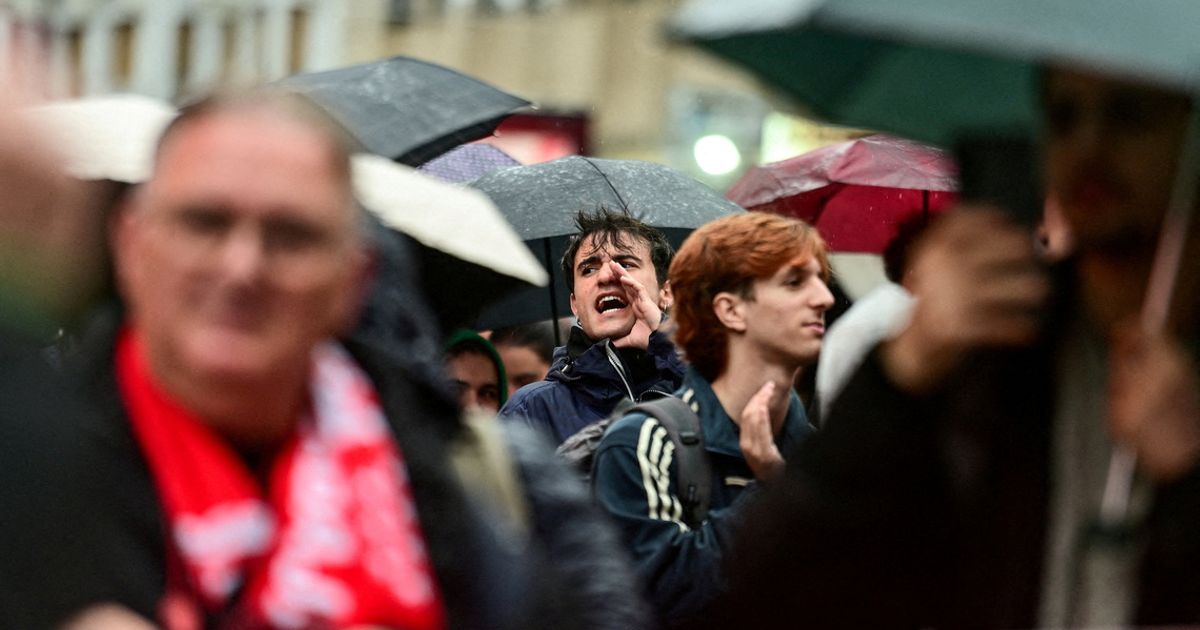
MADRID – Sebastien Ducros, a French data analyst who supports the widespread student protests in his country, has identified an obvious culprit for the lack of government funds for dilapidated schools.“A huge portion of the money is going toward retirees, while many other things are being neglected,” said Ducros, 36. “I honestly think – even if it feels strange to say – that people like my parents are in a position where they should and could” surrender some of their pension payments, he added, saying that they were about to retire.But Laurent Grinwald, 72, who retired recently after decades as a postal worker, isn’t eager for his pension to be reduced, particularly to pay for other state-funded services. Especially, he said, as rents and the cost of living have shot up.“We’ve been working all this time,” Grinwald said, “and now, suddenly, the stance is, ‘Well, no, we’re going to start taking a bit more?’”This disagreement embodies a broader question for Europe, one at the heart of the mass antigovernment demonstrations that returned to France on Nov 14, as well as recent protests driven by frustrated young people in countries including Belgium, Germany, Greece, Italy and Portugal.As Europeans live longer, should the needs of the young be eclipsed by their parents’ and grandparents’ pensions, routinely the largest items in Europe’s national budgets?“It’s a generational clash,” said Jorge Galindo, the director of EsadeEcPol, an independent think tank in Spain, which has some of the most generous pensions in Europe.In much of Europe, spending on a growing population of older people has come at the expense of services and subsidies for young workers whose tax contributions help to fund pensions.Spiralling defence costs, prompted by American pressure and Russian aggression, have also made it harder for governments to balance their books. And high interest rates have driven up the costs of servicing state debt.All of that, coupled with rising rents and house prices, has compounded a sense of generational injustice among young people. Only 38% of people aged 15 to 30 think that policymakers consider the long-term consequences of their decisions, according to a recent European Union survey. Only a third believe that today’s young people have the same shot at success as young people 30 years ago did, the survey also found.The enormous financial burden of pensions – they gobble up around 40% of the spending on social protections in the European Union – has not been lost on European governments.Over the past decade, many countries have tried to tinker with pension formulas, trying to cut costs while postponing major political blowback. To many older Europeans, pensions are considered the sacrosanct base of the European welfare system.Often, they have avoided cutting what each retiree is paid while gradually raising the age at which citizens qualify for those payments – to 67 from 65, for example, or older. Denmark plans to raise it to 70 by 2040.Even that approach has had a political cost. When President Emmanuel Macron of France tried in 2023 to raise France’s retirement age to 64 from 62, it prompted such furious protests that the government eventually froze the measure. But that gave the country a different problem.With one of the highest debt levels in Europe, France says it cannot afford to spend more on education – which has prompted the youth anger spurring the wave of unrest.French riot police officers detain a demonstrator during the fifth Saturday of demonstrations against the high cost of living in Paris, France, on Nov 14. PHOTO: REUTERSOn Nov 14, protest marches took place across France for a fifth consecutive weekend. They were largely peaceful, despite clashes between black-clad agitators and police in cities including Paris and Lyon. The Interior Ministry said the rallies drew 106,000 protesters, less than in recent weeks.Other countries in Europe have tried other ways of softening the generational competition driving the Continent’s protests. Britain plans to save billions by slowing the speed at which its pension payments increase over time, while Spain has enlarged its pool of taxpaying workers.Spain chose in 2011 to raise its pension age to 67 in most cases. Then the current left-wing government enlarged the pension bill by ensuring that pension payments would grow in line with inflation, protecting recipients from rising prices but putting an enormous strain on the budget.To offset those costs, it has bucked the European trend and opened its doors to immigrant labour – more than 1.7 million foreigners have entered the Spanish workforce since 2018.Those workers have increased tax revenue, which in turn helps to fund pension contributions, but eventually, experts note, they will age, too.Spain will spend 17.3% of its gross domestic product in 2050 on pensions, according to the Organization for Economic Cooperation and Development – roughly 4 percentage points higher than now. That means the government would then be spending the equivalent in today’s terms of an additional US$67 billion (S$86 billion) every year on pensions. It currently spends roughly US$79 billion on education.Despite the competition for resources, many of the young people protesting throughout Europe are loath to blame their elders.“Honestly,” said Alice Cossa, 22, an Italian student who protested recently in Venice, “we’ve never talked about it.”Left-wing demonstrators often say that pensions and other benefits can be funded by taxing the rich and corporations. Their right-wing counterparts suggest cutting immigration, blaming immigrants for soaking up welfare benefits.Some feel, though, that at least some pensions, namely those received by wealthy older people, should be reassessed.“We young people have less and less and less,” said Alejandro Rojano, 28, a bank employee who lives in a basement apartment in Madrid with a roommate. He said even his own nonagenarian grandparents received “way” more than his monthly salary, which was less than €2,000 (S$2,830). No political party would dare cut the benefits of such a dependable and powerful voting bloc as retirees, he lamented, adding of the pension payouts, “It makes no sense, you know?”Galindo, the think tank director, said that given the entrenched political interests in protecting retirees, young people might need to form an essentially single-issue voting bloc. Because European governments are typically formed from coalitions of smaller parties, such a party could become pivotal and have its concerns taken seriously with only a handful of seats.But young people are a shrinking demographic in Europe, and the number of older people, who are more likely to exercise political power through union and party memberships, is booming. And young and middle-aged Europeans are reluctant to cut a benefit that they hope to enjoy in the future.As Daniel Ramo, 46, left a recent teachers’ strike in Madrid protesting dismal salaries and packed classrooms, he said that he personally looked forward to receiving his generous Spanish pension after making €2,100 a month after taxes. In the meantime, the benefits of his parents’ pensions would trickle down to help him through tough times.“I’m on strike knowing I’ll have to borrow money from my father,” said Ramo, who said his father’s pension made him the top earner in the family.From the perspective of retirees, the hard-earned benefit helps keep families, and European society, going.“We personally make more than our children do,” said Encarna Matilla, 72, as she took a walk in sunny Retiro Park in Madrid. She said her 88-year-old husband, who worked from 14 to 70, received a pension payment of €2,700, 60% higher than Spain’s median salary, and helped support her great-grandchildren.“We are the safety net,” she said. NYTIMESThis article originally appeared in The New York Times
A ‘generational clash’ is fuelling Europe’s protests
Full Article
Original Source
Read the full article at Straitstimes →KhanList aggregates and links to publicly available news content. We do not host full articles from third-party sources. Always verify important information with original sources.