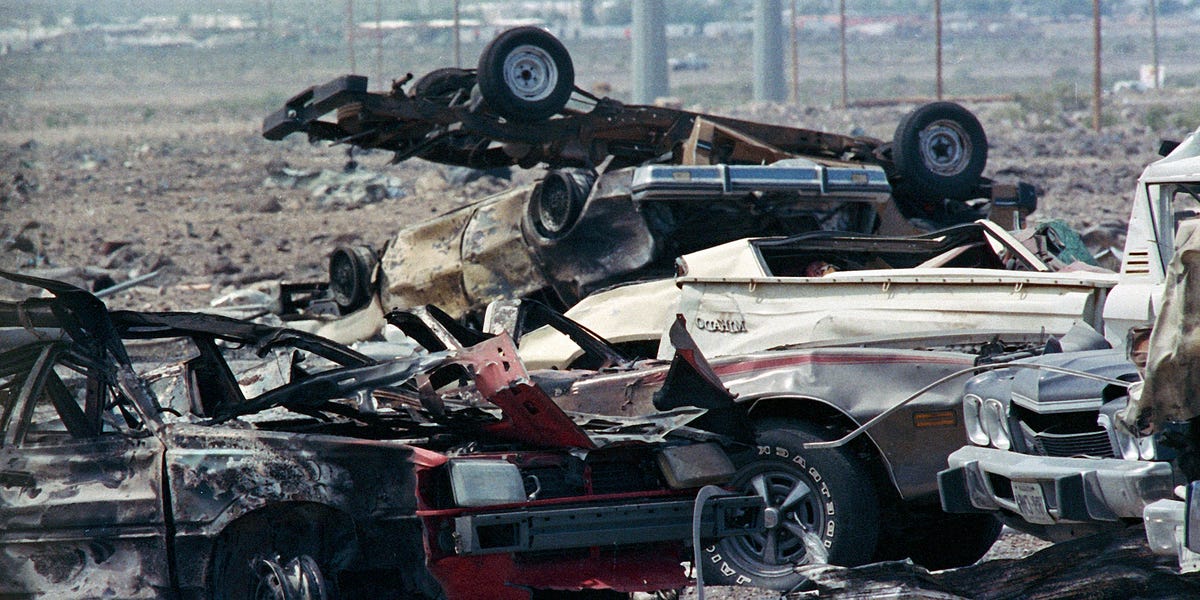
4 min readHere’s what you’ll learn when you read this story:in 1988, a series of mysterious explosions burned down the PEPCON plant, which produced ammonium perchlorate for solid rocket fuel.Ammonium perchlorate is non-reactive on its own, but when one barrel caught fire and interacted with heated plastic and natural gas from a leak below, fire tore through the site.The actual explosions were determined to have been caused by a spark from a welder’s tool heating highly reactive aluminum drums of the fuel, which then detonated.May 4, 1988, dawned on Henderson, Nevada, like any other sunrise. Henderson is a rather unassuming suburb—usually ignored by throngs of hedonists headed for Las Vegas—and was home to the PEPCON chemical plant that manufactured solid rocket fuel for NASA’s Space Shuttle.The PEPCON plant held some 4,500 tons of ammonium perchlorate (a dry white crystalline powder) in more than 10,000 high-density polyethylene drums and 5,000-pound aluminum shipping containers. Ammonium perchlorate is a high-performance oxidizer—unreactive on its own, it will set off a chemical reaction that releases oxygen in a blast of fire when added to burning fuel.At around 11:30 a.m., most employees at the plant were beginning to pause for their lunch breaks as two welders were rehanging wind-damaged siding on the west side of the batch building—the structure where ammonium perchlorate was actually processed—using a torch on its steel-and-fiberglass frame. They were working without a fire watch, in violation of OSHA, fire department, and PEPCON’s own standards. Those same workers caught sight of a curl of smoke at 11:45, but reports of the fire did not mention fears of a general conflagration. While flames sometimes sprang up in the plant, ammonium perchlorate is soluble in water, which extinguishes it on contact.The problem was that, this time, the fire persisted. It climbed the plant’s fiberglass walls as workers scrambled to attack it with hoses. Spiraling flames leapt from one plastic drum to another. Eventually, one of the flaming barrels sent sparks shooting up like fireworks. The resulting flames spread from one building to another until, at 11:48, an explosion detonated. Panicked employees began to flee, and when police and firefighters showed up in response to a frantic 911 call made at 11:51, it was already too late. Another explosion, this one with enough power to rival some earthquakes, belched clouds of black smoke into the air and sent shockwaves out for miles.Chaos erupted even faster than the flames. Many who had managed to run from the building unscathed made an escape in their cars, while some of the wounded wandered around the nearby desert, struggling to process what had just happened. The second explosion was even more intense than the first, with a force measuring 3.5 on the Richter scale and airblast damage comparable to a 1-kiloton nuclear detonation in free air. The blast shook the candy factory next to the site, inflicting some damage there, and burst the windows of surrounding houses and a nearby McDonald’s.“The explosion lifted me off the ground and moved me across a lane […] to the other side of the road,” police officer Bill Adomite, one of the first responders, later told news media. “It was almost something out of a bad movie. You stood up and you looked around and you could see things happening but you could barely see anything, you could barely hear anything, trying to catch your breath all at one time.”Other witnesses compared the spectacle to a nuclear apocalypse. Dozens of people were reported missing, parked cars exploded from exposure to thick toxic fumes, and fire units were scrambling to make their way through roads that were congested with incoming and outgoing traffic. Evacuation orders applied to anyone who lived within a five-mile radius of ground zero. Video footage of the scene would later haunt millions of TV screens at primetime, but the one question startled newscasters were unable to answer was this: Why had a supposedly nonreactive chemical sparked such a massive explosion? The 16-inch natural gas pipeline beneath the property ruptured because of the fire and fed the blaze, but even that shouldn’t have been enough to create such a devastating blast.In the days that followed, conspiracy theories ballooned. Investigators scrambled to identify what had triggered seven explosions—two of them enormous—and $100 million in property damage, while NASA demanded to know how it had lost tons of rocket fuel in a matter of minutes. The gas leak, the flammable resin coating the fiberglass walls, and chunks of burning plastic that broke off one barrel and landed on the next could account for how quickly the fire spread. But they couldn’t account for the blasts.Strangely enough, a simulation showed that the worst explosions didn’t detonate over the gas pipeline or in areas where most of the ammonium perchlorate was stored. Instead, the last explosion had gone off in a storage space densely packed with aluminum drums of ammonium perchlorate (aluminum is highly reactive). Investigators finally concluded that either flames from the first fire or a spark from one of the welders’ tools made contact with the aluminum and caused the drums to explode, and the fire was further aggravated by natural gas from the pipe leak. Remarkably, in spite of its violence, the explosion took the lives of just two employees, though it left 372 people wounded, including 15 firefighters.“The percussion was unbelievable,” an eyewitness told a local news channel. “You could hear it and then all of a sudden you could, just 20 seconds later, feel it, and you could see it coming across the desert.”Elizabeth Rayne is a creature who writes. Her work has appeared in Popular Mechanics, Ars Technica, SYFY WIRE, Space.com, Live Science, Den of Geek, Forbidden Futures and Collective Tales. She lurks right outside New York City with her parrot, Lestat. When not writing, she can be found drawing, playing the piano or shapeshifting.
A Fuel Explosion Leveled a Massive Engineering Plant. It Shouldn't Have Been Possible.
Full Article
Original Source
Read the full article at Popularmechanics →KhanList aggregates and links to publicly available news content. We do not host full articles from third-party sources. Always verify important information with original sources.