
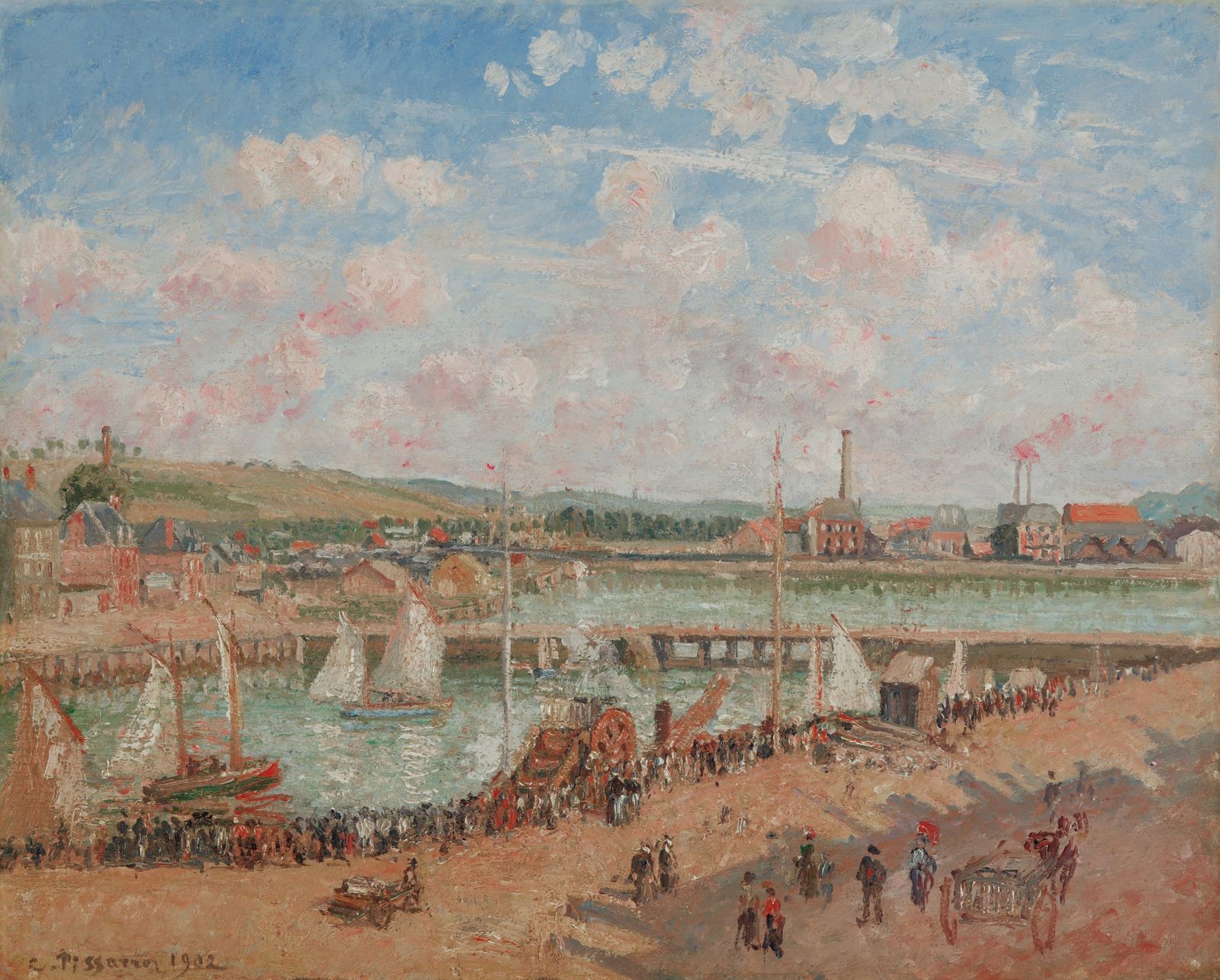
Seven descendants of Jewish banker Salomon Flavian challenged a 2024 auction sale brokered without their knowledge, prompting a court to demand the painting’s restitution and the identity of the anonymous buyer to be revealed November 16, 2026 2:29 p.m. Camille Pissarro, Darse de pêche et bassin Duquesne, Dieppe, après-midi ensoleillée, 1902 Public domain via Wikimedia Commons In 1941, German forces in occupied Paris looted a Jewish banker’s collection of impressionist artworks. Now, more than eight decades later, a French court has stepped in to demand the return of one allegedly looted painting to the descendants of its owner. A 1902 landscape by Camille Pissarro titled Darse de pêche et bassin Duquesne, Dieppe, après-midi ensoleillée (Fishing Dock and Duquesne Basin, Dieppe, Sunny Afternoon) was auctioned by Sotheby’s London on June 25, 2024, to an anonymous buyer for roughly $1.6 million. On November 5, the Paris Judicial Court annulled that sale and ordered Sotheby’s to “disclose the full identity of the buyer of the work” within two months or pay a $1,115 fine for every additional day it fails to do so, CNN’s Lianne Kolirin reports. Between 1933 and 1945, the Nazi regime orchestrated the largest art theft in history, seizing more than 650,000 artworks across Europe—some 20 percent of the continent’s art—including from Jewish families, collectors and museums. Salomon Flavian, a Jewish banker of French and Romanian heritage, purchased Pissarro’s view of the Normandy port town of Dieppe at the Hôtel Drouot auction house in Paris in March 1935, according to the Sotheby’s listing. When war erupted in September 1939, Flavian placed the canvas and dozens of other works into the care of the Westminster Foreign Bank in Paris. In 1941, German forces seized his collection. Although Flavian survived the war and recovered some pieces, the Pissarro remained missing and was listed in France’s official register of looted property. Lot49 L24006 3ZM2Z Nearly eight decades later, the painting resurfaced at Sotheby’s London with a note stating that it was “offered for sale pursuant to a settlement between the current owner and heirs of Salomon Flavian.” That settlement had been brokered by the Mondex Corporation, a Toronto-based firm specializing in recovering Nazi-looted art. At a hearing in this fall, seven descendants of Flavian told the court that two relatives had signed the deal without consulting the rest of the family. The descendants claimed they had only found out about the sale months later, when Mondex sent a letter explaining that it had accepted in their name a “relatively modest” 8 percent share of the net sale price “in exchange for their cooperation,” while the two heirs who signed the contract received a 16 percent commission, the Art Newspaper’s Vincent Noce reported in September. At the hearing, Sotheby’s and Mondex presented research claiming that Flavian had parted with the painting before the war, pointing to a 1939 Pissarro catalogue raisonné by Paris dealer Paul Rosenberg that listed British artist and collector Edward Le Bas as the owner. Sotheby’s auction provenance similarly traced the canvas from Flavian to Rosenberg by 1937 and to Le Bas by 1939. It then eventually passed through several American collections, including David Rockefeller’s, and a 1985 sale at Sotheby’s New York. Earlier this month, the Paris court rejected that timeline, finding “no direct and convincing evidence” of prewar sales to Rosenberg or Le Bas, according to the Art Newspaper. Instead, the court concluded that the family presented “a set of precise, serious and concurring elements demonstrating that Pissarro’s work was indeed looted during” the war. The court ordered “the restitution of the work, wherever and in whoever’s possession it may be, to the descendants of Salomon Flavian,” the London Times’ David Chazan reports. “It is a very important ruling, which opens the way to a restitution that the Flavian family has demanded since the war,” Corinne Hershkovitch, the claimants’ lawyer, tells the Art Newspaper. Did you know? Looted art on display In May, the Musée d’Orsay in Paris opened a new permanent exhibition titled “Who Owns These Works?” It showcases 13 artworks that may have been looted or sold under suspicious circumstances during World War II with the hope that public exposure may help locate the rightful owners. Mondex, which was ordered to pay $11,000 to the heirs, plans to challenge the verdict. Mondex founder James Palmer tells ARTnews’ Brian Boucher that an appeal will be filed “forthwith.” He adds: “We are confident that when the vast amount of complex provenance research evidence is properly understood and considered that the court of appeal will reach a different conclusion.” Because the French judgment applies immediately despite any appeal, the legal battle now shifts toward enforcing the order across the English Channel. Hershkovitch, however, tells the Times that cross-border enforcement between France and England is “a fairly simple procedure.” She adds: “Sotheby’s will have to find a solution very quickly because their reputation is at stake.” In a statement, Sotheby’s London noted its disappointment in the verdict, welcomed the dismissal of charges against the auction house and recognized the “profound losses suffered by the Flavian family during the Nazi era,” per CNN. A spokesperson says that Sotheby’s is considering whether to join Mondex’s appeal, while stressing that “client confidentiality is of paramount importance,” according to the Art Newspaper. You Might Also Like Get the latest stories in your inbox every weekday. More about: Art Art Crimes Art History Auctions Crime France genocide Holocaust Judaism Nazis World War II
A French Court Annuls the $1.6-Million Sale of This Camille Pissarro Painting, Allegedly Looted During World War II
Full Article
Original Source
Read the full article at Smithsonianmag →KhanList aggregates and links to publicly available news content. We do not host full articles from third-party sources. Always verify important information with original sources.