
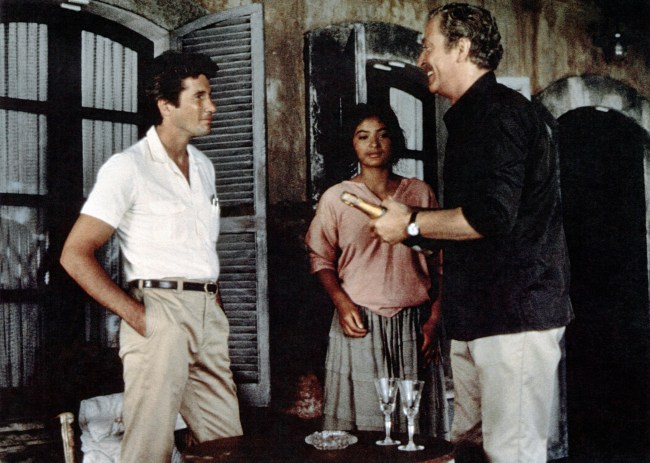
In 1983, Richard Gere was one of cinema’s hottest heartthrobs thanks to a string of sexually-charged roles in skillfully-executed star vehicles. After gaining traction in Hollywood with a sleazy supporting role in “Looking for Mr. Goodbar” and a riveting lead performance in Terrence Malick’s “Days of Heaven,” Gere became a star in Paul Schrader‘s huge hit “American Gigolo,” then followed it with the even huger hit “An Officer and a Gentleman.” “An Officer and a Gentleman” was an out-and-out phenomenon, outgrossed in 1982 only by “E.T.” and “Tootsie,” and if Gere’s follow-up, a lurid remake of Jean-Luc Godard’s “Breathless,” made considerably less money, it was still a hit — and a hit for which Gere could take most of the credit, since most critics didn’t seem to think there was much to the movie beyond Gere and co-star Valerie Kaprisky’s naked bodies. (In recent years, the movie has experienced a deserved reappraisal, largely motivated by the cheerleading of its most famous fan, Quentin Tarantino.) Gere’s hot streak ended when he followed “Breathless” with “The Honorary Consul,” an adaptation of Graham Greene’s 1973 novel that failed at the box office, in spite of Paramount’s best efforts to trick audiences into thinking it was another ode to Gere’s sexuality rather than the thoughtful study in political intrigue that it actually was. For the U.S. audience, the movie was retitled “Beyond the Limit,” and Paramount created a poster depicting Gere in bed with a gorgeous woman looming over him in imagery echoing that of the recently released “Breathless.” That imagery wasn’t exactly a lie — there are sex scenes between Gere’s character Eduardo Plarr and his friend Charley Fortnum’s (Michael Caine) young and beautiful wife Clara (Elpidia Carrillo) — but the poster failed to convey what “The Honorary Consul” was really about. As is typical of Greene’s work, it’s a tale of thorny moral issues, following the love triangle between an honorary British consul in Argentina, his ex-prostitute wife, and a brooding doctor, and examining the repercussions of that triangle when the consul is mistakenly kidnapped by a revolutionary who thinks the consul is the American ambassador. Paramount’s bait-and-switch marketing was a disaster; straight women and gay men who came to the movie for a look at Gere’s firm rump weren’t happy to find so many scenes involving radicals being tortured in bathtubs filled with feces — and viewers who might have been interested in the film‘s sophisticated moral arguments assumed it was just a mindless piece of soft-core pornography. Thus “The Honorary Consul,” aka “Beyond the Limit,” died at the box office, was excoriated by critics (including Greene himself, who hated Gere’s casting), and slid into obscurity almost immediately. The movie deserved better, but for years it wasn’t even available for reconsideration — as far as I’ve been able to tell, there was never a U.S. physical media release beyond the initial VHS pressing, and even in Greene and director John Mackenzie‘s native United Kingdom it didn’t come out until 2019. Now, however, the Australian label Imprint has issued an all-region Blu-ray release of the film as part of its “Directed by John Mackenzie” boxed set, a collection that would be worth purchasing for “The Honorary Consul” alone but which happens to contain a few other terrific movies as well. Mackenzie’s a somewhat underrated figure, a Scottish filmmaker who worked with Ken Loach as an assistant director before embarking on his own career making similar works of social realism for British film and television. He’s best known today for his 1981 feature “The Long Good Friday,” a thriller about a scrappy criminal (Bob Hoskins in his first great film role) having the worst day of his life. Mackenzie beautifully captures London in the early days of Thatcher and uses the setting to both define and deepen the film’s ambitious and doomed protagonist; it’s a movie that honors Loach’s political tradition but infuses it with violent intensity and genre movie kicks. “The Long Good Friday” is in the Imprint box along with two films Mackenzie made after “The Honorary Consul,” the Cold War thriller “The Fourth Protocol” and the cheeky JFK conspiracy flick “Ruby.” All four movies exhibit Mackenzie’s knack for trenchant social and political commentary slightly heightened by his elegance as a dramatist and visceral genre filmmaker, and all are accompanied by illuminating supplements. “The Honorary Consul” is the real gem of the package though, as the collection’s most obscure and underrated release and the one most in need of the kind of context this set provides. The Blu-ray contains interviews with several key crew members who detail the film’s history and its problems, and there’s a terrific audio commentary by writer Matthew Asprey Gear, who delves into not only the making of “The Honorary Consul” but the aborted attempts at adaptation that preceded it. Most fascinating among these is a proposed version to be directed by Orson Welles, who had played one of his most memorable roles in the Greene-scripted “The Third Man.” In a nod to that film, Welles and co-writer Oja Kodar called their screenplay adaptation of “The Honorary Consul” “The Other Man,” and it’s intriguing to consider Welles in the Michael Caine role, and to ponder how the story would have fit into his oeuvre of films about betrayal and power. When Welles’ option lapsed in 1978, producer Norma Heyman (mother of future “Harry Potter” and “Once Upon a Time…in Hollywood” producer David Heyman) snapped up the rights and hired playwright Christopher Hampton to pen a new screenplay. Hampton was well positioned to write about Englishmen out of their element in a foreign country, having bounced around Egypt, Yemen, and Hong Kong when he was younger, and his 1973 play “Savages” shared a number of elements with Greene’s novel — though the similarities had to be coincidental given that “The Honorary Consul” came out the same year. Hampton clearly had a knack for adapting British literary works, particularly those with political or espionage elements; he wrote multiple adaptations of Joseph Conrad’s books (including an adaptation of “Nostromo” for David Lean that was never filmed) and would return to Graham Greene for the 2002 version of “The Quiet American” — which, like “The Honorary Consul,” stars Michael Caine as the older man in a love triangle with a younger man and younger woman. Hampton’s script for “The Honorary Consul” skillfully distills the complexities of Greene’s novel into an efficient, beautifully paced drama that expertly juggles the criss-crossing characters and their shifting allegiances. The script was strong enough to attract Gere and Caine, as well as Mackenzie’s “Long Good Friday” star Bob Hoskins, who is terrific in “Consul” as an insidious local police chief. Hoskins’ performances for Mackenzie are something special; the director knew how to exploit the actor’s natural amiability by having him play sinister characters whose violent tendencies are given more impact by the infectious smile that cloaks inner cruelty. Caine, of course, is excellent as usual, bringing a combination of resignation and dignity to the well-intentioned loser that he plays. ‘The Honorary Consul’©Paramount/Courtesy Everett Collection Caine’s performance was widely praised even by critics who didn’t care for the movie, like Roger Ebert. The same can’t be said for Gere, who was, admittedly, miscast in several ways. First off, the character in the book is weary and troubled, qualities Gere plays but which are offset by his natural confidence and charisma. More problematic was the character’s heritage; he’s supposed to be half-English and half-Paraguayan, and to say Gere’s accent is inconsistent would be charitable. Graham Greene disowned the movie, largely based on what he saw as Gere’s unsuitability for the part. While I can’t entirely argue with the criticisms, I do think they fail to take into account the genuine strengths of Gere’s performance as Eduardo Plarr. He’s another of Gere’s chilly, unlikable characters, a trend that began with the ruthless opportunism of the fugitive farmhand in “Days of Heaven” and continued in “American Gigolo” and “Breathless.” The men in these films are so self-interested as to become almost sociopathic, though Julian Kay in “Gigolo” does have a last-minute moment of redemption (motivated less by anything in the actual plot than by Paul Schrader’s desire to remake “Pickpocket”). Even Gere’s most overtly romantic lead role in “An Officer and a Gentleman,” the movie that solidified his status as a megastar, is often thuggish and unpleasant — Gere was never a movie star interested in begging for the audience’s approval. This is what made him interesting, and it’s what made him right for Plarr in spite of his struggles with the accent. Plarr is intentionally unreadable and unsympathetic, cold and uncaring about both his friend and the friend’s wife he is sleeping with, and Gere’s brooding self-absorption fits him perfectly. It also stands in compelling relief against Michael Caine’s warm, engaging alcoholic rival for Clara’s affections; the scenes between the two men crackle with the tension that comes from seeing two equally powerful but stylistically opposite screen presences in collision. Greene purists, as well as the author himself, bristled at the way Gere’s casting transformed the story, but as pure drama the movie is riveting — and a fascinating case study in just how much a star persona can affect a film. Had Hoskins and Gere switched roles, for example, the movie would completely work without a single line of dialogue changed — it would be equally viable, and completely different. Interestingly, the actor Mackenzie was initially concerned about was Michael Caine, who he thought of as too classy to play the drunken Fortnum. Caine quickly won Mackenzie over, however, and the director worked with him again on “The Fourth Protocol” and “Quicksand.” As for Gere, Mackenzie cast him before “An Officer and a Gentleman” came out, and when it was released during production the film’s success caused no end of headaches, as the studio was suddenly much more interested in Mackenzie’s film than it had been before, and the interference became the bane of Mackenzie’s existence. Like most people, the director himself didn’t have many positive things to say about “The Honorary Consul” after the experience was behind him, and according to an interview on the Imprint disc with one of the movie’s editors, Mackenzie even stepped away from the picture for a while during postproduction. Bad reviews, studio interference, and a disgruntled author aside, however, “The Honorary Consul” remains a compelling entry in Mackenzie, Gere, and Caine’s filmographies, and its revived availability thanks to Imprint provides a welcome opportunity to discover its pleasures. “The Honorary Consul” is available on Blu-ray as part of the “Directed by John Mackenzie” boxed set, now available from Imprint.
A Forgotten Richard Gere Vehicle from His Peak Era Is Back in Circulation
Full Article
Original Source
Read the full article at Indiewire →KhanList aggregates and links to publicly available news content. We do not host full articles from third-party sources. Always verify important information with original sources.