
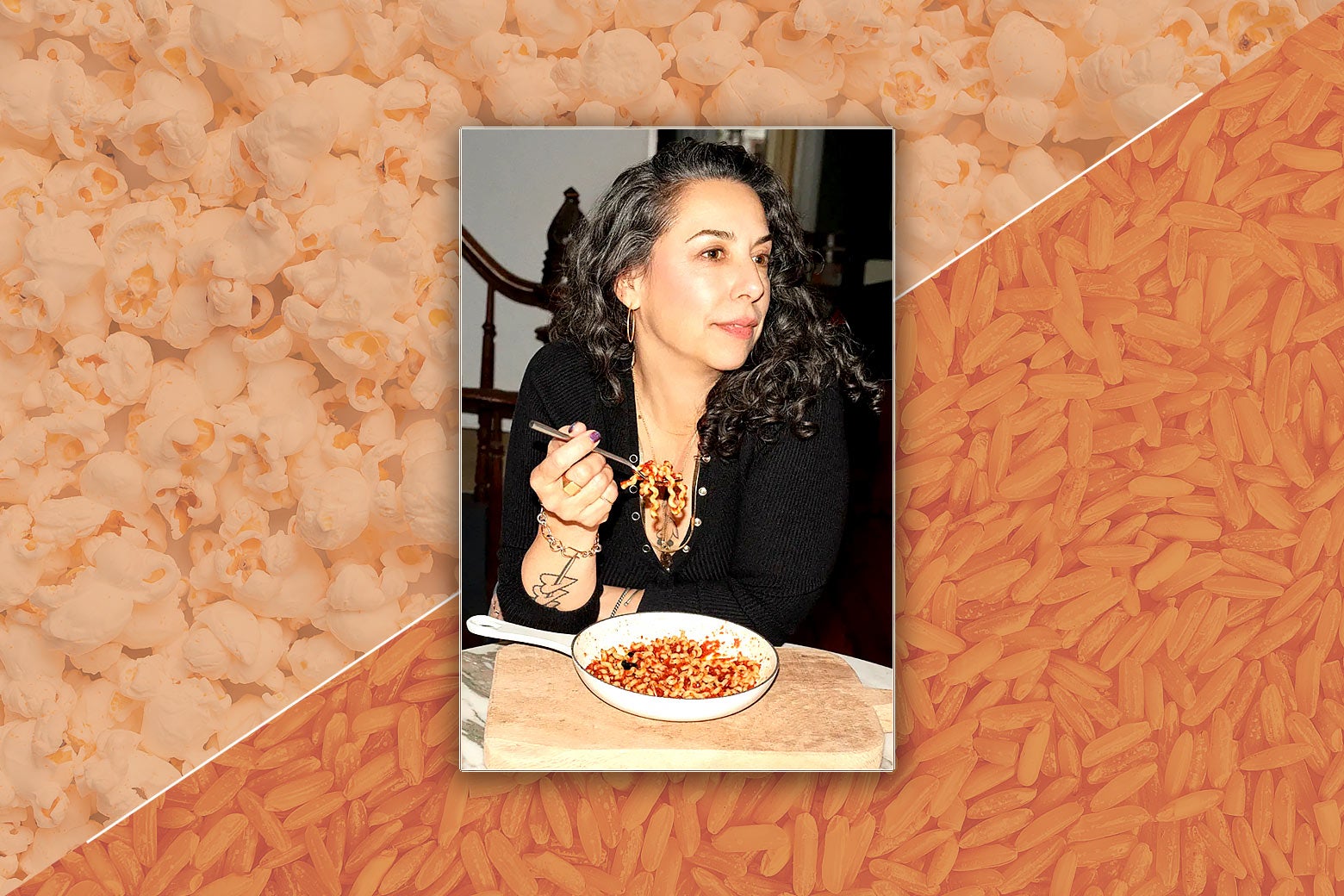
Food Carla Lalli’s Cookbook for the Not-So-Hungry The food-world star wrote a divorce memoir meets cookbook. I, for one, could desperately use it. By Enter your email to receive alerts for this author. Sign in or create an account to better manage your email preferences. Unsubscribe from email alerts Are you sure you want to unsubscribe from email alerts for Scaachi Koul? Sept 04, 20265:45 AM Photo illustration by Slate. Photos by Lucia Bell-Epstein, Olga Arkhipenko/iStock/Getty Images Plus, and sanapadh/iStock/Getty Images Plus. Sign up for the Slatest to get the most insightful analysis, criticism, and advice out there, delivered to your inbox daily. Cookbooks are designed for happy people—people, plural. Recipes are usually written for two or four or six, nudging you into dinner parties or date nights at home, ways to impress someone else or love someone else. In the 40th-anniversary edition of Julia Child’s seminal Mastering the Art of French Cooking, she too writes about the need for a dining partner so you can really enjoy what you’re eating: “You savor it, analyze it, and discuss it with your companions.” The most complex and nuanced culinary experiences still require, somehow, a buddy. Food Is a Feeling: Recipes and Stories, With Love, a forthcoming cookbook from Carla Lalli, likewise offers recipes to feed a duo, a family, a party—but the root of the book is in learning to be alone. After nearly a quarter century of marriage, Lalli and her husband split a few years ago. This, her third cookbook and her second since leaving Bon Appétit’s Test Kitchen in 2020, is an obvious departure in both tone and form. Although her two previous books focused on skill, meal prepping, and practical tools for feeding yourself and your family, this book is almost entirely about feeding yourself first. “There is no shortage of cookbooks that provide editorial service and no-nonsense instruction, including the two I wrote before this one,” Lalli notes in the introduction. “For Food Is a Feeling, I prioritized the emotional service that food and cooking can play in our lives. Less tangible, more elusive, but ultimately more magical.” Lalli isn’t a regular recipe tester, nor is she a typical cookbook author. Depending on how much time you spent on YouTube between 2018 and 2020, her face is likely a familiar one from her years as a fixture in the Bon Appétit Test Kitchen. Lalli worked for the magazine for almost a decade, but once she became a part of its YouTube channel, she assumed the role of de facto “mom” for everyone watching at home. She brought viewers into her cooking, but also into her home, allowing us to get to know her then husband and two children. (You may remember her younger son, Cosmo, from this video, in which he eats a spoonful of citric acid and seems to immediately regret it.) By late 2020, the Test Kitchen had imploded due to allegations of inequitable pay and treatment of the publication’s nonwhite staff, and Lalli became a free agent. Her relationship with her audience has changed drastically since; now most of her work appears on her own Substack. (She hasn’t posted a YouTube video since early 2025.) Lalli is still fostering that parasocial relationship, but her devoted fans will have to come to accept some big changes in her work. Food Is a Feeling is a cookbook, but it’s largely designed for a broken heart: Her first recipe is buttered rice (her mother’s specialty) with greens and garlic, a simple meal that might sound depressing but is elevated with a story about eating it with her sister, Nina. “After Nina left and I went to bed,” Lalli writes, “I relished how it felt to sleep alone, without my back turned to anyone.” The first section of the book, titled “Scaling Down,” is all about making recipes for one (or, sometimes, two). “This is how I see you: in the burrow, the lights on and candles lit, surrounded by the music you like or the voices of the people you adore, doing your thing,” she writes. “I trust you implicitly to make great food, but also to make it mean something to you.” Lalli’s book is made for someone like me. I used to cook plenty, but only for my ex-husband. In the five years since my divorce, I’ve made food periodically, but only out of obligation to my stupid body and its constant, annoying needs—since we split, I’ve had a hard time holding on to my appetite. There’s always been something that feels tragic about making a big, beautiful meal for just me. I’m supposed to eat all this, all by myself? What gluttony, to tend to my appetite with the same care and affection I used to summon to feed someone else. When I left my marriage, I took little from the kitchen other than a wide Dutch oven that I peer at every few weeks as if it’s an intruder in my home. It keeps reminding me of all the things I don’t crave anymore. My mother calls often to ask what I’ve had for dinner, and sometimes I lie so she thinks I’m taking better care of myself. I don’t want to tell her, an expert cook, that occasionally for dinner, I house a bowl of Rice Chex and call it a day. And yet, on Page 57 of Lalli’s book is a recipe I’ve never seen before but have been eating for years since my own cleaving: Night Cereal. One serving of cereal, milk, some frozen berries and maple syrup, and salt. In my own version of this recipe, I never considered salt for my stupid little Night Cereal. Unsurprisingly, it’s a nice addition. Finally, someone who understands how to feed this particularly inscrutable hunger. “The original subtitle was Everything I Cooked and Ate the Year I Got Divorced That Made Me Feel Better,” Lalli told me over coffee in Fort Greene Park, in Brooklyn, near where she’s lived for decades. Her publisher didn’t jibe with the early title the way she did. “I think that’s what scared the publisher: What does this divorced lady have to say?” she said. “Divorced people don’t eat, and also we have cooties.” The night before she and her husband separated, Lalli read Maggie Smith’s 2023 divorce memoir You Could Make This Place Beautiful. “She has this analogy in her book about Russian dolls, and that as humans who go through life transitions, you don’t become a different person. All those previous versions of you are inside, just stacked up in there,” she said. “You don’t have to walk away from all the other things you’ve done in your life. They’re still there. I’m all of those things. I’m a person who was a professional line cook, I cooked for small children, I’m cooking for a big child. I’ve done family, I’ve done holidays. I also have an appreciation of cooking for one or two.” Lalli helped build the foundation of internet food content. She has planned opulent Thanksgiving menus, written about the best risotto, the right way to chop and peel. She was one of the architects of food videos too, yet another home chef making you feel as if you were sitting at her kitchen table and watching a beautiful meal come together in front of you. So this book isn’t about doing things right; it’s about doing things for the right vibe. “I’m less driven by the service of providing a recipe and much more driven by the emotional connection that cooking represents for me. The recipes work. They’re still service,” she said. “It’s more like wanting [to] connect with people on an emotional level, whether that’s the recipe they make or if it makes them think of the food that fills that same need for them.” Food Is a Feeling contains 65 recipes, all made to be mutated by the chef. The six main sections—“Scaling Down”; “Ripe, Spicy, Sweet”; “Learning Curve”; “Mother Sauce”; “Snacks for Sharing With Yourself”; and “Warmer Days”—offer menus that range from the very, very simple (what if dinner were just a very large bowl of popcorn?) to the more advanced (lobster with spicy mayo, seared scallops with chile-cumin butter, a daunting two-page crème caramel). One recipe is, simply, Pennsylvania Dutch pretzels dipped in room-temperature butter. “You may need to move through a few pretzels before finding the proportion that makes you happiest,” she writes. “Give that to yourself.” Scattered among the recipes are photos of Lalli when she was pregnant, Lalli with her children, with her parents, and a younger, wide-eyed Lalli posing in a comically large chef hat from her time at Montrachet, a once wildly popular Tribeca restaurant that closed in the early aughts. Then there are the lists, like “Things I Tell Myself When I Feel Out of Sorts,” printed next to a photograph of Lalli eating fruit cobbler on the sidewalk in Brooklyn, barefoot and smizing, looking every part the hot 54-year-old divorcée. “Be cringe. Be rare. Take risks. Fail. Don’t talk yourself out of it,” the list goes. “Work with people you love. Take money from corporations.” The result is a cookbook that’s part instruction manual and part memoir. Lalli doesn’t speak directly to her time in corporate food media, but there are little nods to her years as one of the most recognized faces within Bon Appétit. That New York C-list fame comes up when we talk too: She’s dating now and trying not to get recognized while she does it. “I’m not so famous that I’m worried about privacy,” she said. “There are a lot of twentysomethings who want to date me, and then I do the math—they were all in high school. They were the audience.” Penguin Random House As Lalli marches into this new phase of her life, she’s also unwinding herself from the impression people had of her six years ago. “There was a lot about the perception of me as a het married woman that I was never comfortable with. I hated that people would be like, ‘Oh, you’re the mom,’ ” she said. Even after she transitioned away from Bon Appétit and started her own YouTube channel, she was not able to be her full self. “I was unhappy for many years before the divorce happened and could not represent myself fully, authentically, onscreen. The entire time we were separated, I was still making [YouTube] videos and pretended everything was fine.” Lalli knows that her core audience might not like the new, authentic self she’s offering in Food Is a Feeling. Already, she’s gotten responses from Substack readers who don’t care about her book tour, never mind her feelings, and just want more recipes from her. But Lalli doesn’t want to make that kind of food content anymore—she already did it, for years. Her life has changed, so the work has to too. “The book feels like an extension of the risk-taking and self-trust I needed to have in order to change my life in a kind of radical way,” she said. “I’m terrified. But I’m so proud of what I did. I’m proud of the book. [If] the book doesn’t sell, I’ll be like, Well, I did what I wanted to do. I’ll be able to live with that.” The day I left my ex-husband, I ordered Thai food. I was staying in a friend’s apartment while she was away for the month, and I ate everything on the floor of her living room while her dog watched. That was the last time I felt real, natural, urgent hunger. I can cook, but nothing I made tasted quite right after that: I burned chicken thighs and undercooked noodles and oversalted eggs. It felt so stupid to make anything for just me. I couldn’t even enjoy it properly. So with my enjoyment of cooking went my enjoyment of having an appetite. These days, I have a limited urge to feed myself. I know it’s lunch because it’s noon, but is that any way to live? I’d like my relationship with food to be less complicated; I’ve fought through my teenage eating disorder, as well as the eating disorder of my 20s and, of course, the eating disorder of my early 30s. What’s left in me is an unsurety of how to fulfill my own wants. I barely have wants anymore, so far as I can tell, when it comes to my appetite, so it was a relief to hear Lalli say that her culinary desires never left even if they’ve sometimes simplified. “There are so many crazy messages in our culture and in our commerce and in our marketing and in our portrayal of women that make food very complicated,” she said. “There are very few things we do in our life for sustenance and pleasure. It’s eating, fucking, and sleeping.” But that’s what divorce does: It takes away what you thought you enjoyed and forces you to find new pleasures or to rediscover old ones you left dormant. Divorce gives you new definitions for yourself, but also what you want. In Food Is a Feeling, Lalli recalls her decades of hating tomatoes, all because her then husband did. “The summer after I separated, I did what I wanted, I ate what I liked, and I started to remember who I was,” she writes. In her aloneness, she rediscovered them. “To be clear—being alone was a thrill. An apologetically messy, pulpy, seedy, sweet, juicy thrill.” If you’re lucky, like Lalli, you know exactly how to feed yourself. You just needed a little permission to go ahead and do it. “Whatever it was, I felt very compelled to satisfy it,” she said of postdivorce cravings. “If I’m craving that cold noodle from Xi’an Famous Foods, I’m going. If I wanted it, I went and got it.” Food Is a Feeling follows a thread of gluttony, but not really for food. It’s for more life, the kind of life you can have only when you’re on your own and you get to make all the decisions you want without consulting a third party about your appetites or wants. “I can do whatever I want. And there was part of being single that you don’t have to get your partner’s buy-in on something. You don’t have to convince someone else that that’s where we’re going to go for dinner,” she told me. “That little tiny thing to me was being free. I don’t have to talk about it with anybody. I don’t have to wait for anybody. I don’t have to manage anybody else’s expectations. I can go do it.” In the middle of writing this profile, I got hungry. This happens rarely unless coaxed by a dining companion or a smokable flower—natural and urgent hunger is a faraway memory for me, much to my daily chagrin. It was 3:30 in the afternoon, hours since my pitiful breakfast, and I thought about the eggplant in my fridge. I don’t know why I buy eggplant. I don’t cook half as much as I’d like to, and I’ve never made anything with eggplant aside from one of my mother’s old Indian recipes. Everyone I’ve ever dated and have cooked for has hated eggplant, even though I love it in all forms. When I was little, my mother bought jewel eggplant for baingan bharta, and I’d hook their stems into my earrings to pretend I had a wealth of amethysts. Usually I pass by the eggplant at the grocery store and ignore them, but earlier in the week, I had bought one as if I were making a promise to the nesting doll inside me who loves them. Lalli’s book has a recipe for Bittersweet Eggplant With Labne, Onions, and Honey. I wanted to eat it immediately. In my fridge, the eggplant had already rotted, its fat bottom soft and leaking. I groaned and considered getting takeout or heading over to the halal place near me, where they know me well and punch in my order while I’m still walking through the door. Instead, I bought a new eggplant and a few lemons. There were already plenty of onions in my fridge. I didn’t have labne, but I had Greek yogurt, which, considering Lalli’s ethos—“I’m not going to tell you that a shallot [substitutes] an onion, or fennel for celery … I’m starting to think you don’t need me for that”—would work just fine. I don’t know what Aleppo pepper is, but surprise! It was in my spice rack, and I abused it more than what Lalli recommended. I cooked for myself, alone. If it tasted bad, no one would know except for me. I didn’t want to make rice or pasta or steak or chicken with it to make it a complete meal. For me, this was enough. I ate it with a too-big spoon, shoveling rounds of eggplant into my mouth, yogurt gathering at the corners of my lips. I forgot the honey until I was halfway through my meal, but I didn’t beat myself up over it. My appetite still isn’t back, and maybe that’s a lasting effect of my divorce that I have to come to terms with. But as the years tick on, my hunger always returns. The recipe was pretty good. I went back for seconds. Books Cooking Dating and Relationships Food Media
A Food-World Star Is Back in the Spotlight. She’s Not Sure Her Fans Will Love Who She’s Become.
Full Article
Original Source
Read the full article at Slate →KhanList aggregates and links to publicly available news content. We do not host full articles from third-party sources. Always verify important information with original sources.