
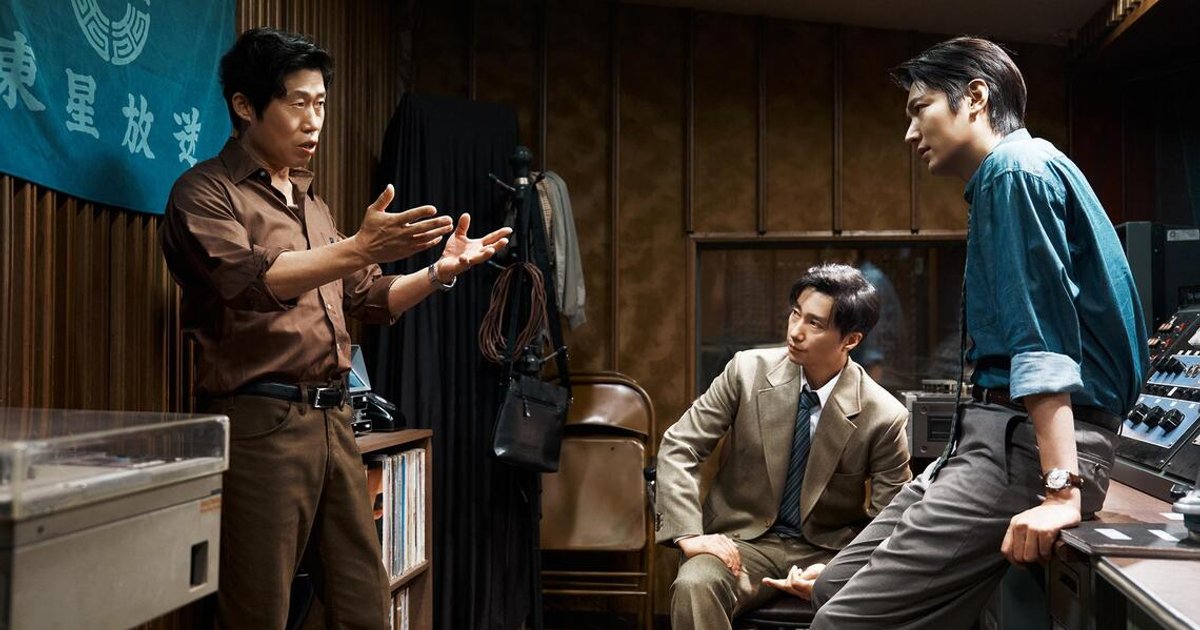
SEOUL - A South Korean film about a 1974 assassination has sparked a controversy so fierce that it has even spilled over to Singapore, with South Korean lawmakers urging the Singapore International Film Festival (SGIFF) to drop it as its opening film. The festival has decided to press ahead with the movie The Assassin(s), saying in a statement on Oct 7 that while it was aware of the ongoing discussions surrounding the movie, it “respects the creative vision of the film-makers” and stands by its decision. The SGIFF runs from Oct 21 to Nov 1.The political thriller dramatises the 1974 assassination attempt on then South Korean President Park Chung-hee, during which gunman Mun Se-gwang – named Mun Tae-gwang instead in the movie – missed the president but fatally shot First Lady Yuk Young-soo instead.Since its release in South Korea on Sept 23, the film has sparked a heated political and historical debate over whether its creative liberties cross the line into historical distortion.The anger also reflects the deep political divide in South Korea between the conservative and liberal camps and their supporters.The conservatives – the People Power Party and civic groups defending the late president – say the film is “political propaganda” that “distorts history”. Meanwhile, the liberals – the ruling Democratic Party and local film industry – argue that “a movie is just a movie” and that artistic freedom should be respected.At the emotional core of the controversy is the reopening of a national wound: the death of Yuk, whose public image as a compassionate and dignified first lady has endured the decades following her assassination.Her husband Park was himself assassinated five years later in 1979. A deeply divisive figure, Park remains highly regarded by many conservatives in the country for presiding over South Korea’s rapid industrialisation and economic transformation, a period of growth that lifted the country out of post-war poverty.But the economic transformation came alongside 18 years of authoritarian rule, marked by the suppression of political opposition and restrictions on civil liberties.The repressive climate under Park’s conservative rule forms the backdrop to the film, as two journalists and a police detective face intimidation and physical violence while doggedly pursuing evidence that suggests the officials’ investigation outcome of the assassination does not add up. The main characters are played by South Korean actors Park Hae-il, Lee Min-ho and Yoo Hae-jin. The film uses parentheses in the title to question whether gunman Mun had acted alone or was part of a larger, hidden conspiracy or state cover-up, and most controversially, whether Park himself could have been in the know. For some South Koreans, such a suggestion is particularly provocative.Former South Korean ambassador Shin Kak-soo, had grown up in the same Okcheon county in central South Korea that Yuk hails from, with his father being close to Yuk’s elder brother. Shin himself had taught Yuk and Park’s son Ji-man international law at the Korean Military Academy in the late 1970s. Yuk and Park also have two daughters, one of them being former president Park Geun-hye.The 71-year-old told The Straits Times that he has no intention to watch the film.“I do not wish to pay money to watch a commercialistic film that divides and misleads our society through historical distortion of the truth,” he said. He was a university undergraduate when the assassination happened and remembers the day vividly, as it was South Korea’s Independence Day, commemorating the liberation of the country from 35 years of Japanese colonial rule in 1945.There was also a festive mood in the air as it was also the same day that Seoul’s first-ever subway line, the current line 2 that loops around the city, was launched. He could not believe his ears when he first heard the news on the radio, and still remembers the deep sorrow on Park’s face at Yuk’s public funeral four days after her death, telling ST that “the twisting of history under the pretext of freedom of expression” undermines the honour and dignity of the family.The Assassin(s) dramatises the 1974 assassination attempt on then South Korean President Park Chung-hee (left), during which the gunman missed the president but fatally shot First Lady Yuk Young-soo (right) instead. PHOTO: THE KOREA HERALD/ASIA NEWS NETWORKPark and Yuk’s three children have all come out to strongly criticise the movie. Park’s youngest child and only son, now 67 and the chairman of a chemical manufacturing company, recalled in an interview with South Korean newspaper Chosun Ilb on Oct 1 that he had never seen his father cry as hard as he did when he broke the news of Yuk’s death to him. “The entire nation saw on live TV how my mother collapsed from Mun’s bullet,” said the younger Park, who was 16 years old at that time. Questioning the conspiracy theory explored in the film, Park Ji-man asked: “Is my father hated that much?”Through an aide, former president Park Geun-hye released on Oct 2 a letter her father had written to her two days after Yuk’s death. In it, he wrote of his grief and “how much better it would have been” had he been the one to take the bullet.A university lecturer who wished to be identified only as Ms Lee, who is in her early 50s, told ST that she watched the film because of the controversy.She said the furore over a film might be difficult for foreigners to understand, but to her, casting aspersions on Park, whom she credits with laying the foundations for modern South Korea, felt blasphemous.Backlash from criticsThe maelstrom unleashed by the film has seen calls for it to be pulled from cinemas, the cancellation of cast promotional appearances over safety concerns, and heated exchanges between rival political camps in South Korea’s National Assembly. The film’s director, cast and production company have also faced threats and personal attacks, prompting concerns over their safety. Actor Yoo was placed under police protection on Oct 6, after protesters gathered outside his home in northern Seoul on Oct 4, demanding that the film be withdrawn and that its cast apologise. ST’s checks on Oct 8 showed that the protestors have dispersed.Director Hur Jin-ho has defended his approach in media interviews, explaining that the film was intended to raise questions rather than offer a definitive conclusion. He said that he had drawn on historical records and research while adding cinematic imagination, leaving viewers to interpret the possibilities for themselves.Hur, whose previous historical films include The Last Princess, about Deokhye, the last princess of Korea’s Joseon dynasty, and Forbidden Dream, about King Sejong, also encouraged viewers to watch the film first before drawing their own conclusions.Is it ‘just a movie’?Despite its divisive nature, the film has continued to perform strongly at the box office, holding the top spot from its release through Oct 4, according to data from the Korean Film Council.Most of the online reviews on the website of South Korea’s largest cinema operator CGV were positive. Many wrote that they watched the movie because of the controversy and actually enjoyed it, adding that it prompted them to read up on the facts of the actual incident. One review read: “It seems like a good movie is not getting the proper recognition it deserves because of political trolls. When I watch the movie, I honestly cannot understand why they are making such a fuss.” After watching the movie on Oct 4, Kim In-sook, 79, a conservative supporter, told ST that the movie was less biased than she had thought.“I felt that the movie’s tone was actually fairly neutral. However, because the movie draws heavily from real historical events and backgrounds, audiences who did not live through that era or are not very familiar with this history might find it difficult to tell which parts are factual history and which were added or dramatised for cinematic effect,” said Kim, who described Yuk’s death as the “heartbreak of the nation” at that time.Standees of former South Korean president Park Chung-hee and his wife outside the house which was his birthplace in Gumi City. PHOTO: ST FILEPerhaps the film has reopened not only old wounds over a national tragedy, but also exposed the deep political polarisation that continues to divide South Korea.Former ambassador Shin acknowledges that politicians bear responsibility for fuelling this divide. “Politicians are accountable for this kind of polarisation, by inciting, encouraging and worsening it,” he said.“The conservative camp’s backlash against the film will, in turn, shed light on the dark side of the liberal camp, creating a vicious circle. Inevitably, the controversy will become entangled in the political battle between the liberal and conservative camps,” he said.
A first lady’s death, a nation’s old wounds: Why a film is dividing South Korea
Full Article
Original Source
Read the full article at Straitstimes →KhanList aggregates and links to publicly available news content. We do not host full articles from third-party sources. Always verify important information with original sources.