
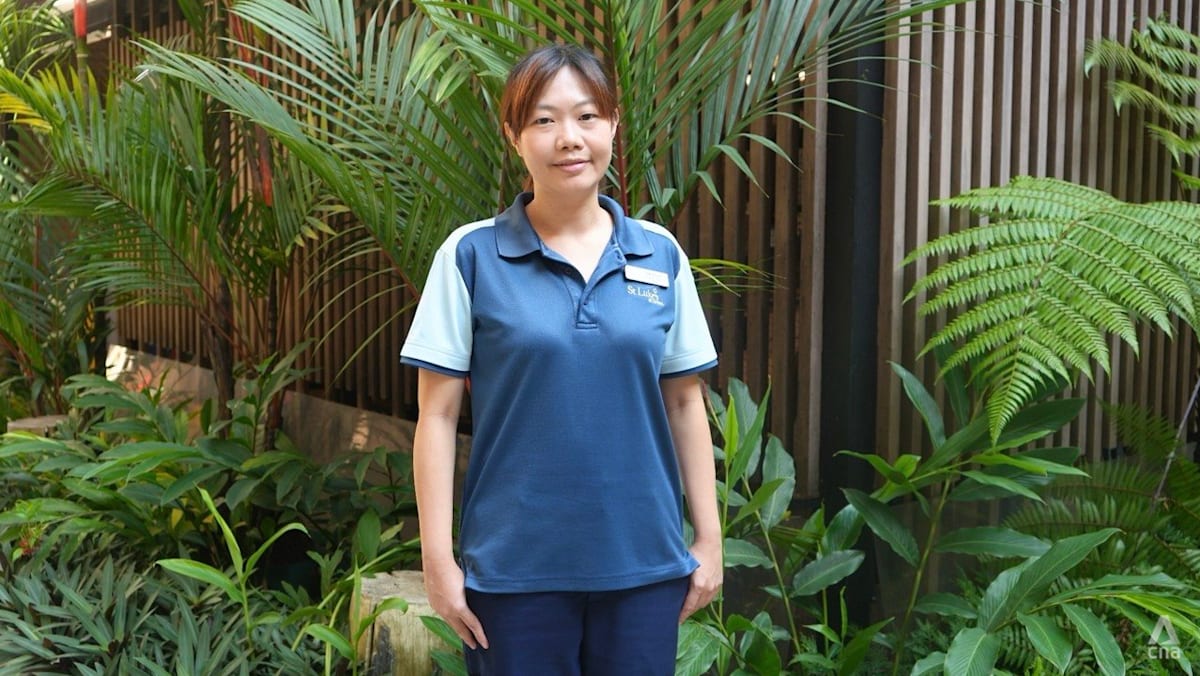
Women Some patients worry less about dying than about the loved ones they will leave behind. For St Luke’s Hospital occupational therapist Esther Lim, caring for people nearing the end of life has revealed their regrets, surprisingly simple wishes and moments of joy. Occupational therapist Esther Lim of St Luke’s Hospital helps patients nearing the end of life find comfort, fulfil their last wishes and create meaningful memories for their loved ones. (Photo: St Luke’s Hospital) New: You can now listen to articles. This audio is generated by an AI tool. After working with terminally ill patients at St Luke’s Hospital for the past three years, occupational therapist Esther Lim has observed how patients’ priorities shift as they approach the end of life. In the face of death, many think about loved ones they will leave behind.One elderly patient wanted a makeover and photo shoot with his loved ones. Another asked to return home and spend his remaining time with family.Other patients wrote letters, made cards or recorded messages for their loved ones, while some wanted to reconcile with an estranged family member.“When time is limited, the priorities often become much clearer,” said the 40-year-old. “A fair share of our patients are concerned not so much for themselves, but whether their loved ones can cope emotionally or financially after they are gone.”Some patients also reflect on their lives, expressing regret that they spent so much time on work and had less time for the people they loved, she added.HELPING END-OF-LIFE PATIENTS FIND MEANING AND COMFORTWorking in the palliative care ward, Lim is part of a multidisciplinary team that helps patients navigate the last days of their lives.Patients admitted to the ward generally have a prognosis of three months or less, said Lim. They may have conditions such as advanced cancer, end-stage organ failure or neurological conditions, including late-stage dementia. Lim joined the community hospital in Bukit Batok in 2014, rotating through several wards before working with palliative care patients in 2023. Her patients range in age from their 30s to over 100.While occupational therapy (OT) is typically associated with recovery and regaining independence, the goals are different for patients with advanced and life-limiting illnesses.“In palliative care, the goals of OT are not so much of restoring function or independence, but about bringing comfort, exploring meaning and having closure,” explained Lim.This includes managing symptoms such as pain, fatigue and breathlessness through energy conservation techniques, as well as modifying tasks and patients’ environments.THE PATIENT ENCOUNTER THAT LED HER TO PALLIATIVE CARESometimes, what a patient needs may be much simpler. This became clear to Lim after encountering an elderly patient in a wound care ward who had only months to live. Lim began working with palliative care patients at St Luke’s Hospital in 2023 – her patients range in age from their 30s to over 100. (Photo: St Luke’s Hospital) At the time, Lim was accustomed to helping patients recover and regain independence. But recovery was no longer possible for that patient.During a therapy session, she asked him if he needed anything and expected a practical request, perhaps help getting his favourite food or drink.Instead, the patient, who did not have family other than an elderly sister, asked if he could hold her hand. “I just held his hand and assured him that he’s not alone in that journey, and that the healthcare team will continue to walk alongside him,” she said.The encounter prompted Lim to think differently about how OT could continue to support patients nearing the end of life.It is also the reason why a significant part of Lim’s work in palliative care now involves fulfilling patients’ last wishes and helping them create something meaningful to leave behind for people they love. HOW TO RECONNECT WITH SOMEONE APPROACHING THE END OF LIFE For those hoping to reconnect with someone who is at the end of life, there is “no perfect moment” or “perfect script”, said Leong Si Jie, a senior medical social worker at St Luke’s Hospital. She suggested ways to approach them:Don’t force reconciliation: When approaching an estranged family member, first explore whether they are open to reconnecting. Reconciliation should never be assumed or forced.Begin gently and calmly: Start with a simple check-in. Ask open-ended questions, for example, “What do you think about what the doctor has shared regarding your medical condition?” or “How are you feeling about it?”.Let them set the pace: Pay attention to both verbal and non-verbal cues. For example, if they turn their head away or keep answers brief, change the subject or remain quiet.Listen and acknowledge their feelings: Simple statements such as, “I imagine this news must be difficult for you” or “I’m here to listen if you feel like talking” can help the patient feel heard and supported.Avoid dismissing feelings and giving false reassurances: Responses such as “You will recover” or “Why are you giving up?” may shut down the conversation.If the person dies before reconciliation is possible, Leong said the first step is to acknowledge the loss and allow yourself to experience the emotions that come with it. If it helps, talk to a trusted friend or family member.“Sometimes, it is about finding your own sense of resolution after the loss,” she said.If unresolved grief or feelings about the relationship continue to significantly affect your daily life, seek support from a counsellor or psychologist, said Leong. Collapse Expand PRESERVING MEMORIES AND FULFILLING LAST WISHESLegacy projects give patients an opportunity to reflect on their lives and share what matters most with their loved ones, said Lim. This could involve creating photographs, cards, fingerprint art or voice recordings for loved ones.These projects, she explained, provide comfort and connection for the patients and their loved ones, and offer a tangible reminder of the person after they are gone.For patients who have difficulty writing, Lim adapts by adjusting their sitting position or propping them up in bed and providing a modified table to make writing easier. For those who are no longer able to write, Lim explores other options, such as audio recordings and photographs.Lim said not every patient wants their messages handed over immediately. Some have told her: “Pass it to them when I pass away”. Lim also helps some patients fulfil their last wishes. Going home is a common request. When families cannot manage care at home, the team may search for a middle ground, such as a trip home for a few hours, said Lim.Other common requests involve satisfying a craving for a favourite food, such as a simple bowl of mee rebus, some fried carrot cake, chicken rice or char kway teow.Lim has facilitated outings to coffeeshops near St Luke’s Hospital. “We need a lot of manpower for these trips because at the end of life, patients generally do not have much strength,” she said.With the help of staff, volunteers and family members, Lim has wheeled patients out in reclining wheelchairs, with portable oxygen cylinders and painkiller drips in tow, to have their favourite hawker meal. MAKING ROOM FOR JOY AND JOKESWhen Lim first started working with palliative care patients, she worried about how she would cope emotionally. She soon realised that the end-of-life journey is not always filled with sadness and tears.“There are also moments of laughter, joy and connection,” she said. Lim feeding a patient during an outing outside the hospital. (Photo: St Luke’s Hospital) There was a seriously ill patient who made her laugh during a photo shoot because he knew she was camera-shy. Then, there was the octogenarian who, after a makeover, appeared in a blazer, vest and hat, and had photos taken with around 20 family members by the hospital’s fishpond.“I could see how happy he was. He shared with me: ‘I come alive now’,” she said. “It’s not always just sadness. Many patients can also be quite humorous and share jokes.”Working with palliative patients has also reminded Lim that “no one will truly know how much time we have”.A patient once asked her: “If you only had seven days left on Earth, what would you do?”“It prompted me to reflect on my priorities and what gives my life meaning. It reminds me to be present, to nurture the relationships that are important to me, and to make time for what truly matters,” she said.Lim has come to see death as a part of life. “Life is full of transitions. Death and dying are also one of them – the final transition,” she said.That’s why she believes conversations about end-of-life care and death should begin early and openly.Having these conversations early, Lim said, can reduce fear and uncertainty, and help patients and families navigate this final stage of life “with love”. CNA Women is a section on CNA Lifestyle that seeks to inform, empower and inspire the modern woman. If you have women-related news, issues and ideas to share with us, email CNAWomen [at] mediacorp.com.sg.
A family photo, a hand to hold: An occupational therapist learnt what matters most to dying patients
Full Article
Original Source
Read the full article at Cnalifestyle →KhanList aggregates and links to publicly available news content. We do not host full articles from third-party sources. Always verify important information with original sources.