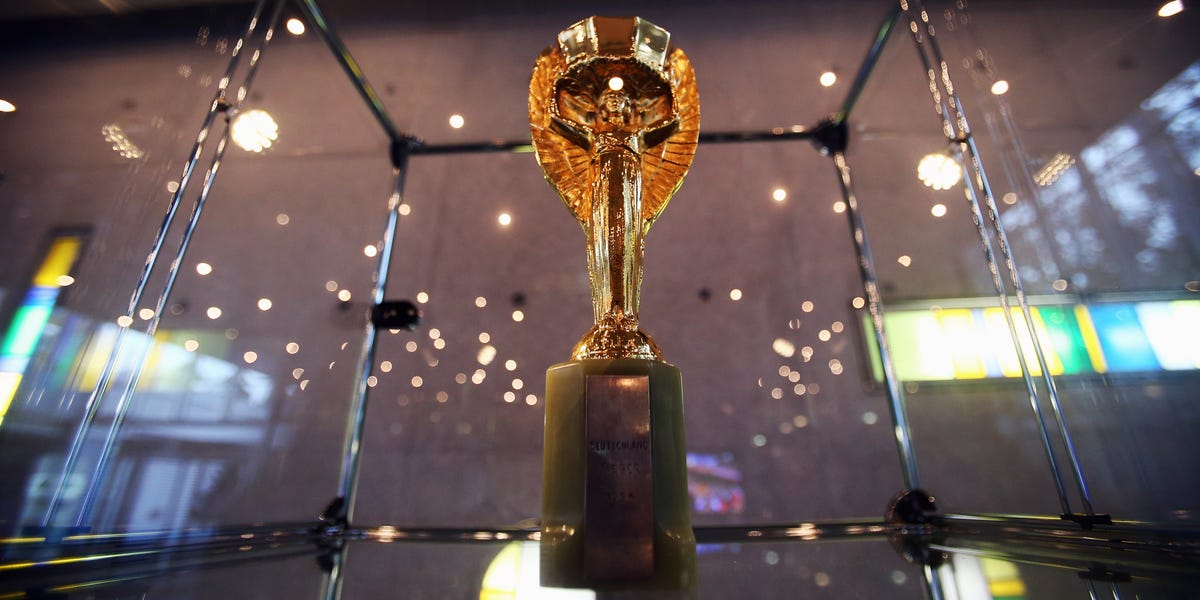
5 min readHere’s what you’ll learn when you read this story:The first iteration of the World Cup trophy—known as the Jules Rimet Cup—was made for the inaugural World Cup tournament in 1930 and featured a figure of Nike, Greek goddess of Victory. The cup was on display for the 1966 World Cup in London when it was stolen by a band of robbers who later left it under a bush, only for a dog to discover it there a week later.After Brazil won in 1970, the cup stayed there until robbers swiped it in 1983.It was 1966, London was swinging, and England was thrumming with excitement at the prospect of hosting the World Cup. In anticipation, the Jules Rimet trophy had been put on display at Methodist Central Hall to promote the coming tournament. Created by French sculptor Abel Lafleur, the gold-plated silver trophy mounted on a base of lapis lazuli was named for FIFA President Jules Rimet, who’d kicked off the global soccer tournament in 1930. The trophy was meant to be a vision of Nike, the Greek goddess of victory, lofting the cup above her head with her wings spread in an eternal blaze of glory. It was the most prestigious athletic trophy ever—until it vanished.Around 11 a.m. on March 20, 1966, someone managed to slip inside the building, which was still open for church services, despite the fact that the trophy exhibition was closed. The intruder broke through the padlocked door to the exhibition, snatched the trophy from its case, and took off. When the unsuspecting guards came by on their regular rounds at about noon, they found only an empty case where the trophy had been.The doors were also flung open, and as detectives later found, a metal plate on one handle had been unscrewed, which would have made the padlock and chain malfunction. Only a handful of screws and a now-broken padlock had been standing between the thief and the Jules Rimet World Cup. Witnesses came forward, headlines screamed about the heist, and FIFA launched into hysteria.Hardly 24 hours later, English Football Association chairman Joe Mears received an anonymous phone call. He was told that a package was on its way to the Chelsea Football Club. When it arrived at their doorstep the next day, it was opened to reveal the lining of the cup that Nike had been holding—and a ransom note. Signed only “Jackson,” the scrawled note threatened that the statue would be melted for its gold if any information leaked to the press or police. Demanding the equivalent of £15,000— about $42,000 at the time, or roughly $425,000 today—“Jackson” promised to return the trophy if Mears posted an ad to the personal news column that he was “willing to do business.”Posing as Mears’ assistant, Detective Inspector Len Buggy accepted the thief’s offer to meet him in Battersea Park—as did the police. They successfully arrested a man involved in the heist who turned out to be petty thief Edward Betchley. But the trophy was nowhere to be found.Betchley confessed that he was paid to be a middleman for the actual mastermind behind the crime, but even though police thoroughly scoured the area after finding out that piece of information, they came up with nothing. Seven days later, South London resident David Corbett headed outside to walk his collie mix Pickles, who had apparently seen something interesting and bounded over to his neighbor’s car. Corbett noticed a package under a bush, wrapped in newspapers and tied with string, and when he tore a piece from the bottom, he saw engravings of the names of previous World Cup winners Uruguay, West Germany, and Brazil. Unwrapping it the rest of the way, he was stunned to find that he was holding the Jules Rimet World Cup in his hands.When Corbett initially handed over the trophy to local police, they doubted him. After all, it was impossible to know whether what Pickles had sniffed out was genuine without further examination. Detectives suspected Corbett of masterminding the plot to steal the trophy and whisked him away to Scotland Yard for questioning, but he was quickly cleared and given a ride home.There, he was shocked to find the press swarming outside his Norwood flat. Pickles experienced a meteoric rise to fame—he won Dog of the Year and Italian Dog of the Year, making television appearances, meeting celebrities, and netting Corbett reward money and sponsor payouts that added up to more than any player on a winning World Cup team had ever earned. England would go on to become World Cup champion that year, and the trophy was passed to Brazil after they won in 1970.Brazil displayed the cup proudly at the Brazilian Football Confederation (CBF) headquarters in Rio de Janeiro—until 1983, when it then fell into the hands of a band of burglars led by banker Sergio Pereira Ayres, who claimed he was also an agent for Clube Atlético Mineiro in Belo Horizonte, Brazil. Francisco Rivera and José Luiz Vieira tied up the overnight security guard before breaking the wooden frame of the trophy’s case (which was made of bulletproof glass) and snatching their prize. Brazil was on the receiving end of some international embarrassment from this inside job, since Abrain Tebel, of Brazil’s football federation, had famously taunted England that the Cup would have never been stolen under their watch: “It would never have happened in Brazil. Even Brazilian thieves love football.”Meanwhile, panic overcame legions of Brazilian football fans and the CBF feared that the trophy it swore to protect really had been melted down this time. This time, though, the thieves didn’t stay anonymous for long. A tip from an informant—a man Ayres had originally tried to recruit for the job—led police to the culprits within weeks, and in 1988, Ayres, Rivera, and Vieira were each sentenced to nine years in prison for the heist, though none served his full term. A fourth man, Argentine goldsmith Juan Carlos Hernández, received a three-year sentence for taking possession of the trophy and, by most accounts, melting it down into gold bars—although Hernández himself later muddied the waters by claiming the cup had actually been sold intact. Justice for the trophy itself, however, never came: its whereabouts are still unknown to this day.The Jules Rimet World Cup could be anywhere, perhaps safely buried in an unmarked location or languishing in someone’s basement. But there is, at least, a claimed solution to the English half of the story. In 2018, Reg’s son Gary told the Daily Mirror that his father and his uncle, south London gangster Sidney Cugullere, had taken the trophy. He told reporters that his father and uncle had stolen the trophy purely for an adrenaline rush, but began to grow anxious when they realized there wasn’t enough gold to make bank on. The cup allegedly sat in a coal shed for a while until they finally hid it in the bush, where Pickles the dog made his shocking discovery. Cugullere died before he could be caught. Pickles remains an icon.Elizabeth Rayne is a creature who writes. Her work has appeared in Popular Mechanics, Ars Technica, SYFY WIRE, Space.com, Live Science, Den of Geek, Forbidden Futures and Collective Tales. She lurks right outside New York City with her parrot, Lestat. When not writing, she can be found drawing, playing the piano or shapeshifting.
A Dog, A Heist, and How the First World Cup Trophy Disappeared—Twice
Full Article
Original Source
Read the full article at Popularmechanics →KhanList aggregates and links to publicly available news content. We do not host full articles from third-party sources. Always verify important information with original sources.