
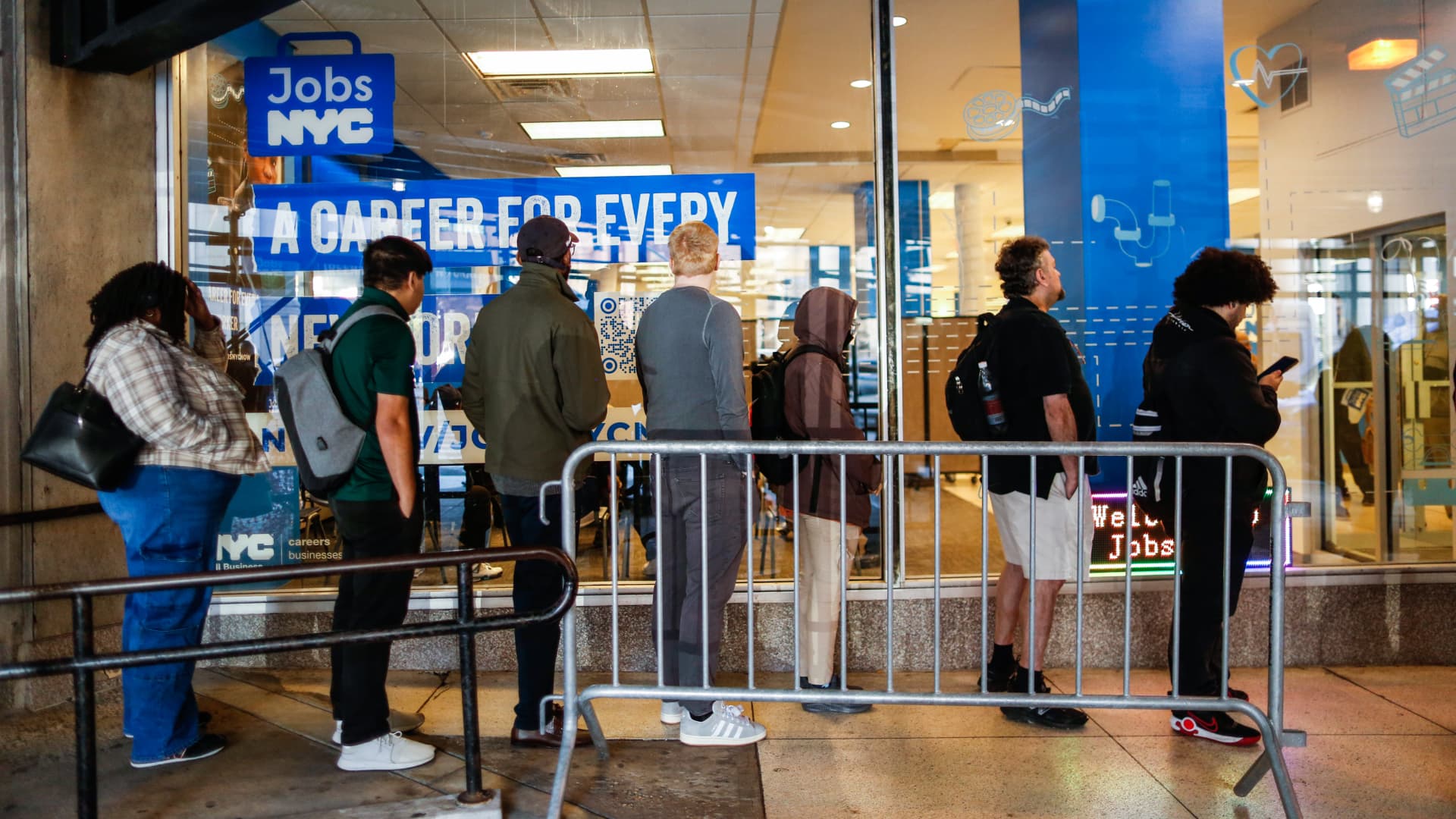
Jobseekers wait in line outside the Jobs NYC Center in New York, US, on Tuesday, Oct. 6, 2026. Kena Betancur | Bloomberg | Getty ImagesAmericans who lose their jobs these days are facing a harsh new problem: It's getting harder to find another one quickly.The average jobless worker's bout of unemployment surpassed 27 weeks in October on a seasonally adjusted basis, according to Friday's jobs report from the Bureau of Labor Statistics. That amounts to a job search of nearly seven months, the longest outside of the pandemic period since 2016, when the U.S. labor market was finally getting back on track after the 2008 financial crisis. About 2 million Americans have been without work for at least 27 weeks, the BLS reported. People in this category are referred to as the "long-term unemployed" and accounted for 27.6% of all jobless workers in October, the highest share since late 2021."This is a series that can be noisy from month to month," said Cory Stahle, senior economist at Indeed, a hiring platform. "But if you look over a longer time horizon, there is no mistake in the trend."It's a troubling sign in an otherwise steady labor market. Workers stuck on the sidelines are a casualty of what's become a "low-hire, low-fire" job market, in which companies are hesitant to lay workers off, but aren't adding them either. Research shows that Americans who experience long-term unemployment face depleted savings, lower earnings potential over time and declining mental health.What's more, workers who are unemployed for extended periods risk falling into a self-perpetuating cycle, researchers at the Federal Reserve Bank of Richmond wrote earlier this year. "Time spent unemployed may itself reduce the probability of finding a job, perhaps because skills depreciate, networks thin or employers interpret long unemployment durations as a negative signal," the researchers warned.Workers stop being able to claim most, if not all, government unemployment benefits after 26 weeks in a year. Given that, a rising share of long-term unemployed people can explain in part why initial and continuing jobless claims have remained low. "Now, the average unemployed person takes longer to find a job than their benefits would last," Stahle said. "That is a really key point of this."A 'jarring' narrativeWhile jobless workers appear to be having a tough time, this week's employment data shows strength in other areas of the labor market.Nonfarm payrolls blew past economists' forecasts for October and added 165,000 jobs, according to Friday's release. The unemployment rate ticked down to 4.1%, slightly lower than economists predicted.Job openings came in much higher than economists expected in September, according to a separate report from the BLS released on Tuesday. The number of workers quitting jobs — a barometer of their confidence to obtain new employment — spiked to levels not seen since March 2025.The BLS also said layoffs and discharges dropped to their lowest volume in more than a year. However, a recent string of high-profile workforce cuts could throw cold water on views among workers that the market is heating up.CNBC reported this week that Disney is planning to axe thousands of jobs, the latest of several waves of layoffs at the media giant this year. American Express said last month that it was slashing head count by 5% as it reorients around artificial intelligence."It's difficult to separate what's happening to you or the people around you from the big picture," said Elizabeth Renter, lead economist at Life360. "When your LinkedIn is filled with layoffs and your social circle features a few folks who have been job seeking for several months, positive narratives about the labor market can seem jarring."
A disturbing employment trend is hiding beneath the latest strong job numbers
Full Article
Original Source
Read the full article at Cnbc →KhanList aggregates and links to publicly available news content. We do not host full articles from third-party sources. Always verify important information with original sources.