
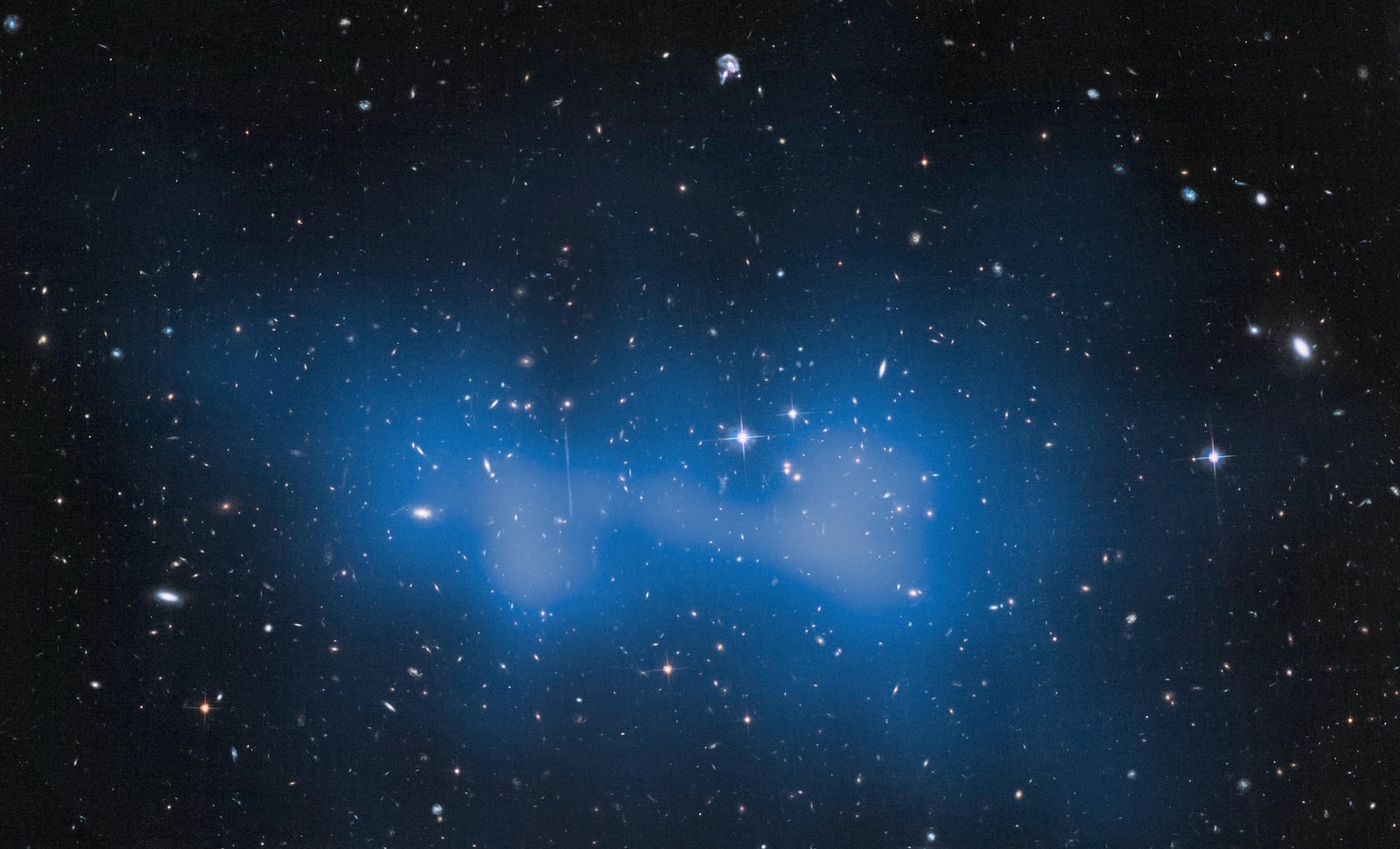
Seven billion light-years from Earth, there is an unexpected cluster of galaxies. It has two regions in the process of colliding with each other with a combined mass of more than two quadrillion solar masses. Given its mass, the distant cluster has been nicknamed El Gordo, the Fat One. What makes it unusual is that it's extraordinarily large for that period of the Universe. How did such a large supercluster form so early? El Gordo is so surprising that some astronomers hold it as a counter-example to the standard model of cosmology. It's difficult to explain how cold dark matter in an inflationary universe could generate a large supercluster so quickly. A new study looks at how self-interacting dark matter could explain it all. Dark matter makes up the bulk of mass in the cosmos. It doesn't interact strongly with light, if at all, hence the name. This also means that dark matter doesn't interact strongly with regular matter, since most matter interactions are electromagnetic in nature. One of the key questions, however, is whether dark matter can interact strongly with itself. The most popular view is that dark matter isn't self-interacting. This is because observations show dark matter is mostly cold, meaning that dark matter particles don't have a lot of kinetic energy. If dark matter particles could collide with each other, then they would stay warm, just as regular matter can heat up when it collides. Self-interacting dark matter (SIDM) could create an early supercluster like El Gordo, but it would also produce plenty of warm dark matter. To overcome this problem, this new study proposes a two-state dark matter interaction. Regular matter mostly interacts through elastic collisions. For example, the air molecules in your room tend to bounce off each other without losing much energy. This is why your room can stay a constant temperature. If the collisions were inelastic, losing energy with each bounce, then your room would rapidly freeze. Most SIDM models assume a similar elastic interaction. Tweak the interaction just so, and you can accelerate galactic clustering while not overly warming dark matter. The results of this approach have been mixed. The author considers a dark matter model that has a ground state and an excited state. With this two-state model, most interactions would be elastic, just like regular matter. But with the right energy, a collision could kick a dark matter particle into an excited state, thus removing kinetic energy from the collision. Dark matter particles can then cluster together and cool down at the same time. Based on N-body simulations of the colliding regions of El Gordo, a two-state SIDM model with both elastic and inelastic collisions is the best fit to what we observe. It provides a better fit than both non-interacting and elastic only interactions. The catch is that there is still quite a bit of uncertainty as to the exact mass of El Gordo and the speed at which the two regions are colliding. If the supercluster is on the low end of this range, then the two-state model wouldn't fit the data. So this is a possible solution, not a definite one. Until we directly observe dark matter particles, all sorts of possibilities are on the table. As this study shows, dark matter might be more complex than we've thought. Reference: Valdarnini, R. "Hydrodynamical simulations of the merging cluster El Gordo in a two-state self-interacting dark matter scenario." The Astrophysical Journal 1008.1 (2026): 105.
A Distant Supercluster of Galaxies Points To Self-Interacting Dark Matter
Full Article
Original Source
Read the full article at Universetoday →KhanList aggregates and links to publicly available news content. We do not host full articles from third-party sources. Always verify important information with original sources.