
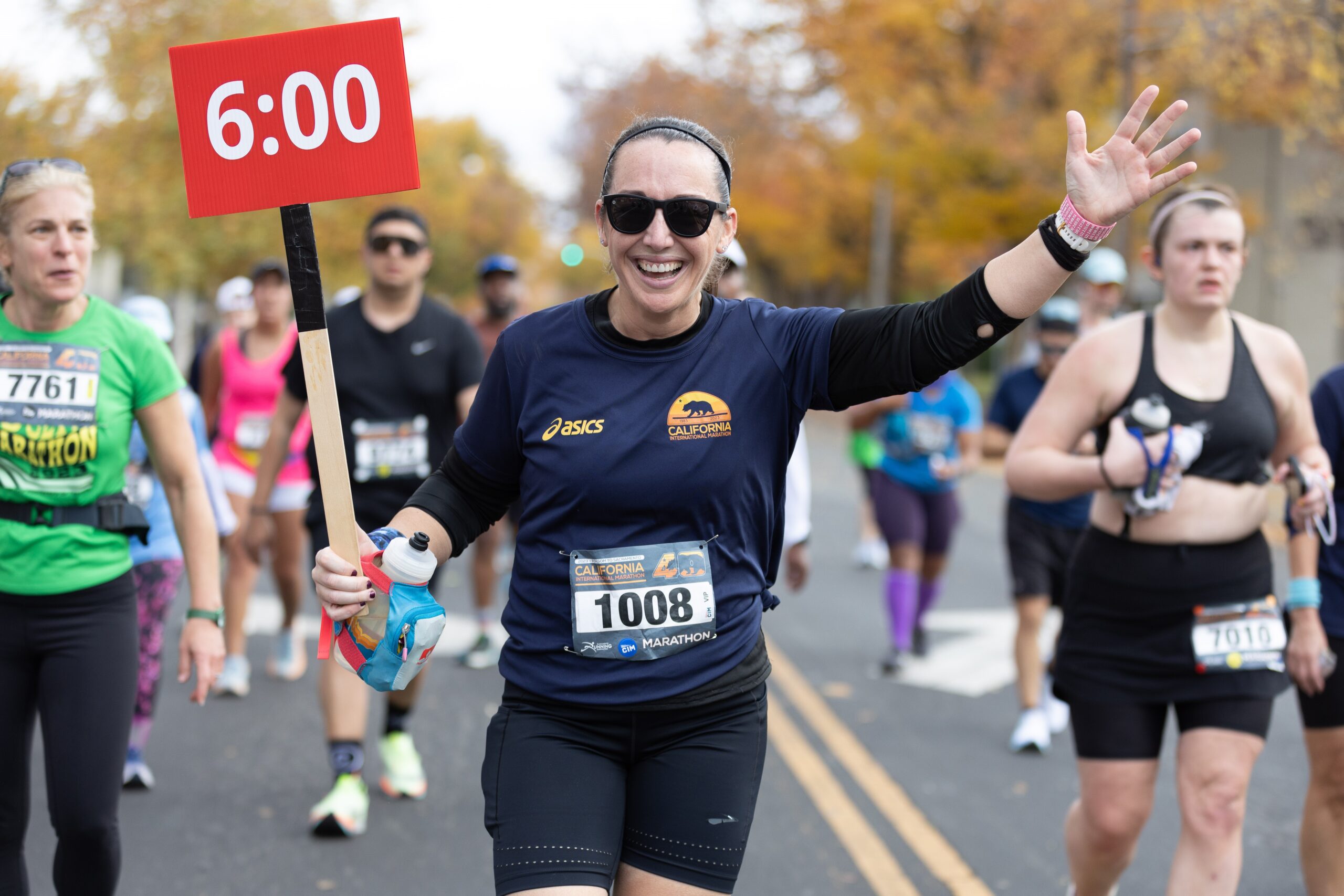
SACRAMENTO, Calif. (CN) — Standing at the start line of the California International Marathon, Stephanie Dunlap felt out of place.It was 2021, and Dunlap was making her first run as a six-hour pacer.Unlike many marathon runners, who try to complete this 26.2-mile race as quickly as possible, some just want to finish the whole course within the maximum allowed time of six hours. Pacers like Dunlap ensure that anyone who stays with them will finish in that pacer’s specified time.As Dunlap waited for the race to start in 2021, she looked at the thousands of participants in front of her going for faster times.They looked like real runners, Dunlap recalled in a phone interview. As for herself, she was four weeks postpartum and hardly felt like an athlete.With an elevation decline from start to finish, the California International Marathon or CIM is what’s known as a fast course. The race has several sanctioned pacers, who each hold signs stating their finish time in hours and minutes: 3:10, 3:55, 4:30.Rounding out the end of the race is Dunlap. If the front of a marathon is fast-paced and competitive, the rear is supportive and collaborative, summed up by one of Dunlap’s mantras: “All runners count.”“We’re speaking belief into the people around us,” Dunlap told Courthouse News.Scott Abbott helps organize the California International Marathon as executive director of the Sacramento Running Club.He points to Dunlap as someone who’s helped make marathon culture more inclusive.When running first became popular in the 1970s and ’80s, races like these drew athletes who prioritized speed and performance.“The focus was on the front of the pack,” he said.Stephanie Dunlap, center, paces the six-hour running group in the 2022 California International Marathon. (Dorothy Leo via Courthouse News)As half-marathons came into vogue and more and more people got interested in competing, organizers wanted to make sure everyone felt welcome.Dunlap exemplifies that trend. She’s an ambassador for a more inclusive running culture, helping encourage new runners with her blog and podcast.Some marathons have “sweepers”: runners who signal the tail end of the marathon.Runners can’t complete the race if they fall behind a sweeper. Roads and vehicle traffic might even start to reopen.This design sends the wrong message, Abbott said — sweeping stragglers out of the race as if they weren’t good enough, rather than celebrating their attempts. Some marathons like CIM have phased them out in favor of using pacers at the end of the race.“Stephanie obviously was the perfect person for that,” Abbott said.As the 44th annual California International Marathon kicks off this Sunday, Dec. 6 in Sacramento, Dunlap will once be serving in the role.The CIM kicks off at 7 a.m. At that point in the morning in December, Sacramento is still dark and often pretty cold.The professional athletes at the front are often ready to get moving — but it can be a different story at the back of some 10,000 racers. Dunlap tries to convince new runners that they can feel both insecure and courageous. It’s about “feeling the fear but doing it anyways,” she said — a feeling she knows quite well.Though officially a six-hour pacer, Dunlap’s actual pace time is five hours and 50 minutes. That gives runners a bit of a buffer if they fall behind.As far as Abbott knows, CIM was one of the first races to implement a six-hour pace group. The final 30 minutes is now a celebration of those who managed to complete the race.Dunlap’s path to becoming a CIM pacer started more than a decade ago.She used to be a teacher at an international school in Torreón in Mexico’s Coahuila State.The course for the city’s Lala Marathon was near her apartment. Some coworkers ran the race. Watching them pass at mile 20, she became inspired and decided to start training.The next day, Dunlap ran a city block. The day after that, she ran two.The next year, in 2012, she completed the Lala Marathon. She says “the high of just completing 26.2 miles” was infectious and made her want to keep on doing it.Returning to the United States, Dunlap continued chasing her new hobby.The year 2016 was her biggest year of running, she said. She completed almost 30 races, ranging from 5Ks to marathons. She discovered the online running community.Dunlap also became an official ambassador for CIM, spreading the good word about running and helping people register. In that role, she encountered many first-time marathoners. She tried to encourage them. “I said, ‘Hey, don’t worry, I got you.’”Participants walk and run along a tree-lined road during a 20-mile run. (Alan Riquelmy/Courthouse News)In 2017, Dunlap decided to run the CIM as an unofficial six-hour pacer. She told people if they wanted to finish the marathon within the required time, they should stay with her and she’d ensure they did.Dunlap told the story at a CIM kickoff party in 2021.“That’s where our relationship with Stephanie began,” Abbott said.Days later, Abbott emailed her. He said the Sacramento Running Association was starting an official six-hour group. He wanted her to pace it.The starting gun had gone off.Dunlap’s encouragement has helped many confront the daunting challenge of finishing a full marathon.Take Usha Swini, who had life-threatening surgery in 2024 and wanted to do something big when it was over.Living in Sacramento at the time, Swini registered for CIM and saw Dunlap. She’d run with her the year before, but not in a full marathon.In 2024, she stayed with Dunlap the entire race, achieving a PR or personal record.“I cannot imagine doing that without her help,” Swini said.Ivan Casillas feels the same. He ran in high school but was years out of practice. When a job change gave him more time, he decided to once again pick up running as a hobby.Casillas put CIM on his bucket list, running his first marathon in 2022. He finished the race, but it wasn’t quite the experience he’d hoped for.“I didn’t quite enjoy it like I wanted to,” he said. Looking back, he wished he’d eaten pizza bites and taken a whiskey shot on the route. Whiskey is sometimes offered by spectators.Casillas met Dunlap the following year at an annual 20-mile run. He took note of the effort she put into her group, as well as her belief that all runners count.Casillas was also impressed that she could predict her finish time within 42 seconds.“That’s insane to me,” he said.Casillas is planning to compete in this year’s CIM. His goal is four hours and 30 minutes, a time that will put him ahead of Dunlap’s running group.Even though they won’t be running together this year, Casillas draws a straight line from Dunlap’s encouragement to where he is today.“She always encourages people to try their best,” he said. “Stephanie built this community of people that all share a common goal, even if it’s at a different pace.”Runners at the 2024 California International Marathon. (Alan Riquelmy/Courthouse News)Subscribe to our free newslettersOur weekly newsletter Closing Arguments offers the latest about ongoing trials, major litigation and rulings in courthouses around the U.S. and the world, while the monthly Under the Lights dishes the legal dirt from Hollywood, sports, Big Tech and the arts.Additional Reads
‘A different pace’: 6-hour pacer aims to make marathons achievable
Full Article
Original Source
Read the full article at Courthousenews →KhanList aggregates and links to publicly available news content. We do not host full articles from third-party sources. Always verify important information with original sources.