
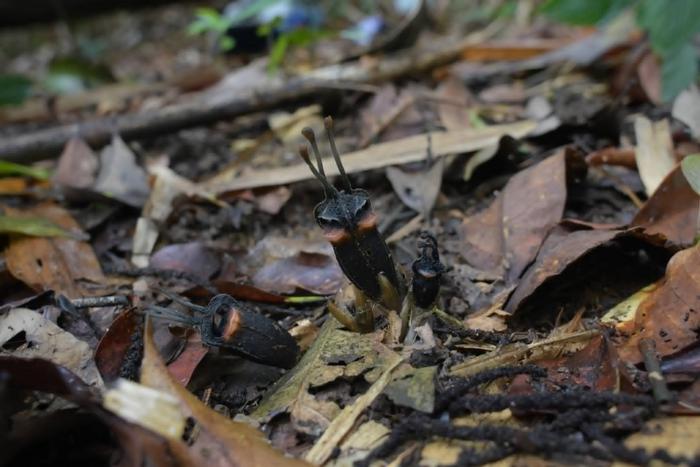
Botanists in Thailand have identified a new-to-science species of “fairy lantern” — plants that live almost entirely buried under leaf litter, emerging aboveground only occasionally to flower. Researchers were surveying evergreen forests in the mountains of Thong Pha Phum National Park when they chanced upon a plant none of them had ever seen before, at an elevation of almost 1,000 meters (about 3,300 feet). They’ve since named it Thismia daemona, according to a recent study. Like other plants within the Thismia genus, commonly referred to as fairy lanterns, T. daemona lacks chlorophyll, meaning it can’t photosynthesize. Instead, it spends much of its life hidden from view under leaf litter, deriving all its nutrients from soil fungi, the study authors reported. “Finding Thismia daemona in Thong Pha Phum National Park was indeed a major surprise,” study co-author Sahut Chantanaorrapint of Thailand’s Prince of Songkla University said in a press release. “Typically, Thismia species are known to occur in perennially humid lowland rainforests, however, this population was discovered in a seasonal, montane evergreen forest at an elevation of nearly 1,000 meters above sea level.” T. daemona has a dramatic, “devil-like” appearance, the authors write — hence the name they chose for it. Its flower features a blackish floral tube crowned with dark, horn-like appendages and vivid reddish-orange outer petals near its base. “Combined with its hidden, subterranean and mysterious lifestyle on the forest floor, our team unanimously agreed that naming it Thismia daemona perfectly captured its enigmatic and devil-like essence,” Chantanaorrapint said. Despite its recent discovery, the species’ future is precarious. T. daemona is currently only known from a single site within Thong Pha Phum National Park, with a population numbering fewer than 50 individuals confined to an area smaller than about 5 hectares (12 acres). This sole known habitat also sits along trails regularly traversed by tourists, posing a threat of habitat disturbance, the authors write. Based on the IUCN Red List criteria, they’ve provisionally classified T. daemona as critically endangered. Chantanaorrapint said in the press release that inspiring local people to take pride in their natural heritage would both safeguard the plant’s microhabitat and “support sustainable, community led ecotourism.” Banner image: Thismia daemona in its natural habitat. Image by Sahut Chantanaorrapint (CC BY 4.0). Credits Topics
A ‘devil-like’ flower from Thailand is new to science — and critically endangered
Full Article
Original Source
Read the full article at News →KhanList aggregates and links to publicly available news content. We do not host full articles from third-party sources. Always verify important information with original sources.