
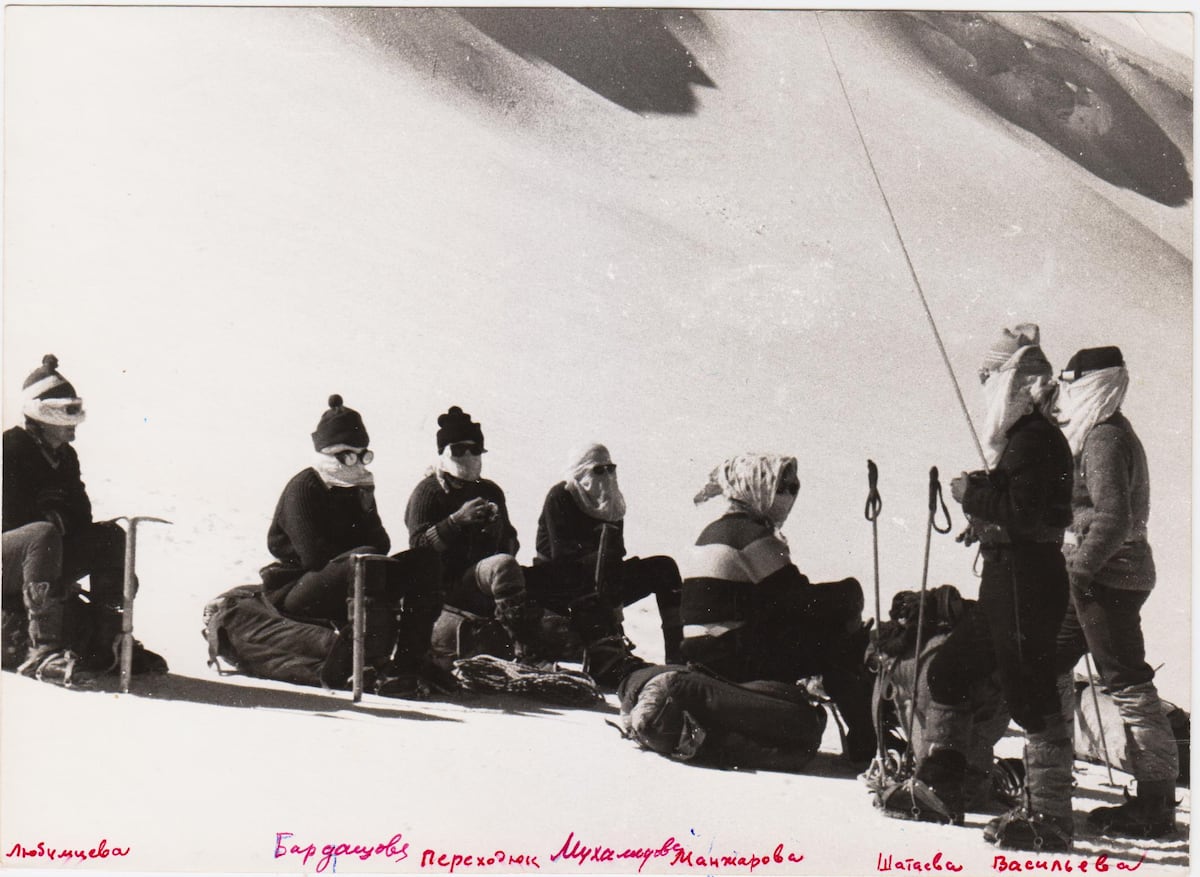
Night falls over the mountain. It’s cold; the ice creaks. With no clouds in the sky, the moon casts blue reflections on the snow, and the stars are flashes of light in a darkness as thick as pitch. During the day, the light is like a knife. Why would anyone want to venture up to these 7,000 meters of frozen solitude? Noelia Ordieres Buarfa-Mohamed (Llanes, 41) has some answers to that question. One of them is that she’s searching for a story. To find it, she’s had to climb all the way up here, to the summit of Lenin Peak in the Pamir Mountains on the Kyrgyzstan–Tajikistan border. Because it was this summit that the eight climbers of the first all-female rope team to reach it in 1974 conquered — and where they died.The result of that search and ascent is Las edelweiss del Pamir (The Edelweiss of the Pamir), a book that mixes essay, personal narrative, and travel writing. It includes an epilogue by climber Chus Lago and illustrations by Sandra Arias, and was published by Trea in a series edited by Pablo Batalla Cueto.Elvira Shatayeva, Tatyana Sardashove, Nina Vasilyeva, Irina Lyubimtseva, Lyudmila Manzharova, Ilsinar Mukhamedova, Galina Perekhodyuk and Valentina Fateyeva are the eight protagonists of this story. Their names, and their photographs, appear on the monolith that stands over the modest graves that hold their bodies, in the Edelweiss meadow at the foot of Lenin Peak. Noelia Ordieres’s boots also reached that place, though there was no signage to guide her, no marked trail, no plaque. “The first thing I did when I was at the place where they’re buried was to say their names out loud. And I thought that if I’d made it all the way there, it couldn’t have been for nothing — I had to tell their story,” she says.Ordieres learned of the story of the eight Soviet climbers while she was recovering from a broken right leg sustained training on an indoor climbing wall. Two operations, six months in a wheelchair, a year to walk again. And loneliness, because there were still coronavirus restrictions in place. Now, two plates and sixteen screws later, she is back on the mountain. During that long year of healing, reading became a refuge. One of the books she read was Cuerdas rebeldes (translated as Wild Ropes) by Arantza López Marugán, about pioneering women in mountaineering and alpinism. There she found the story of that first women’s expedition to Lenin Peak. But when Ordieres tried to dig deeper, she was surprised to find there wasn’t much information.“I was struck by how little was known about this story. I wondered how it was possible that I hadn’t heard anything about the first all-female climbing team to reach Lenin Peak — especially since they were among the best female mountaineers of the time. It seemed to me that there was a deafening silence surrounding their story,” she says. That silence wasn’t due solely to a lack of information, but also to the misrepresentation of that information.In 1974 the Soviet Union had opened Lenin Peak to international expeditions for the first time, and 170 climbers from various countries gathered at base camp on the Edelweiss meadow to attempt its 7,134-meter summit. There were Americans, Japanese, Austrians, Swiss, Germans, and French, among others. The eight Soviet climbers were there too, wearing the tracksuits of their club, Spartak. The event was organized by the experienced mountaineer Vladimir Shatayev, husband of team leader Elvira Shatayeva. Shatayev was one of Ordieres’s direct sources during research for the book, providing unpublished photos.The climbers reached the summit on August 5, but when they began the descent visibility dropped to between 20 and 30 meters, so they decided to set up a bivouac: they made camp and waited for the weather to improve. Instead the storm worsened: the wind raged and tore their tents. People began to freeze to death. The first to perish was Irina Lyubimtseva. The last were Elvira Shatayeva and Galina Perekhodyuk; Galina’s husband, Valeri, was one of the climbers at base camp. Reading the radio communications the climbers made in those moments, reproduced in the book, is chilling.“I’m beginning to realize that when it comes to this story, there are always the same messages, the same narratives, and nothing in depth,” says Ordieres. “They’re reduced to an anecdote that isn’t really one — the idea that they died up there. I confirm that this is a silenced story through Elvira’s husband, Vladimir, who witnessed everything that happened and sent me what I needed for the book, as well as through Sergei Shibayev’s research, which took 10 years.” The Soviet Union’s official narrative blamed them above all else, because the system had to show that it worked, that it was perfect, Ordieres asserts. “They were very well prepared, but the medical reports spoke of a hysterical fit upon finding themselves in that situation; they mentioned problems related to menstruation. Vladimir tried to have that removed and received threats not to go against the official reports.”To understand what happened, the testimony of Elmira Abramovna Gurmuzova is also important — a ninth climber at the outset of that expedition who had already summited Korzhenevskaya Peak (today called Ozodi Peak), one of the Pamir’s seven-thousanders. Although she was not ultimately part of the chosen rope team, she was part of the expedition. “Her analysis shifted the focus from the climbers’ gender to equipment, organization, communications, weather forecasting, and the actions of those who had responsibilities,” Ordieres writes.In addition to delving into the story of these eight climbers, the book narrates the author’s journey to Lenin Peak and reflects on women’s relationship with mountaineering and alpinism. The author also advances that work as president of La Muyerada, a mountaineering club of 240 women, from those who climb the highest mountains to those who hike in the Picos de Europa of northern Spain. “My part of the story is only important because I managed to connect with their stories. I want to remind everyone that we are following in the footsteps of other women. And we have to keep telling ourselves this over and over again — so that we don’t forget, and so that the generations that come after us don’t forget: what happened on Lenin Peak cannot be reduced to a mere footnote in the history of world mountaineering; these women are our role models, and they must not be forgotten.”Sign up for our weekly newsletter to get more English-language news coverage from EL PAÍS USA Edition
A descent from oblivion for the first all-female climbing party to Lenin Peak
Full Article
Original Source
Read the full article at English →KhanList aggregates and links to publicly available news content. We do not host full articles from third-party sources. Always verify important information with original sources.