
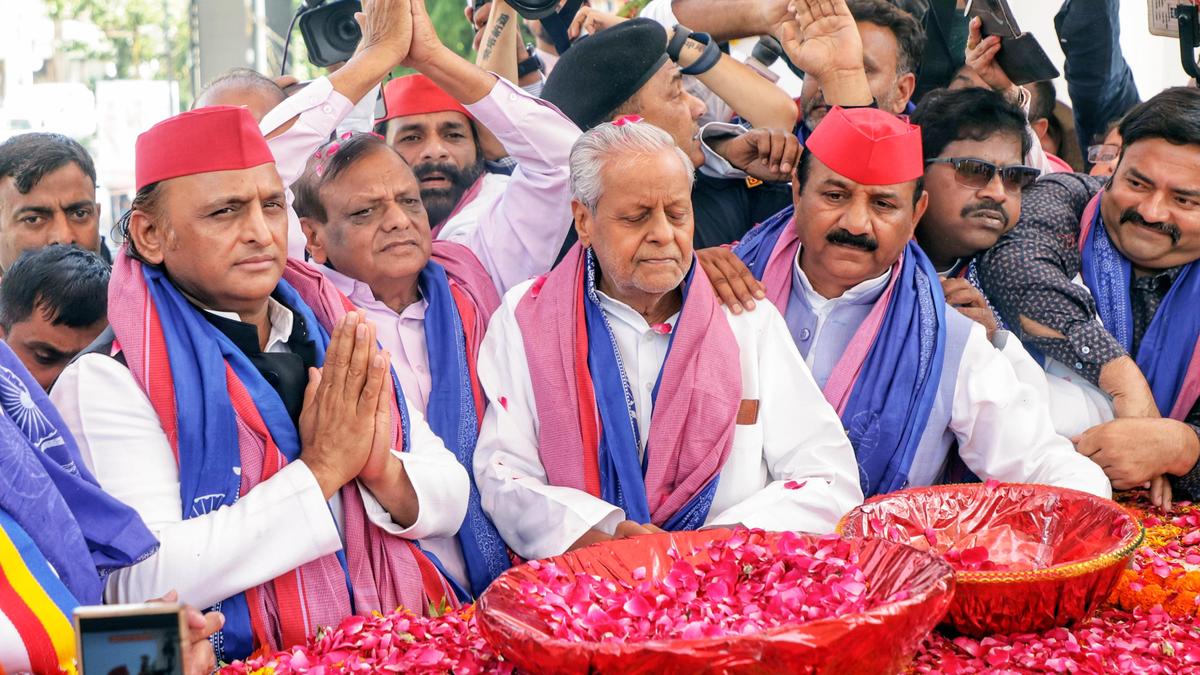
In the high-stakes arena of Uttar Pradesh elections, the line between social representation and competitive polarisation is razor-thin. Samajwadi Party (SP) spokesperson Rajkumar Bhati discovered it last week when he faced trolls from the Bharatiya Janata Party (BJP) and a reprimand from the party’s top leadership after participating in a Buddhist Dhamma Diksha ceremony in Delhi.During the annual ceremony, Mr. Bhati, a prominent OBC leader of SP in western U.P., participated in the mass recitation of Dr. B.R. Ambedkar’s 22 vows. The viral video recorded him explicitly repeating the controversial opening segments of the pledge, which include the statements: “I will not consider Brahma, Vishnu, and Mahesh as gods, nor will I worship them. I will not consider Rama and Krishna as gods, nor will I worship them.” He was also filmed repeating the vow to refuse any religious rituals performed by Brahmin priests.The 22 vows, which Ambedkar took with his followers on October 14, 1956, stem from his formulation of Navayana Buddhism. He did not want his followers to transition from one ritualistic or superstitious framework to another. He observed that historically, whenever reform movements emerged within India, they were eventually absorbed back into the dominant Hindu fold as mere sub-sects. He drafted the vows as an explicit checklist to guarantee a complete, irreversible psychological break from the Hindu social order.A Gurjar by birth, Mr. Bhati organised a massive rally for party president Akhilesh Yadav in March this year. His Dalit push seemed in line with the party’s Lohiate policy of numerical aggregation, uniting everyone outside the so-called upper-caste hegemony to capture state power. Ram Manohar Lohia’s “Socialisto ne bandhi ganth, pichhde paavein sau mein saat”, referring to roughly 40% OBC and 20% SC vote in the State, still echoes in the air. He also put forward the idea of roti-beti for intermingling of castes. SP founder Mulayam Singh Yadav put the slogan into action by joining hands with Bahujan Samaj Party founder Kanshi Ram in 1993, captured by the popular slogan, ‘Mile Mulayam-Kanshi Ram, hawa mein ud gaye Jai Shri Ram’ – but the caste barriers remained. Now Mr. Akhilesh seeks to revive Lohia’s logic through his comprehensive PDA (Pichhda, Dalit, Alpsankhyak) formula.Ambedkar’s 22 vowsHowever, his uncles, Ram Gopal Yadav and Shivpal Yadav, reacted to Mr. Bhati’s overtures, reviving Ambedkar’s fears about numerical aggregation. While Mr. Ram Gopal threatened to strip Mr. Bhati of his post in the party, Mr. Shivpal said, “Hum Ishwarwadi hain.” Political observers feel the Yadav leadership can’t separate its cultural ties to Lord Krishna. A Shiva temple has come up in the Yadav stronghold of Saifai, whose trust is headed by Mr. Akhilesh.Right-wing elements reminded the SP of their party president’s recent statement that P in PDA also stood for Pandit. Facing an FIR, Mr. Bhati clarified that he repeated the words out of respect for the organisers and Ambedkar, without intending to change his religion. But he also underlined that Ambedkarites would understand the spirit of his stance and respond to his right-wing trolls.Dalit intellectuals emphasise Ambedkar consistently argued that the Hindu caste structure is not a simple binary of oppressors and oppressed, but a system of graded inequality. Shudras/OBCs, while socially backward compared to upper castes, historically sit higher in the rural socio-economic hierarchy than Dalits.The Bhati episode mirrors previous political flashpoints, demonstrating that while mainstream parties actively engage in competitive adulation of Ambedkar, their leadership quickly distances itself the moment a politician explicitly recites the radical, anti-scriptural elements of his 22 vows.In 2022, Rajendra Pal Gautam, a prominent Dalit leader and senior Minister in Arvind Kejriwal’s Delhi Cabinet, took the same vows at the same event and faced similar pressure from the BJP and its parivar ahead of Gujarat polls. Mr. Kejriwal, who was indulging in competitive communalism at the time, succumbed to pressure. Mr. Gautam resigned and subsequently joined the Congress in 2024. Today, he is the All India Congress Committee in-charge for U.P. and is seen as the central leadership’s eyes and ears.Whether Mr. Bhati is on a similar trajectory and sees a space in an idea-rich, cadre-thin Congress if SP gives in, only time will tell. Rumblings in the INDIA bloc suggest the SP leadership wants Congress to bring in a share of the mature Dalit vote. When Ajay Rai was replaced and the State Congress presidency was split between Mona Misra and Imran Masood, a senior SP insider told this journalist that if the Congress really wants to turn the clock back, instead of focusing on Brahmins and Muslims, it should try to win back 40-plus Dalit voters from Mayawati’s hold. “The rest we will manage,” he said. This is the voter Mr. Bhati was addressing.Meanwhile, the BJP is finding itself in a bind over allegedly providing cover to its ‘nationalist’ Dalit leader Dushyant Gautam in the Ankita Bhandari case by making him a Governor. Framing it as beti vs Dalit vote narrative, a section of social media influencers who post in favour of the ruling dispensation accuse the BJP of appeasing a Dalit leader without a considerable mass base, which would hurt the party in U.P.For now, Mr. Akhilesh, who has often cited an incident where a temple was cleaned with ‘Ganga jal’ after his visit, hasn’t taken a stance on Mr. Bhati’s vows. Political observers feel the BJP seeks to appropriate Ambedkar the same way Brahminical scholars appropriated Gautam Buddha as part of the Hindu pantheon, but the Hindutva ecosystem doesn’t want to extend reservation benefits to those who openly negate the presence of Brahma, Vishnu, and Mahesh, and herein the Opposition sees a vote bank.
A Delhi event unveils fault lines in the Dalit-OBC formulation of SP politics
Full Article
Original Source
Read the full article at Thehindu →KhanList aggregates and links to publicly available news content. We do not host full articles from third-party sources. Always verify important information with original sources.