
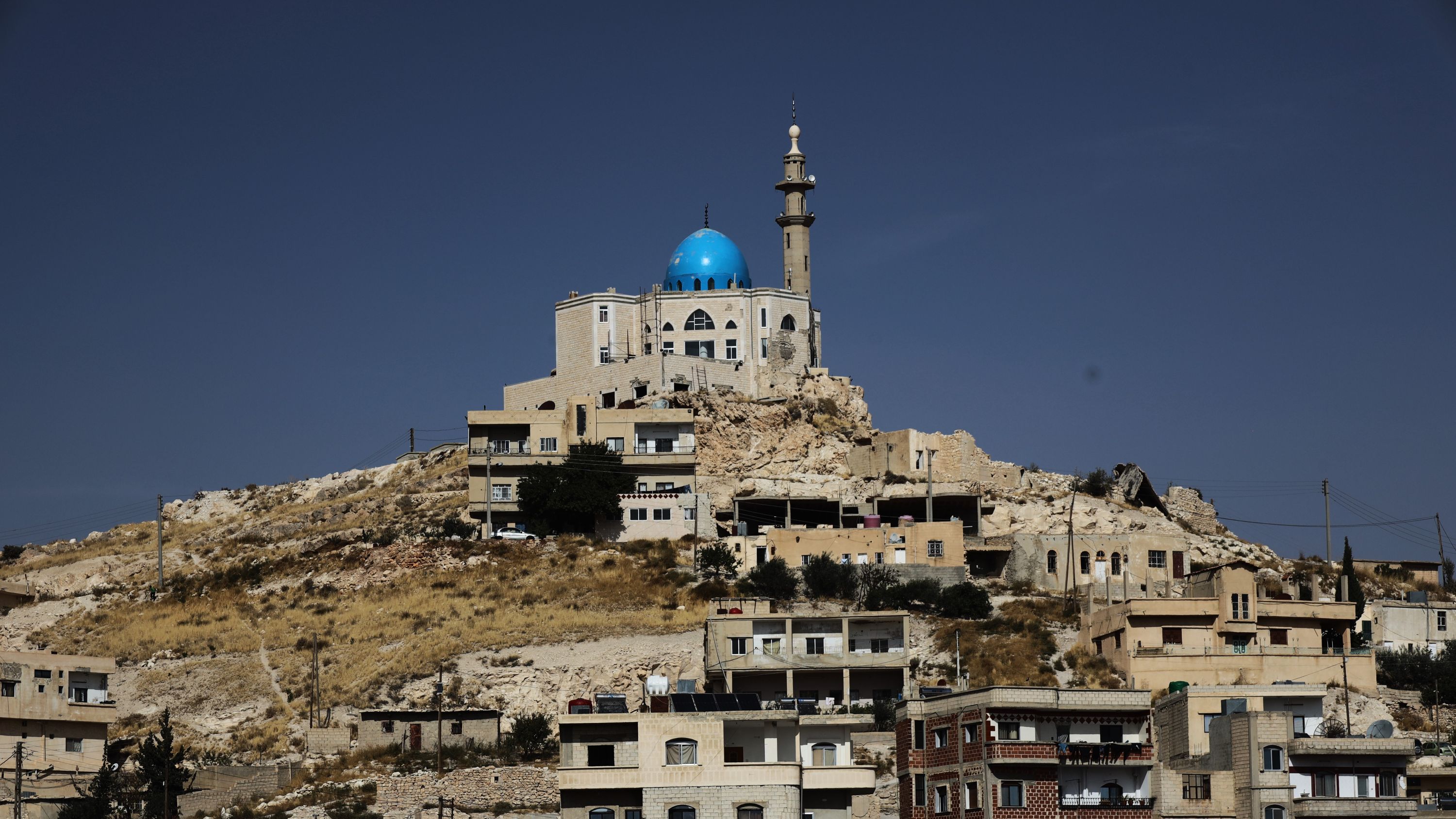
Driving north from Damascus, I made my way toward the Lebanese border, through barren apple and cherry orchards, up into the Qalamoun mountains. As the town of Rankous came into view, 33-year old Abu Jad, a former member of the Free Syrian Army (FSA) who fought against former ruler Bashar al-Assad, was waiting for me on the main street. He waved at me from the darkened window of his SUV and greeted me with a grim smile. “Welcome to Rankous, the capital of the revolution in Qalamoun,” he said. Early in the morning of 22 October, the town’s habitual calm was shattered when Syrian security forces stormed homes and shops, rounding up 45 people and killing five. According to the Ministry of Interior, the victims had links to the Islamic State (IS), held “extremist ideas,” and had “declared the Syrian state as infidel”. New MEE newsletter: Jerusalem Dispatch Sign up to get the latest insights and analysis on Israel-Palestine, alongside Turkey Unpacked and other MEE newsletters Three of the victims were unarmed at the time, while two opened fire on the security forces, killing two of its members, according to residents. For three consecutive days, hundreds of residents and visitors converged on the town square, where a collective wedding was supposed to be held in less than two weeks’ time. Instead of celebrating life, they were left mourning their sons who had lost their childhood to the war, only to be killed after it finally came to an end. For the people of Rankous, the latest bloodshed has deepened a sense of loss and injustice in a town that gave hundreds of lives to the revolution. Many feel that their community has been left on the margins of the post-Assad order, with little representation in state institutions or support to rebuild. As Syria approaches the second anniversary of Assad’s fall, grievances are quietly growing among many war-scarred communities across the country, with groups like IS poised to exploit them. Descending from his car, Abu Jad extended his left hand to give me a firm handshake, while holding the other tightly against his chest. In 2014, he lost the use of his right arm from a bullet wound. Today, he serves as the media spokesperson for Firas al-Bitar, who founded the FSA-affiliated Sham Liberation Brigade after defecting from the Syrian army in 2012. Residents on Rankous line up in the town square at a funeral for the five men killed by the security forces (Ammar Stifi) A native of Rankous, Bitar rallied hundreds of men from the town to fight against the Syrian regime, leading to its withdrawal in late 2012. In 2014, he and his men fought tooth and nail once again, this time against the Lebanese group Hezbollah, who entered Syria to defend Assad's administration. Overwhelmed by the militia’s firepower, his troops withdrew from the town and were transported to the rebel stronghold of Idlib on the regime’s notorious green buses. But on 8 December 2024, Bitar and his men made a triumphant return to Rankous, cruising in on trucks from northern Syria as Assad’s army crumbled before them. They rode on euphoria for months, until they found themselves sitting at home utterly destitute. A historic rival of the rebel faction that took power in December 2024 - the now officially dissolved Hay’at Tahrir al-Sham (HTS) - members of FSA factions found themselves sidelined by the new Syrian army being built. According to some media reports, Feras al-Bitar flagged the young men to the authorities due to their connections to Jamal Zainia (nom de guerre Abu Malik al-Talli), a former HTS member still under international sanctions. Abu Jad denied that the raid was linked to a higher-level dispute between him and Zainia. Zainia has also publicly denied involvement in any sort of disagreement. General security raid I got into Abu Jad’s car and we drove to the house of Ahmad al-Khattib, the father of one of the victims, 21-year-old Youssef al-Khattib. He greeted me respectfully at the door and accompanied me to a modest living room, where a dozen men were seated in silence paying him their respects. At 6 o’clock in the morning, the security forces had burst into Youssef’s home, shoving his wife aside as she opened the door. 'He used to dance at weddings and play taekwondo. Plus, I smoke and my son never once reprimanded me - would someone who belongs to IS have been that way?' - Ahmad al-Khattib “Youssef and two friends were seated in the living room drinking matte together after returning from dawn prayers,” his father told me, relaying his wife’s version of the events, who declined to speak to me. “There was an exchange of fire and all three were killed. “We didn’t expect those who carried out the raid to be General Security; we thought they were from Hezbollah perhaps, which explains why my son must have resisted the raid,” Ahmad told me, adding that his home had been occupied by Hezbollah during the war. “He used to dance at weddings and play taekwondo. Plus, I smoke and my son never once reprimanded me - would someone who belongs to IS have been that way? The five boys, my son included, merely had faith in God, nothing more.” Prior to the fall of the Assad regime, Youssef had been providing intelligence to the rebel factions in Idlib. “He was communicating with and supporting Hay’at Tahrir al-Sham from behind the front lines; I didn’t even know until he took up arms the day of the liberation, which gave me great happiness,” his father said, a smile spreading on his face. “However, he only received limited compensation from the state.” Youssef’s younger brother Majd was also an informant for Hay’at Tahrir al-Sham. In 2020, Assad forces raided his home, killing six of his friends and injuring him in his back. “I didn’t feel anything when I was injured because Youssef was by my side; he would carry me around the house,” he told me. “My accident pushed him to also become an informant.” Ahmad al-Khattib stands in the cemetery where his son Youssef is buried (Ammar Stifi) When Assad fell in December 2024, Youssef joined the new Syrian army, but he only lasted a few months because he was deployed to another province and the salary was low. Another knock came at the door, and the men stood to greet Muhammad Suleiman, father of 25-year-old Majd Suleiman, and Muhammad Faraoun, father of 22-year-old Ahmad Faraoun. Majd Suleiman was killed that fateful morning at the small supermarket where he worked in a shootout with the security forces. “He was with the revolution from the age of 10, when he would attend protests with his friends,” his father recalled. Majd spent much of the war hiding at home, as he was wanted by the government for mandatory military service. 'We want justice for the blood of our sons, we want to see those responsible held accountable in court. We joined the revolution to live in freedom and dignity' - Muhammad Faraoun However, Majd, like many other young men of Rankous, was not accepted into the army, citing a lack of available positions. “He wasn’t accepted into the army so, unemployed, he committed himself to [going to] the mosque," he said. His father says he had a good reputation, with no criminal record, and practised taekwondo in his free time. In mid-November, he was supposed to have his wedding, alongside several other young couples. “The wedding was supposed to be in the same square where the funeral is now taking place,” his father said, eyes hollow with grief. “We ask for the spies and informants to be exposed. There are informants now like there were at the time of the regime - nothing has changed, only the accusations,” he added, his voice wavering with anger. The Assad regime maintained a staggering network of informants, who provided real or fabricated intelligence on their coworkers, friends, and even family members. “We want the truth to be revealed and the identities of the informants who are creating social divides to be exposed,” Muhammad echoed. “Our hearts are with the government, but those who wrote security reports [on our sons] and acted on unreliable information are at fault,” chimed in Muhammad Faraoun, father of 22-year old Ahmad Faraoun, a fifth-year student studying information technology. “We want justice for the blood of our sons, we want to see those responsible held accountable in court. We joined the revolution to live in freedom and dignity." Tipping point Ahmad offered to accompany me to the town cemetery, where his son has been laid to rest. We drove to the top of a hill, where hundreds of graves overlook a valley surrounded by the Qalamoun mountains. His grave was unmarked, the brown earth upturned and the tombstone not yet engraved. He pointed to graves further afield belonging to “the martyrs of the revolution,” he said. He looked stoic, with deep wrinkles etched into his sun-tanned face, his grief all too familiar to the residents of Rankous. Over 600 people of the town were killed under the siege or detained by the regime, with some 60 men disappearing into the depths of Saydnaya prison, a 15-minute drive away. He pointed to a blue-domed mosque, which overlooks the cemetery from the top of another hill. “It was converted into a regime military base during the war and was rebuilt by our sons when the war ended,” he told me. He said the new government has not done anything to rebuild the town or provide basic services, with a trace of reproach in his voice. Why is Syria considering joining the Saudi-Turkey-Pakistan defence pact? Read More » I bid Ahmad farewell and made my way to the town square where dozens of mourners had started to gather. Chairs lined both sides of the street leading up to the funeral tent, where pictures of the "martyrs" had been strung up and the Qur'an was playing on loop. I then encountered Nihad al-Shahin, head of the local development committee. The committee was formed in early 2025 to carry out basic repairs using donations from local residents amid the paralysis of the state, which lacks resources to rebuild the country on the massive scale that is needed. The World Bank estimates that $216bn is required for reconstruction. “We are from the revolution, but the state has provided nothing in return,” Abu Jad said. “We have footed the bill for basic services and reconstruction, from street lighting and roads to schools and mosques.” Frustration had been building since the fall of Assad, but the latest events constituted a tipping point. “The outcome of what happened at the hands of the internal security forces has left a deep wound in one of the most prominent incubators of the revolution in the Qalamoun region,” al-Shahin told me. “Those who lived through 14 years of war naturally seek peace and stability, and this is a sentiment shared by all our people in Rankous.” Al-Shahin demanded that the authorities undertake an investigation and present evidence to residents that the young men were in fact linked to the Islamic State. But he says that even if the evidence is legitimate, a raid of such a magnitude was unjustified. “The raid was flawed in the manner it was conducted - it never warranted this level of violence,” he said, indignance flickering across his face. “There are numerous ways to resolve such issues and prevent bloodshed among our people.” In former rebel strongholds like Rankous, the recent events have reopened old wounds and triggered memories of the former regime. “There remains an inherited security mindset that requires review and must be rebuilt anew,” al-Shahin added.
A deadly raid tests a revolutionary town’s faith in Syria's new government
Full Article
Original Source
Read the full article at Middleeasteye →KhanList aggregates and links to publicly available news content. We do not host full articles from third-party sources. Always verify important information with original sources.