
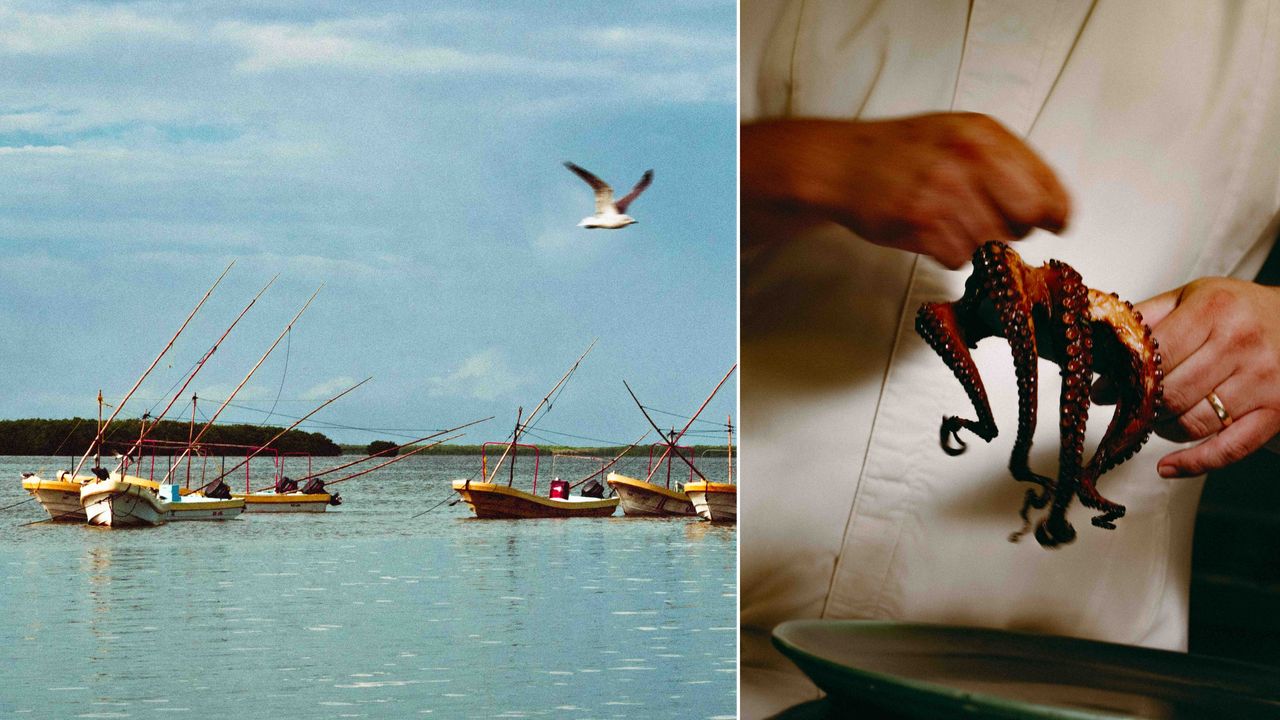
Along the coast of one of Mexico's most popular vacation destinations, writer Megan Spurrell traces the source of her seafood.Maroma, A Belmond Hotel, Riviera MayaThe turquoise, bathtub-warm water of the Yucatán is extra sudsy today. Our little skiff, known around here as an alijo, is bobbing like a toy as our captain gently tugs on a few lines descending into the water. “Paciencia,” he repeats, reaching for the next line, before a knowing draw confirms, still, no octopus.We’re just a 20-minute boat ride from the sleepy town of Rio Lagartos, aboard the Yahilin, captained by 55-year-old Limberth Orlando Alcocer Diaz, who has been fishing since the age of eight. His parents were fishermen too; these waters provide supple mero, a white fish loved for ceviche, and juicy shrimp that Alcocer Diaz promises is some of the tastiest you’ll find in the region. But there is another catch unique to this coastline, and the reason I'm here today: the octopus maya.The writer and local chefs join fisherman Limberth Orlando Alcocer Diaz aboard the Yahilin Maroma, A Belmond Hotel, Riviera MayaA grilled octopus maya is prepared at Maroma, a Belmond Hotel, in Riviera Maya Maroma, A Belmond Hotel, Riviera Maya“The octopus maya is a bit smaller than the kind you get from the Mediterranean—it looks beautiful on the plate,” says chef Cesar A. Landeo, who has joined me and Alcocer Diaz on board Yahilin. A bucket of bait crabs wiggle between us. Landeo is currently the executive chef at the luxury Maroma, a Belmond Hotel, located about three hours from Rio Lagartos by car and where I'm staying—the night prior, I'd enjoyed a wood-grilled octopus, sourced from these very waters. Another chef, Karla Encisco, who has worked for various Cancún hotels over the years and now acts as a hospitality consultant, is on the other side of me, sharing tips for cooking octopus in a dry-pot method that uses only the seawater released by the animal for steaming. We're all here with the same shared interest: to trace the seafood I was enjoying at Maroma to its source, and gain a better understanding of the divisive choice to eat them at all.This part of Mexico has earned a reputation for its sustainable approach to octopus fishing—and to understand why, you need to set sail with someone like Alcocer Diaz. He is one of several hundred fishermen who use a unique artisanal method built off of just two long pieces of bamboo (known as “jimbas”), a few cords, and a live crab and maybe some lobster as bait. Some records show this style of fishing has existed for hundreds of years among the Maya, but it has been employed commercially for the last five or six decades. And it is built entirely around an understanding of the animal we’re searching for.Live bait crabs are used to catch octopus using an artisanal fishing method unique to the Yucatán. Maroma, A Belmond Hotel, Riviera MayaKnown colloquially as both the four-eyed octopus, the petite octopus maya is recognizable by divers and fishermen for its “false eyes” that sit below the real ones. A coral red in color—at least, when it isn’t camouflaging—it also lives a pointed existence of roughly one year. As Alcocer Diaz explains, once females have laid their eggs in a cave, they will guard them diligently from predators, abandoning their need for food until, finally, once the eggs hatch, the mothers literally drop dead, famished and withered.Alcocer Diaz mimics a thin, spindly tentacle with a finger to describe the ones he’s seen. “Not even scavengers will eat what’s left of them,” he says while threading his bait. It’s not much better for the males, who may mate several times during a season before their own demise, expiring after they’ve completed a summer of procreation. Octopus fishing here is only allowed from August 1 to December 15, and not a day later, to catch the cephalopods at the sweet spot of their lifespan, with enough time to repopulate.It's also why the jimba method is key to the process: By tying a crab or a lobster’s torso to a line and launching it overboard, letting it dangle from the bamboo, only males will take the bait they encounter on the sea floor while the females remain on their starvation-inducing egg-watch. The males willingly wrap themselves around the shellfish, just as they would to feed normally, and when fishermen check a line and notice a pound or two of extra weight attached—“it just feels different,” Alcocer Diaz tells me in Spanish—they reel them in.Two long bamboo poles, a few fishing lines, and live bait are the backbone of this method Maroma, A Belmond Hotel, Riviera MayaAn octopus maya, smaller than its Mediterranean or Pacific counterpart Claudia Novelo, Environmental Defense Fund“They are really intelligent,” says Alcocer Diaz with a sense of awe, mimicking how the octopuses he catch will simply walk off his fiberglass boat and back into the water if he doesn’t act quickly. His method is swift: a spike between the eyes for a sudden brain death, a method more recently popularized under the ethical Japanese process of ikejime.The animal’s intellect is, of course, why some diners will turn down the chance to eat a perfectly grilled pulpo. It’s also the reason that Encisco, who is often tasked with preparing these eight-armed creatures, still can’t watch the documentary My Octopus Friend. Lando admits his wife raised the same concern when he left early this morning for our excursion. (“‘Fishing octopus?’ she said to me, ‘But aren’t they so smart?’”). Alcocer Diaz considers it as a fact in the cycle of life. Everything he does, from gassing up his boat to choosing which seafood to fish based on the weather or season, comes from an understanding of his place on the food chain: “I just want to feed my family,” he says. I'm hoping that, by the end of our expedition, I'll have an answer of my own.Pelicans and seagulls watch passing fishing boats outside the town of Rio Lagartos, Mexico. Maroma, A Belmond Hotel, Riviera MayaAs pelicans circle our boat, used to seeing scraps of fish tossed off the side of the ajilos, I prod Alcocer Diaz for a greater mission, or calling, driving his choice to use this artisanal method, and his commitment to respecting the rules of the “veda,” the months when octopus fishing is banned in the region so that the population can regenerate for the next season. He talks about sustainability as crucial to maintaining his livelihood. Later, over a lunch of octopus ceviche at a portside restaurant in town, Alcocer Diaz's friend Wabi Martin Tabasco Marfil—another fisherman in the same co-op—breaks down the logic further for me: “If we fish everything today, what will be left tomorrow? If we take all the little fish, how will the big fish survive—and then, how will we get the big fish?” It's a needs-based understanding of sustainability.Reinforcing this commitment among local fishermen is an ongoing effort—both on the part of the fishing cooperatives organized by workers in every single port, all the way up to the chefs who purchase their seafood to put on a menu, and, finally, the consumers who order it. This is how Pesca Con Futuro (Fishing for the Future), an organization connecting chefs with sustainable fishing collectives throughout Mexico, came to fruition. “In almost all cases, consumption shapes how food is produced,” says Citlali Gomez Lepe, the biologist who founded Pesca Con Futuro eight years ago. Today, the group helps chefs restaurants and hotels source shrimp from the Gulf of Mexico, red lobster from Baja California, and rainbow trout from Michoacan, to name just a few products, with over 60 fisheries involved.“If consumers of fish and seafood in Mexico show a preference for [artisanal and sustainably sourced] products—and if the market transmits that signal all the way along the value chain to the fishers themselves—then those fishers who operate according to best sustainability practices will find allies at the end of the chain,” says Gomez Lepe. Both Encisco and Landeo source seafood via Pesca Con Futuro for the hotels they work with, as do familiar culinary names like Gabriela Camara and Javier Plasencia, among many dozens of other Mexican chefs who act as ambassadors.Chef Cesar A. Landeo plates grilled octopus at Maroma, a Belmond Hotel Maroma, A Belmond Hotel, Riviera MayaFisherman Wabi Martin Tabasco Marfil fishes for octopus maya Maroma, A Belmond Hotel, Riviera Maya“We realized chefs have a huge voice in what lands on the table,” Enciso says, when I ask why she got involved with Pesca Con Futuro. “For those of us who work in hotels, we can educate the people who come into their restaurants.”On the Riviera Maya, where the scenic coastline is home to a smattering of hotels from 1,800-key all-inclusives to luxury brands like Belmond and local boutiques, the sheer number of diners here presents a challenge—or an opportunity for sustainability, depending on how you look at it. Enciso is an optimist about the power we each hold when we sit down for our lobster dinner on vacation—whether that's choosing to eat only in-season seafood, or asking where your crustacean was sourced. “There’s a phrase I love,” Enciso says. “Little people in little small places doing little things can change the world.”A day on the water requires more patience than I’d expected. After two hours of lurching on the waves, and hopelessly tugging lines that lead Alcocer Diaz to shake his head in the negative, we decide to return back to shore. “On a good day, you can get 50 kilos of octopus,” says Alcocer Diaz—that's about 25 octopuses. But last season was fantastic, he says. “Some days we got 70-80 kilos.” Today, the weather was against us, with an approaching storm muddying the waters and making it difficult for our eight-armed friends to see the bait. Despite our best efforts, the only octopus we will see today is on our plates.Back on land, we sit for lunch at El Perico Marinero and order the famous pulpo rojo, all of which has been purchased from the local fishing co-op. I have no complaints when it lands on the table. A special ceviche distinct to this part of the Yucatán, it features octopus that has been sliced, battered, and fried into crispy pieces before being tossed in lime juice with chopped onions and sliced jalapeños. Every tentacle is a crunchy delight. Circling us like the morning's pelicans are plates weighed down with more octopus prepared in other ways: sautéed in garlic and butter, or cooked in a tomato-rich sofrito “a la Mexicana.”Hotels that work with programs like Pesca Con Futuro can offer local, sustainably sourced seafood to guests—an answer to diners who are increasingly interested in knowing where their seafood comes from. Maroma, A Belmond Hotel, Riviera MayaThat said, dining on sustainable seafood here still isn't a given. As we pass plates of battered shrimp and sliced habanero swimming in lime, the fishermen commiserate over a growing number of hurdles. The demand for local sea cucumbers, which get exported to China, is too high to sustain; there is also an ongoing battle between artisanal fishermen and those who use shortsighted methods to turn a quick buck. Limberth speaks of divers from a neighboring state who hit the water late at night to fish during the seasonal bans Limberth vouches that, while diving just offshore, he has seen an increasing number of bleached rock caves underwater—usually the result of freediving fishermen, who squirt the chemical into an octopus hideout to send them fleeing for an easy catch. I can’t help but think of the octopus eggs left behind.The impact of climate change also remains an ongoing issue. “When the water is warm enough to dive without a wetsuit, I know I won’t see octopuses the rest of the season. They go deeper. Way deeper,” Limberth says, pointing further out toward the continental shelf. Even then, studies have shown that the octopus maya is vulnerable to high water temperatures, dying once they hit 80 degrees.As we watch the water lap against boats beside the boardwalk, I begin to understand why many of our conversations keep ending on the words “círculo de la vida”—the circle of life. The fishermen respect the vulnerabilities in an octopus's lifecycle; and yet, they must continue to fish, and protect their future ability to fish, so that they can sustain their families. After a day out at sea with Alcocer Diaz, I still can’t answer the existential quandary of whether or not to eat octopus, but I can appreciate how considered the creature is in their fishing method. On the flip side, I feel guilty for a months-prior omakase dinner in New York City that featured creamy octopus eggs, not understanding how precious they are.Alcocer Diaz, meanwhile, is preoccupied that our fishing efforts were unsuccessful. So much so, that he motorbikes off at the end of lunch, returning with some achiote-rich rechado (a chili paste for cooking, and regional specialty) as a parting gift.An ajilo (skiff) boat sets off on the water Maroma, A Belmond Hotel, Riviera MayaA dock in the town of Rio Lagartos Maroma, A Belmond Hotel, Riviera MayaA couple of days later, I sit with Landeo on the restaurant terrace of Maroma. The menu before me has a blue icon beside various dishes to indicate that the key ingredient has been sourced via Pesca Con Futuro—the chef hopes that, soon, all of his seafood will come through the collective.“When I started working here on the Riviera Maya, I thought it was going to be like Disneyland in terms of ingredients,” Landeo says. “But there have been real challenges. The majority of hotels here are all-inclusive, so the product they use is different than what we offer.” He hopes that Pesca Con Futuro can continue to get the buy-in from chefs and hotels that it needs to expand even further—and that all begins with diners. “For me, Pesca Con Futuro just makes sense.”We look out at the sloshing sea, struck by the stories the fisherman told us.“I also want my son to find a world better than the one I got,” he says. “And it's why I want to work responsibly.”Maybe we aren’t so different from the octopuses, diligently guarding their offspring. It's all a bet on the future.Megan Spurrell is the Senior Features Editor at Condé Nast Traveler, where she writes and edits travel features on trends, emerging destinations, and experiences worth traveling for—from free-diving in Hawaii, to trekking through archaeological sites in Peru's cloud forest, to salsa-ing through Mexico's oldest dance halls. Originally from Los Angeles, ... Read More
A Day at Sea With the Octopus Fisherman of the Yucatán
Full Article
Original Source
Read the full article at Cntraveler →KhanList aggregates and links to publicly available news content. We do not host full articles from third-party sources. Always verify important information with original sources.