
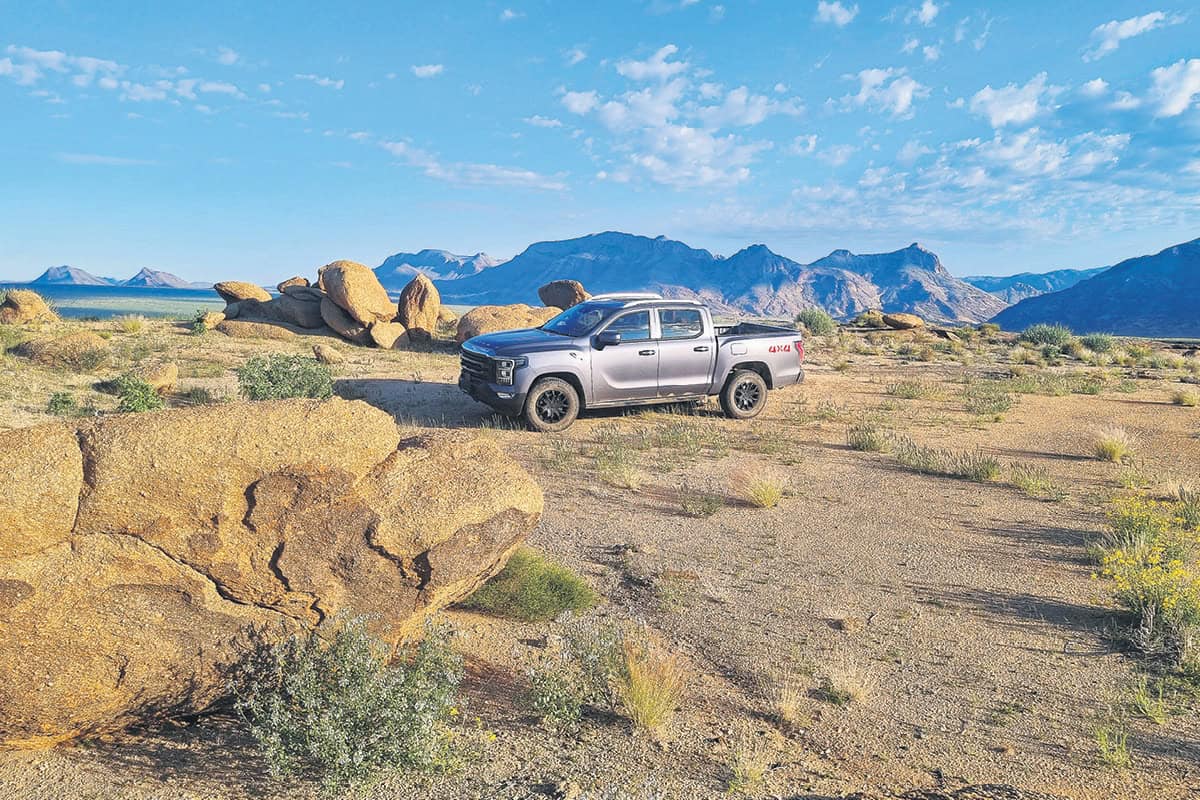
Breathtakingly spectacular big-sky country. If there had to be a South African thesaurus and you were looking for a one-word synonym for the concept “back of beyond”, that word would probably be Pofadder. Actually, you could pick just about any place name in that part of the Northern Cape known as Bushmanland. It is a region so remote and geographically inhospitable it was chosen in decades gone by as a nuclear waste disposal site. Yet not far away is the lush “Green Kalahari”, fed by the Orange River. The main tourist attraction in the area is the Augrabies Falls, but visitors are equally drawn to vineyards that line the river from Keimoes to Kakamas. Few people are aware that the area is also home to the biggest date farm in the southern hemisphere, Klein Pella, which spans nearly 20 000 hectares. While only a fraction of this is given over to date-farming, about 14 000 trees are cultivated for their fruit. For those who have not been keeping up with their botany, date palms are dioecious, which means there are both male and female trees. Picture: Jim Freeman/Supplied Only female trees produce fruit. Males are required to supply them with pollen. Dates are naturally wind-pollinated but, in modern commercial orchards, they are manually pollinated by labourers on ladders or by wind machines. Most of the workers come from nearby Pella, a sprawling settlement whose main claim to fame is the cathedral that dominates its central square. Pella is, in fact, an oasis fed by a spring that was discovered by the San people, and their presence continued to be felt (not always welcomingly) after the arrival of the first Dutch-speaking Europeans in 1776. The place assumed its still-pervasive religious character when a mission station was established in 1814. It was renamed after a town in Macedonia to which early Christians fled to escape persecution by the Romans. The station got off to a rocky start – heat, loneliness, marauding San and other tribesmen, drought and deprivation tested the faith of most of the missionaries and found them wanting – and this lasted until the arrival of 23-year-old Father John Marie Simon from France in 1882. He was joined by Brother Leo Wolf, and together they served the Pella community for over half a century. According to Father (later Bishop) Simon’s biography, the two decided to build a church. However, without funds, they could not employ an architect and had to do the work themselves. Without plans or experience, they consulted an old encyclopaedia (published more than 100 years before), constantly referring to a chapter on bricklaying. Learning as they went and with minimal assistance, it took seven years before the Immaculate Conception Cathedral was consecrated in August 1895. Bishop Simon and Father Wolf are buried in the church. Today, Pella is home to about 2 500 people and can be accessed from the N14 that links Springbok and Keimoes. There are few tourism facilities other than a farm-style guesthouse and campsite on Klein Pella farm. The latter is popular among off-road adventurers because of its proximity to the Great Pella Mountains. These are known colloquially as the “Mountains of Mars” because of their desolation and, in many places, red-coloured rock formations. I was in Pella with two colleagues to do some serious 4×4 driving. Because we did not feel like pitching tents, we booked into a guesthouse in Pofadder, 53km away. Picture: Jim Freeman/Supplied While there is little in Pofadder to recommend to any tourist, I would not hesitate to revisit 7de Laan Guest House and Overnight Chalets, a self-catering establishment whose billets were clean, well-equipped and comfortable. Set back from the street, it seemed to be home away from home for travelling reps and contractors to the mines in the area. After a convivial braai with neighbours and an early night’s sleep (we had adjoining chalets, each of which could sleep a couple), we set out before dawn to explore the mountains and backroads in a very capable Foton double-cab bakkie. The route we would be covering forms part of the Namakwa 4×4 Eco Trail that runs from Pella to Alexander Bay on the West Coast. One of our group knew the area well; a boon, since the expanse we had to cover was vast and too challenging to traverse at speed. Also, time tends to run away when you’re frequently stopping to take pictures of rock formations, views and weird flora (wildlife is sparse because soil alkalinity allows for little grazing). You do not want to be caught out in that Martian landscape when darkness falls. The scenery was stupendous. This is big-sky country taken to the next level. Yes, it’s an arid world without a trace of softness, but every life form has adapted to wring the most out of every drop of moisture. Warning: You don’t want to be doing this at the height of summer when daytime temperatures routinely exceed 40°C. Picture: Jim Freeman/Supplied
A date in the desert
Full Article
Original Source
Read the full article at Citizen →KhanList aggregates and links to publicly available news content. We do not host full articles from third-party sources. Always verify important information with original sources.