
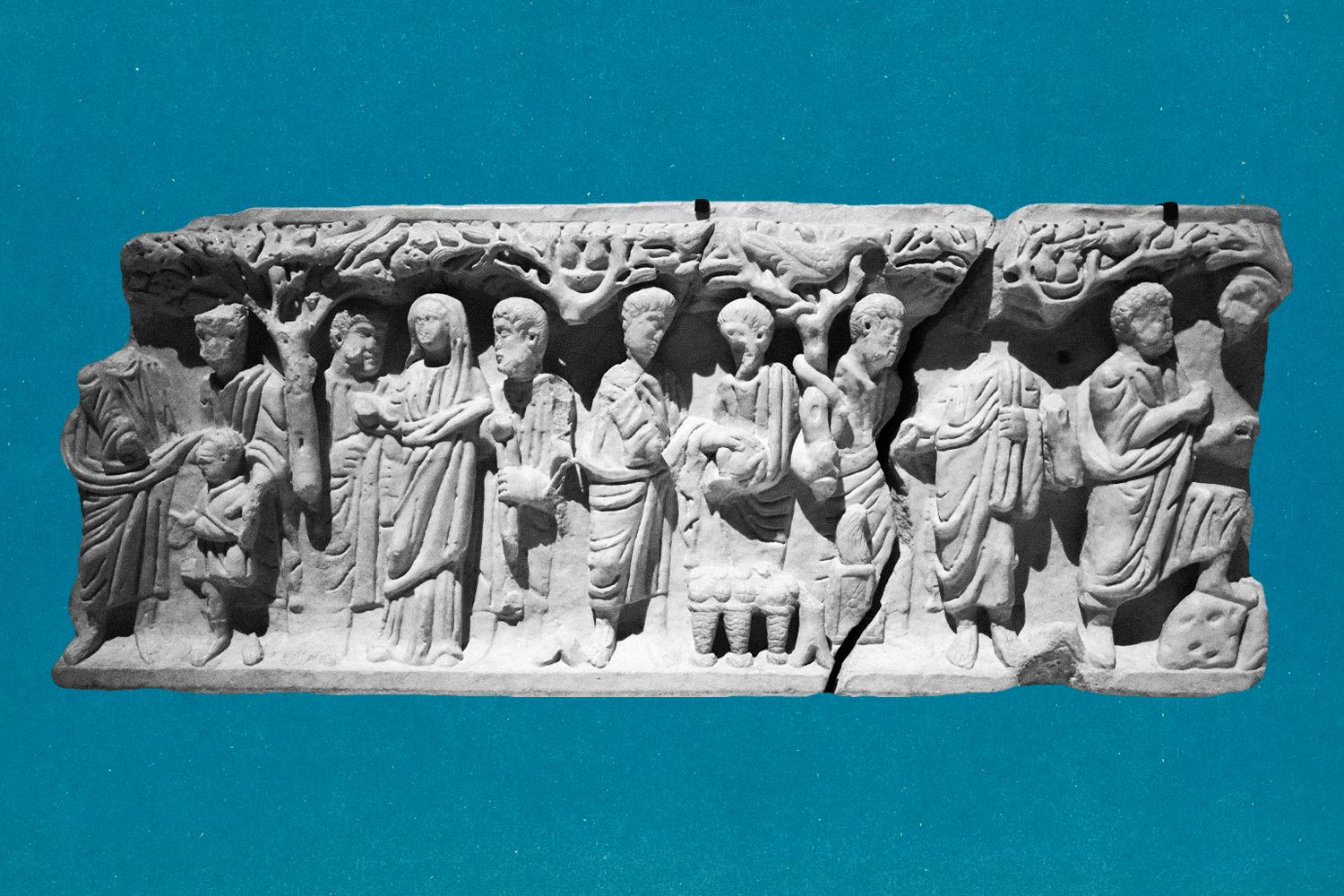
Augustus was seen as a descendant of the gods who would go on to redefine authority. New research posits that his rule paved the way for Jesus This relief on a fourth-century sarcophagus from Gaul depicts scenes from the Bible, including the famous miracle of Christ multiplying the loaves (center). Public Domain How did the scattered followers of an itinerant preacher come to form the most populous religion in the world? Tim Whitmarsh—a classicist at the University of Cambridge and author of magisterial books about empire, the early novel and more—offers a compelling answer in his new book, Rome’s Age of Revolution: Augustus, Empire and the Making of Christianity. To wit, Christianity took much of its shape from the cult of Augustus, first emperor of Rome. The Augustan age saw a unique revolution that redefined authority, space and literature, remaking both the inner world and the outer. Augustus drew on centuries-old Roman prophecies to cast himself as the promised one. According to his propaganda, Italy experienced auguries and miracles at Augustus’ nativity; Augustus was declared a descendant of Rome’s mythical founder, Aeneas, and therefore of the gods, and he promised to renew Roman liberty from the decadence of the late Republic. As Whitmarsh writes: “The new world was presented as the fulfillment of all the best ideals of the old.” Just so, Jesus’s birth was claimed as the fulfillment of Old Testament prophecies about a coming emissary of God on Earth, and this novel form of monotheism was simultaneously cast as the fruition of the Hebrew faith. Whitmarsh goes further, arguing: “What we call messianism is a symbolic byproduct of the concentration of absolute power over vast territories and multiple populations in the hands of one individual or family.” Jesus, then, is “the divine doppelgänger of the most powerful human authority imaginable,” i.e., Augustus, and Christianity came to operate “as a strange doppelgänger of the Roman imperial system.” Just as unitary empire helped prepare people for the concept of a unitary god, Augustan infrastructure—including an empire-spanning network of roads—literally paved the way for the transmission of stories about Jesus and his followers. Letters and trade flourished, and religions, which had long been deeply tied to location, could become universal. Whitmarsh has a keen eye for the religio-cultural give-and-take between Judea and Rome: “The Christian idea of a savior king ... is partially shaped by the prior model of Augustus as a world savior. But that model was itself partially indebted to Jewish messianic traditions.” Causality, after all, is a subtle thing, and Whitmarsh avoids oversimplifications. He invokes a cultural dynamic that he calls a “swirl,” which gets kicked up by political or technological revolution—but also precedes the revolution. It can be a hazy concept. But with Whitmarsh’s sharp and often inspired readings of history and literature, it offers an imprecise but necessary honesty. Thou shalt not bear false witness, indeed. Did you know? Did Virgil foretell the birth of Christ? Augustus relied on poets like Virgil, the famed bard of the early Roman Empire, to popularize his reign. Virgil’s eclogues, a series of 10 pastoral poems, describe a savior child born to a virgin mother. The poem is dated to 40 B.C.E. and has been interpreted by some as a prophecy of Christ. Virgil wrote that the Earth would celebrate the savior’s birth with miracles: Snakes would die, and goats would no longer fear lions. The poem’s vision is referred to as the Cumaean Prophecy—and itself may have been inspired by earlier sources, possibly the eastern cult of Mithras, or from the book of Isaiah. A Note to our Readers Smithsonian magazine participates in affiliate link advertising programs. If you purchase an item through these links, we receive a commission. You Might Also Like Get the latest Travel & Culture stories in your inbox. More about: Ancient Rome Book Reviews Books Christianity Cults Religion Religious History Roman Empire
A Cult Grew Around the First Emperor of Rome in 27 B.C. A New Book Argues His Followers Might Have Created the Template for Christianity
Full Article
Original Source
Read the full article at Smithsonianmag →KhanList aggregates and links to publicly available news content. We do not host full articles from third-party sources. Always verify important information with original sources.