
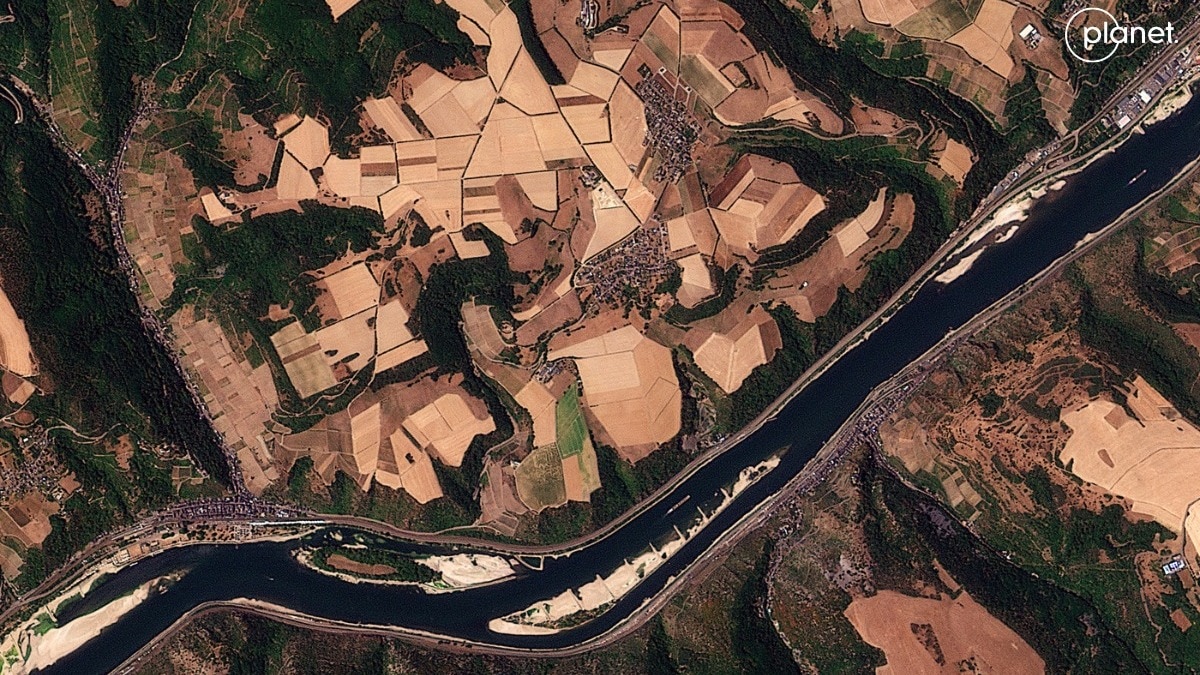
Europe has long sold itself on cool summers, green parks and riverside escapes. But across ten locations, satellite images are capturing a very different Europe - lawns turning brown, rivers pulling back, and exposed riverbeds cutting through some of the continent’s most familiar landscapes.From the Loire, Rhine, Po and Danube to London, Vienna and the fields around Stonehenge, the signs of water stress are visible from space. Using imagery provided by Planet Labs PBC, India Today’s Open Source Intelligence (OSINT) team traces the footprint of Europe’s 2026 drought.Kensington Gardens, London: Large lawns that were predominantly green in 2024 are covered by extensive straw-brown patches by July 2026, although the Round Pond and Long Water remain visible. The Environment Agency has earlier declared large parts of England, including London, in drought. "Kensington Gardens, London. Satellite photo: Planet Labs PBC" Danube River, Hungary: Between August 2025 and 2026, pale sandbanks become substantially more exposed, while neighbouring farmland appears markedly drier. ESA said the Danube had fallen to a “record low in Hungary due to a severe drought in central Europe.” "Danube River, Hungary. Satellite photo: Planet Labs PBC" Rhine River, Germany: By late July, gravel bars are clearly visible inside the channel and the surrounding landscape is much browner than it was in May. Official Rhine monitoring recorded a “nine-day low-flow episode at Kaub” in July. "Rhine River, Germany. Satellite photo: Planet Labs PBC" Garonne River, France: Around Moissac, fields that appear deep green in May are predominantly tan by August. Harvesting is also likely to account for part of that seasonal change. Tarn-et-Garonne authorities imposed “drought-related water restrictions from August 1” as local water systems came under pressure. "Garonne River, France. Satellite photo: Planet Labs PBC" Auer-Welsbach-Park, Vienna: Large stretches of lawn turn from green to brown within a year, even as many mature tree canopies remain green. GeoSphere Austria warned that “prolonged, extreme drought” was continuing, with national rainfall around 30% below normal by late July. "Auer-Welsbach-Park, Vienna. Satellite photo: Planet Labs PBC" Prahovo, Serbia: A Second World War shipwreck sits exposed beside pale sediment in the Danube - a striking marker of how far the water has retreated. Serbia’s official hydrological service recorded the Prahovo gauge at -126 cm on August 10, falling further to -133 cm by August 13. "Prahovo, Serbia. Satellite photo: Planet Labs PBC" Po River, Italy: Across successive August images, sandbars near Boretto become increasingly prominent as water occupies less of the broad channel. The Po River Basin Authority classified Boretto under “severe drought”, with flows significantly below the 1991-2020 average. "Po River, Italy. Satellite photo: Planet Labs PBC" Loire River, Saumur: Between 2023 and 2026, the Loire becomes visibly more fragmented, with broad sand and gravel bars emerging between narrower channels of water. Copernicus, cited by an EU Space Policy paper, said August imagery showed “exceptionally low water levels”, leaving normally submerged bars exposed. "Loire River, France. Satellite photo: Planet Labs PBC" Stonehenge, UK: The agricultural landscape surrounding Stonehenge changes from a patchwork of green and brown in 2023 to overwhelmingly tan by August 2026. "Stonehenge, UK. Satellite photo: Planet Labs PBC" Reggio Emilia, Italy: Across four summers, agricultural land becomes increasingly dominated by brown and tan parcels, although crop cycles and harvesting remain important factors when interpreting the change. "Reggio Emilia, Italy. Satellite photo: Planet Labs PBC" According to the regional environmental agency, Arpae Emilia-Romagna (ARPAE), “July 2026 was the third hottest since 1961”, with temperatures persistently above normal across the region.Taken together - and matched against official hydrological and meteorological observations - these images capture a broader shift: exceptional heat and mounting water stress are reshaping parts of Europe, on the ground and from space.Please rotate your deviceWe don't support landscape mode yet. Please go back to portrait mode for the best experience
A Continent Running Dry: Europe's Drought Seen From Space
Full Article
Original Source
Read the full article at Indiatoday →KhanList aggregates and links to publicly available news content. We do not host full articles from third-party sources. Always verify important information with original sources.