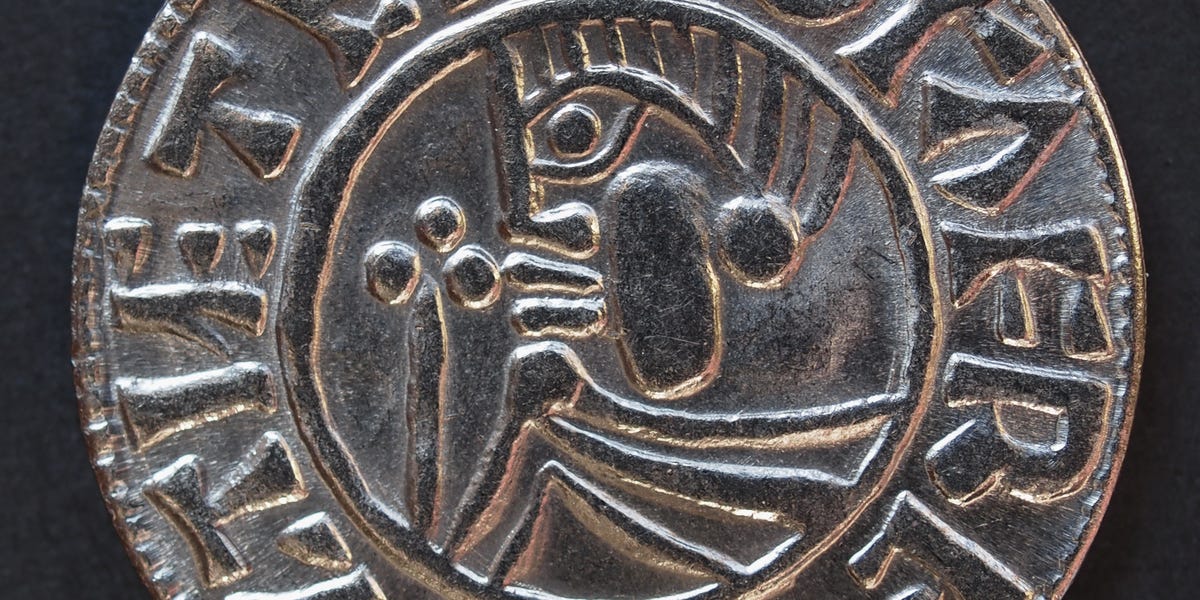
3 min readHere’s what you’ll learn when you read this story:In 1957, an amateur archaeologist and coin collector discovered a silver coin on Maine’s central coast. The coin was considered an old English artifact until 1978, when it was correctly categorized as a Norse penny.How a Viking penny from around 1080 C.E. ended up in Maine hundreds of years before any other European examples remains a mystery. For 17 years, a silver coin discovered in 1957 along the central Maine Coast sat in a private collection of the amateur archaeologist and coin collector who dug it out of the ground. Guy Mellgren thought he’d found an ancient English coin five inches below the surface at Naskeag Point in Brooklin, but when that coin made its way—upon Mellgren’s death in 1974—to the Maine State Museum, the story took a turn.Experts descended upon the find, scientifically analyzing the piece and concluding that what had been dubbed both the Maine penny and the Goddard coin (named after the archaeological site where it was found) was in fact a genuine Viking-age Norse penny from the reign of King Olaf III, which lasted from 1067 to 1093 C.E.Considering that most of the other artifacts pulled from the Goddard site were dated to between 1180 and 1235 C.E., the inclusion of a Viking penny complicates the North American historic record, placing European goods on what would become the United States a solid 400 years prior to the arrival of Christopher Columbus. The small silver Norwegian penny couldn’t be ignored—its history has been proven. Its provenance, however, remains in question.According to the Maine State Museum, Mellgren located the coin during his second year of exploration at the Goddard site. But the amateur didn’t document his find, didn’t mark any discoveries alongside it, and didn’t provide experts with any sort of ability to track the dig. While the avid coin collector and part-time auction house worker mistakenly believed he’d found a piece of English history, the coin was hidden from the public for 17 years. Following his death, the coin made its way to the museum, and a British coin dealer spotted it in an article from the Maine Archaeological Society. He questioned the coin’s English identification, and a leading authority on medieval Norse coinage soon stepped in.Analysis of the coin via neutron activation testing in the 1970s confirmed its Norse history, the museum said. Later chemical analysis showed that the coin was buried in the ground horizontally in a watery deposit in Brooklin for centuries, according to the Bangor Daily News. The Goddard coin represents the only pre-Columbian Norse artifact found within the United States.So, where did it come from? Extensive archaeological investigation of the Goddard site has revealed no evidence for a Norse settlement. Instead, what’s been found is a sizable Native settlement from up to 900 years ago—possibly the largest Native American village in Maine at the time, according to the museum.While there’s no question surrounding the Norse coin’s authenticity, there’s also no corroborating evidence that Norse people were in Maine during the period when it was made. Could the find’s location be a hoax—a genuine coin planted at the site by collectors? And if so, to what end? The Maine State Museum and Smithsonian view it as legitimate, but not everyone agrees. The American Numismatic Society reportedly noted “there is no reliable confirmation on the documentation of the Goddard coin, and much circumstantial evidence suggests that someone was deliberately trying to manipulate or obfuscate the situation. The Norse coin from Maine should probably be considered a hoax.”One (more readily discarded) view is that the Nordic settlers from L’Anse aux Meadows visited the Maine village and left a coin behind. After all, the Goddard site was known as a key trading hub, with goods coming from as far as Pennsylvania, the Great Lakes, and Labrador. The perforations on the coin show it was worn as a necklace and not likely used as payment—which is historically plausible, since the Wabanaki people along Maine’s coast didn’t use silver coins for trade. Experts believe the coin was obtained in Newfoundland near a known Norse settlement, and eventually reached Goddard via trade networks.A 2017 study published in the Journal of the North Atlantic by Norwegian numismatist Svein Gullbekk considered whether the coin was genuine or a hoax. “Accounting for the remarkable and exceptional nature of the find,” Gullbeck wrote, “this article concludes that both the penny and its modern archaeological and numismatic context offer plausible evidence that this find is genuine.”Tim Newcomb is a journalist based in the Pacific Northwest. He covers stadiums, sneakers, gear, infrastructure, and more for a variety of publications, including Popular Mechanics. His favorite interviews have included sit-downs with Roger Federer in Switzerland, Kobe Bryant in Los Angeles, and Tinker Hatfield in Portland.
A Coin Collector Thought He Found an Old English Penny. It May Be the Crux of a Viking Hoax.
Full Article
Original Source
Read the full article at Popularmechanics →KhanList aggregates and links to publicly available news content. We do not host full articles from third-party sources. Always verify important information with original sources.