
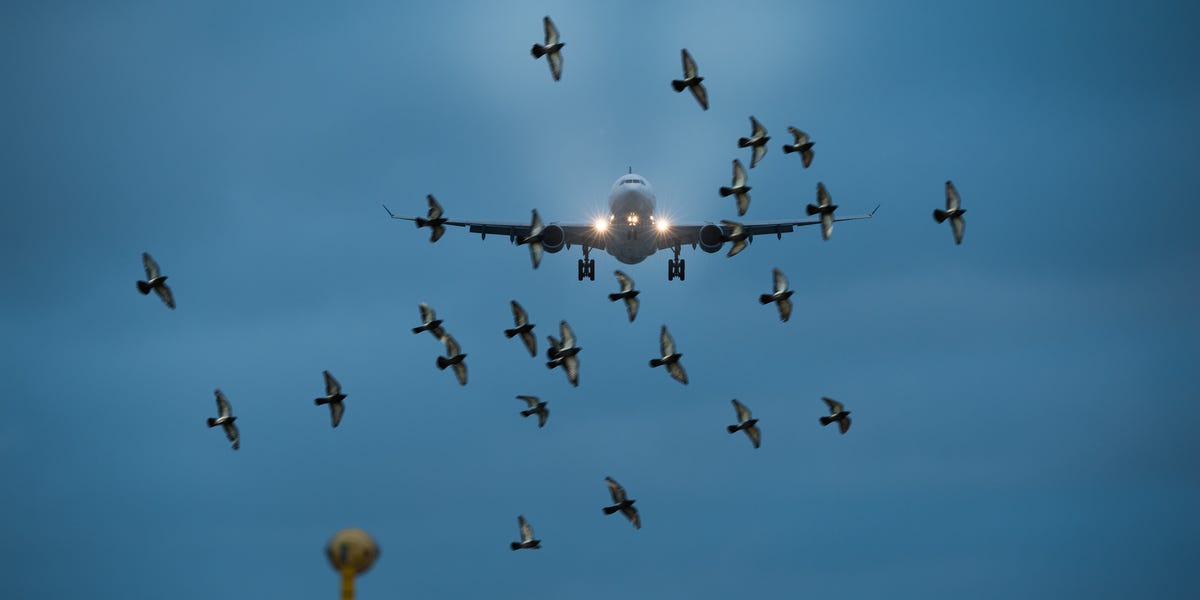
4 min readHere’s what you’ll learn when you read this story:Since World War II, the U.S. and other countries have devised “chicken guns” for testing sensitive aircraft equipment against bird strikes. The Federal Aviation Administration (FAA) estimates that losses from bird strikes can total up to $300 million per year, not to mention the danger for passengers on board planes. One of the most powerful chicken guns, operating at Arnold Air Force Base in Tennessee, can fire poultry at up to 600 miles per hour.As long as there have been airplanes, there have been bird strikes.Less than two years after his historic flight in Kitty Hawk, North Carolina, Orville Wright noted in his journal that his aircraft struck a bird (most likely a red-winged black bird) while flying over a cornfield near Dayton, Ohio. Over a century later, the dangers that birds pose to aviation haven’t abated. In fact, 104 years after Wright’s avian encounter, pilot Chesley Burnett “Sully” Sullenberger III famously landed an Airbus A320 on the Hudson River after the aircraft flew through a flock of Canada geese, several of which were simultaneously ingested by both CFM56 engines. The emergency water landing became known as the “Miracle on the Hudson.”So it’s been very clear since the inception of powered flight that bird strikes are a definite problem, and it’s also been clear that aviation authorities have gone to some pretty extreme lengths to test aircraft safety. In the late 1940s, in one strange example, the National Advisory Committee for Aeronautics (the precursor to NASA) purposefully crashed dozens of old twin-engine cargo planes used for the Berlin Airlift to study how to control and prevent aviation crash fires. But arguably one of the most outlandish-yet-useful ideas is the chicken gun, an entire family of a poultry-based cannons that fire chicken carcasses—in some cases at speeds of up to 700 miles per hour—at a variety of aircraft structures to test their ability to withstand real-life bird strikes.The U.S. Civil Aeronautics Administration, which would later be renamed the Federal Aeronautics Administration (FAA), developed a cannon in Pittsburgh, Pennsylvania, to test bird strikes against safety glass used in aircraft such as the DC-3, the world famous aircraft that brought air travel to the masses. Soon aviation counterparts in the U.K. and Canada developed similar cannons. Arguably the most impressive of these “chicken guns” was constructed in 1972 at the AEDC Ballistic Range S-3 at Arnold Air Force Base in Tennessee.Initially built to test bird strikes on the F-111 Aardvark, which often flew during the Vietnam War at high speeds and at low-altitude—the perfect combination for an avian encounter of the deadly kind—the single-stage air gun stretched 60 feet long and had a ten-cubic-foot chamber. The gun worked by loading the chicken carcass in a sabot, a carrier shell that holds a smaller projectile made of balsa wood. A thin, plastic diaphragm (or air pressure regulator) separated the sabot from the air chamber which, once ruptured, launched the projectile down the launch tube. A tapered barrel eventually stopped the sabot in its tracks, but as Isaac Newton’s Laws of Motion stipulate, an object in motion stays in motion, and so the chicken eventually exited the barrel at roughly 600 miles per hour.Flinging the corpses of our avian friends isn’t the most tasteful of enterprises, so engineers tried to devise an acceptable alternative (such as water bags), but none quite recreated the exact conditions of a real-world bird strike.“The best thing to use to simulate a bird strike is a bird. And chickens are the easiest to come by,” Randall Watt, then-project manager for the Arnold Bird Impact Test Facility, said back in 1996. “The preference of most of the Special Program Offices is to simulate the event as close to reality as possible, using whole chicken carcasses.”Eventually NASA retrofitted the gun to fire projectiles made of insulating foam to simulate pieces of the external tanks of the Space Shuttle breaking away during launch and flight, an engineering mishap that unfortunately doomed the Space Shuttle Columbia in 2003. Other chicken guns have moved on to different areas of research as well. The Aerospace Research Center at the National Research Council of Canada now uses its “chicken gun” to test drone impacts on aircraft, as hobby drones continue to fly perilously close to airports.“This is a very important area that a lot of regulators are working on, because there is (currently) no regulation related to drone impact,” NRC research officer Azzedine Dadouche told CNN in 2021. The NRC Super Cannon can fire drones up to 290 miles per hour at sensitive aircraft structures.More than 120 years after the first recorded bird strike in aviation history, chicken cannons are still hard at work hardening the next generation of aircraft.Darren lives in Portland, has a cat, and writes/edits about sci-fi and how our world works. You can find his previous stuff at Gizmodo and Paste if you look hard enough.
A Cannon That Hurls Chickens at 600 Mph May Have Saved Your Life
Full Article
Original Source
Read the full article at Popularmechanics →KhanList aggregates and links to publicly available news content. We do not host full articles from third-party sources. Always verify important information with original sources.