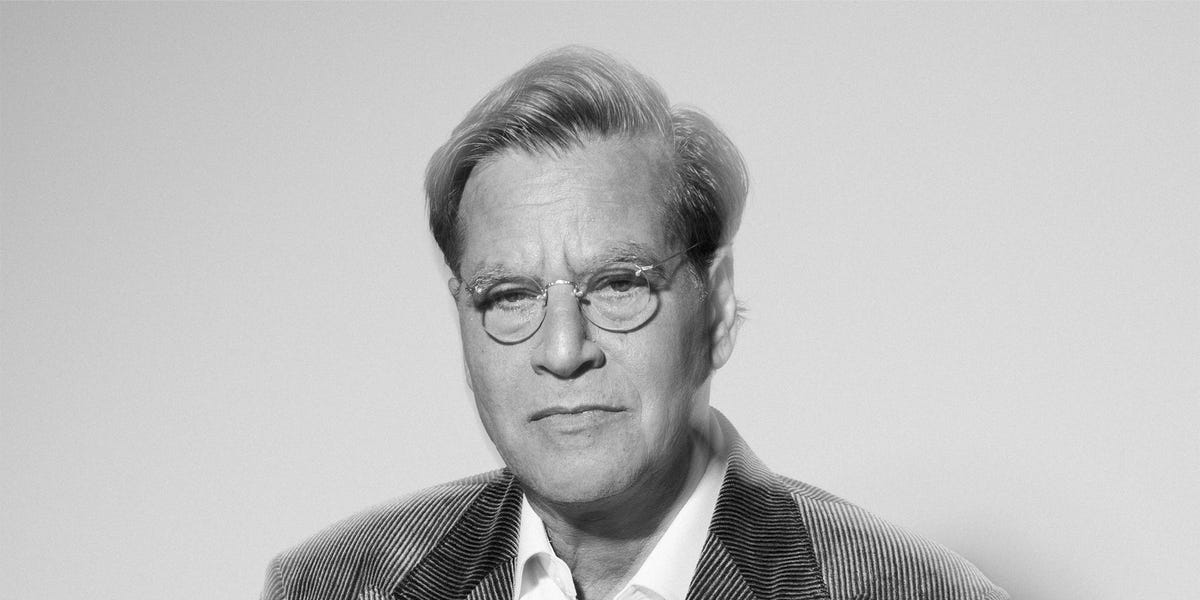
16 min readThe way we view complex, occasionally sinister, culture-defining institutions is largely shaped by one man: Aaron Sorkin. A Few Good Men (the military), The American President and The West Wing (the White House), and The Newsroom (TV news) are all products of Sorkin’s keyboard. Since the late eighties, he’s written eleven movies, four TV series, and four Broadway plays, and directed four movies. And yet a century from now, his legacy will be defined by his depiction of one institution in particular: Facebook.In 2011, Sorkin won an Oscar for writing the screenplay for The Social Network, which depicts Mark Zuckerberg’s fevered, single-minded spinning up of Facebook. Though Zuckerberg disputed many of the details, the film colored how most people see him. Now Sorkin has written and directed a follow-up, The Social Reckoning, in theaters October 9. It is the true story of Frances Haugen, a product engineer at Facebook, played by Mikey Madison, who enlists the help of Wall Street Journal investigative reporter Jeff Horwitz, played by Jeremy Allen White. Together they uncover the heavily guarded secrets of Facebook and its algorithm. The world has changed dramatically since 2011—thanks in large part to Zuckerberg’s social-media empire—and Sorkin is betting the Hollywood treatment will help audiences understand the profound extent to which Facebook has changed their lives.An erudite man of sixty-five, Sorkin wears blazers and chinos and speaks like a character on The West Wing. He’s also a recovering drug addict who has a nearly unshakable belief in the promise of America. When we met for our interview in Los Angeles this summer, he was thoughtful and polite but didn’t hesitate to share his strong opinions on all manner of topics, including AI, CBS News, and the corrosive effects of social media. Our conversation has been edited for clarity and condensed.ESQUIRE: When you won the Academy Award for writing The Social Network, you mentioned Paddy Chayefsky, who wrote the movie Network, during your acceptance speech. A theme of his work is the decay of institutions. You’ve spent years writing admiringly of American institutions. Which one of you turned out to be right?AARON SORKIN: It depends who’s occupying those institutions. I was minding my own business reading an interview with Adam McKay, and the interviewer asked, “Who in Hollywood is you on the Right? Who’s Adam McKay on the Right?” And he said, “I guess Aaron Sorkin.” I couldn’t believe what I was reading. So I asked him about it and he said, “It’s your belief in American institutions.”You’ve called The Social Reckoning a David and Goliath story. Who’s the David?It is a David and Goliath story if Goliath invited us all to a party and then spiked the punch and David was a nerd who’s played by Mikey Madison.CHANTAL ANDERSONJacket by Brunello Cucinelli; shirt by Emma Willis; Rolex Daytona watch, Sorkin’s own.This article appeared in the September 2026 issue of Esquire subscribeYou said in an interview: “I blame Facebook for January 6. Facebook has been tuning its algorithm to promote the most divisive material that will get you to the infinite scroll.” Is January 6 part of the movie?What definitely is part of the movie is what Facebook did in 2018. They were in trouble. Engagement was going down, there was competition from TikTok, and they had to do something. So they retuned the algorithm. A comment was worth five times as much as a like; an emoji was worth fifteen times as much as a like. A reshare would be worth thirty times a like. Why is that significant? Because they knew that the things that get reshared the most are rage bait. So they began pumping into the air supply all this stuff intended to make you mad. Certainly, you can draw a line from that to January 6.When The Social Network came out, Mark Zuckerberg called parts of the movie a lie. At the time, you said in a New York magazine article: “I don't want my fidelity to be to the truth. I want it to be to storytelling.” Is that the case for The Social Reckoning as well? Do you think Mark will call this one a lie? First of all, he's welcome to come out and say what he likes. I get my say in the theater for two hours, and of course he's going to respond. But let me tell you what I meant by my fidelity is to storytelling and not the truth. I'll use an example from The Social Network. That movie begins after the scene with—I'm sorry, this is just for people who've seen the movie…CHANTAL ANDERSONCoat by Dolce & Gabbana; shirt by Emma Willis; trousers by Brunello Cucinelli; shoes by Manolo Blahnik.I think most people have seen the movie at this point. It opens with a scene with Jesse Eisenberg and Rooney Mara, right? It's a bad date. They kind of break up. Jesse Eisenberg as Mark goes back to his dorm room and he begins blogging and drinking and talking about how he's going to hack into a bunch of dormitory facebooks and create this hot or not website called Facemash. I had his live blog from that night where he tells us that he's drinking and he tells us that he's drunk. I wrote that Mark comes into his dorm room, camera's on his computer, he walks through the frame, powers up his computer, walks out of the frame, comes back in, puts a glass down, puts ice in the glass, vodka goes in the glass, orange juice goes in the glass. All the while in voiceover we're hearing his live blog of this. About two or three weeks before shooting started, we found out that he was drinking beer that night. He was drinking Beck's. So David Fincher said, “Okay, we got to change it to beer.” And I said, “No, no, no, no, don't change it to beer. Keep it vodka and orange juice.” Not only is it more interesting visually than opening a beer, but a college kid drinking a beer doesn't necessarily read as drinking to get drunk. And that's the important thing, that he was drunk. Now, I lost that argument. If you see the movie, he's drinking a beer, but that's what I mean by the important truth isn't what he was drinking. It was that he was drunk. I wouldn't have him shooting up heroin. I wouldn't have him doing a line of cocaine. That's different. So when I say, “My fidelity is to storytelling and not the truth,” that's what I mean. I wouldn't defame someone and I wouldn't pervert truth that's important, but a different way of putting it is that it's a painting and not a photograph.In 2019, you wrote an op-ed in The New York Times addressed to Mark Zuckerberg. As you put it, “the screenplay was vetted to within an inch of its life by a team of studio lawyers.”Same with The Social Reckoning. It has been vetted to within a half inch of its life.Have you spoken to Mark in any other way beyond the Times op-ed pages?No. That’s the only communication we’ve had. With The Social Network, we set out to get his cooperation or input. We met with a bunch of his lieutenants at a hotel, and I was really glad that we didn’t get his cooperation or input. I think it would have been a different movie and people would have said, “Well, this is a Mark Zuckerberg approved version of the story.”What have you learned about social media and its effects on all of us from having written these two movies?Well, listen, what social media was in 2010 when The Social Network came out and what it was in the mid-aughts when Facebook was invented is very different than what it is now. Back then it was a fun way to keep up with people you went to high school with. When The Social Network ends, we put up on the screen that it has 500 million users, which was meant to elicit a gasp from the audience.It’s quaint now.Yeah. It’s 2.8 billion now, which as one of the characters of the movie points out is more than twice the size of the largest country on earth. I don’t want to get the stat wrong, but it’s about a third of American adults get their news from Facebook. That is very dangerous. We’re no longer agreeing that the sky is blue and two plus two equals four.So it has a corrosive effect.It does. And by the way, let me be clear: I don’t think Mark Zuckerberg ever intended for it to have a corrosive effect. I think his intentions were good. He was somebody who, like a lot of people, had difficulty fitting into the social structure of college life and probably high school. He invented his own social structure, and he got to be the mayor of it and couldn’t be excluded from it. His brilliance is undeniable, and that was a cool thing and it got way out of hand. It’s gone completely out of control.I re-watched it the other day and one thing that jumped out at me that I didn't notice the time I saw it is a through line from Mark Zuckerberg and Sean Parker to some of what we now call the manosphere—this idea of these guys hanging out talking about retrograde stuff, which is now fueling a lot of our politics. You probably didn't see that coming as you were writing it, but do you see that connection now?I didn't see it coming when I was writing it. I do see that connection now. And if you're not scared, you ought to be. Louis Theroux has a terrific documentary right now on Netflix called Inside the Manosphere. These guys are such boneheads, but what's terrifying about it is that they'll walk down the street, whether it's in New York, or London, or wherever they are, and young boys—13, 14-year-olds—treat them like they're The Beatles. They're really having influence over young people's lives, encouraging them to collect women and money and stuff, and that's what living is.CHANTAL ANDERSONJacket by Brunello Cucinelli; shirt by Emma Willis; Rolex Daytona watch, Sorkin’s own.You revealed to The New York Times in 2023 that you had suffered a stroke. What do you learn about yourself after you have such a significant health scare?First of all, I’m fine. I’ve managed to recover 100 percent. But I had been not living a very healthy life. I wasn’t exercising enough. I was still eating the way I ate in college. I was smoking a lot. So I decided not to do that anymore. And it wasn’t even because I felt bad. It was because I saw the look in my daughter’s face. I scared the hell out of her, and I didn’t want to do that anymore.What’s an obstacle you’ve had to overcome that helped define you as a man?Writing isn’t easy for me. I love it, but it’s hard. When I’m done with something, whether it’s a movie, a play, or an episode of television, I can’t imagine ever being able to write something else. I wrote eighty-eight episodes of The West Wing. I said, “Guys, I’m out. I’ve used all the words that I know in every order I can put them in.” So there has been that obstacle. The other obstacle is I lost my thirties to cocaine. I’ve been clean and sober for a long time now, but you don’t stop being a drug addict. You’re just in recovery.The things that fuel your writing have changed over the years. You’ve talked about using cocaine or crack cocaine while you wrote in the ‘90s. You also smoked cigarettes to help with the writing process, which you've given up since your stroke. Where are you now with the writing process? How do you sit down and write without the chemicals that have fueled you for so long?It ain't easy for me, and I really envy the people for whom it seems to be easier. There are writers I really admire who go to their office at nine o'clock and write until six o'clock and then they go home. I don't know how they do that. Here's what I do: First, I have to find the intention and obstacle. It might be an adaptation of a book or a true story that I read in Esquire, but what's the intention and obstacle? Who wants what and what's stopping them from getting it? I've never outlined anything. Most of the time when I start writing something, I don't know how it's going to end.I love that.For me, the difference between being on page two and page nothing is life and death. Staring at the computer screen, that flashing cursor, it's the worst. It'll take me a few months of climbing the wall, of driving around in my car listening to the music I listened to in high school, that gets me going. But if I can come up with an interesting first scene, and I know what the intention and obstacle is in the first scene, I'll put an index card up on a bulletin board. If I can get three index cards up, then I'll start writing. It's like walking through the woods at night with a flashlight. You can only see as far ahead as that beam will go, but the further you get into the woods, the further you can see.CHANTAL ANDERSONJacket and shirt by Ralph Lauren Purple Label.There’s this great quote from George Orwell: “Writing a book is a horrible, exhausting struggle, like a long bout of some painful illness. One would never undertake such a thing if one were not driven on by some demon whom one can neither resist nor understand.” What is the demon driving you?I’m not sure if this is a demon, but here it is. I’m better on paper than I am in life. If I could sit in a room and write and just have somebody pass me a tray of food under the door and I’d slip the pages out underneath, that would be the best. I don’t feel like I’m alive or have worth unless I’ve written something. If I were to stop right now and say, “Okay, I’m retiring, that’s it,” I couldn’t do it, because I’d feel like I wouldn’t have any friends or wouldn’t know why I’m getting up in the morning. I think I’ve just described a very sad person, but I’m not.One of the things we always hear is you shouldn’t tie your self-worth to what you do. My daughter is a screenwriter and director. If she said to me what I just said to you, I would say, “Oh, honey, you can’t do that. You’re worth so much more than what you write.”This is parenthood, though.This is parenthood. All I can say is don’t be like me. Do I look happy to you?I have a question about The Newsroom. In 2014, in front of a Tribeca Film Festival audience, you said, “I wish that I could go back to the beginning of The Newsroom and start again.” What specifically would you have changed?I always felt like the real news media and I got off on the wrong foot with The Newsroom. The West Wing took place in a parallel universe. The Newsroom took place in this one. I did that so that I wouldn't have to invent news stories. And I think that real news people felt like I was going to show them how it should have been done.Like you're scolding them.Yeah, and they were rightly offended by that, though that wasn't my intention. I also felt like we did the show for three seasons on HBO, and I was just never comfortable in my chair writing the show. I always felt like there was a pebble in my shoe. I just wasn't getting it right. I could write a good scene—I could write a good couple of scenes—but I just could not put a good episode together of the show, and it was driving me nuts.I want to get your thoughts on what’s happening at CBS News. There’s new ownership, they’re dismantling 60 Minutes, Scott Pelley has been fired. Are these alarm bells for not only the media but democracy?Yes, of course. Because listen, it would be one thing if Bari Weiss came in and just fired some people who shouldn’t be fired and took 60 Minutes segments off the air that should have aired. But it is happening to curry favor with a president who is very easily bribable, and that’s terrifying. Being just a couple of generations removed from the blacklist, I’ll watch things about it and think, I don’t get how these very powerful people—these studio and network heads—just fell in line and recognized a blacklist. Now I see how. It happened just like this. So we have been, for a little while now, knocking on the door of a second blacklist. I just hope this time around the studio heads and the network heads won’t be so malleable, but it doesn’t look like that’s the case.You’ve spoken about American stupidity. Fifteen years ago, you referred to the “glamorization of dumbness.” You were talking about Sarah Palin, which seems quaint. I’m curious what your prognosis of this problem is today. We need to get back to respecting professionalism. Here’s one of the things I mean by I’m better on paper than in real life: The characters I write are all smarter than I am. People who are smarter than I am don’t make me feel bad about myself. And certainly a president—I need the president to be smarter than I am. There are millions upon millions of voters who seem to have a mass debilitating inferiority complex and feel like a smart president, Obama for instance, is looking down his nose at everyone else, or he’s a poindexter, or he’s not a real man.Right. He eats arugula.We got to knock that off. There has been a glamorization of dumbness.I don’t mean to be a cynic here, but can these things be corrected, or is it too late? Can the American experiment be salvaged?I have to think that. First of all, it’s how I make a living. Even more than that, yes, it can. It’s going to take leaders, but it can and I think easily and quickly. Put competent people in leadership positions and of course we can turn this around.CHANTAL ANDERSONJacket and knit by Zegna.A Few Good Men, which you wrote, is returning to Broadway this fall. I want to talk about the film adaptation, and Rob Reiner, who directed the movie. There’s this Premiere magazine story from long ago in which you talk about how much you love Reiner. You say: “I will wash his car. I will clean his house. I’ll marry him.” You describe him as a writer’s director. What did you learn from Rob Reiner?I do love Rob, and I miss him. A Few Good Men was my first movie, American President my second. He directed and produced both. He also owned the studio, Castle Rock, that made them. He saw A Few Good Men when it was a play and took me out to dinner afterward. He said: “I want to do this movie. I want you to write the movie.” I said, “I’ve never written a screenplay before.” And he said, “After this, you won’t be able to say that.” I was living in New York at the time. He took me out to L. A., and I would come to his office every morning at Castle Rock. He called it Turning Pages. We would go through it and pound on every beat, every moment. I was learning how to write a screenplay. This was like being paid to go to grad school. There would be a problem that we’d be trying to fix and I’d have an idea, but I’d say, “Is it okay if I go away and just write it instead of pitching it to you?” He started calling those, “Trust Me, I’m Aaron scenes,” but I would do that and it worked.It’s got to be surreal to see lines that you have written appear on lists of the greatest movie lines ever. Probably the most obvious one is “You can’t handle the truth.” But I’m curious, what is your favorite line of dialogue, not that you wrote but that’s appeared in film?First of all, yes, it is surreal seeing a billboard for Burger King that says, “You can’t handle this Whopper.” My favorite line of dialogue from any movie? There’s all of Paddy Chayefsky. Let’s put that in one pile. There’s also Butch Cassidy and the Sundance Kid. William Goldman won the Oscar for it. It is about as perfect a screenplay—as perfect a movie—as there’s going to be. But it’s hard for me to pick a favorite. So that we can move on, I’ll say, “We’re going to need a bigger boat.”That’s the correct answer, actually. Okay.You brought up Butch Cassidy and the Sundance Kid. I know that’s an important movie for you. That movie is all about these guys in a world that’s changing. They’re bank robbers, they’re train robbers, and technology is advancing. Do you ever feel that way in Hollywood right now? Do you feel like Butch Cassidy?Until this moment, I hadn’t drawn the Butch Cassidy comparison, but yes, I do. Of course, the biggest thing is AI. I have a very optimistic view of our future with AI, and here’s why: I don’t think it’s going to work.Please explain.Some time ago I was at a party at someone’s house looking at a painting on the wall. It was an abstract. The host came up to me and said, “That was painted by a machine.” I was impressed by the technology, but whatever I was feeling about this painting was gone. If you ask anyone who plays video games, like Call of Duty, they’ll tell you they don’t have any emotional connection to the people they’re shooting. That would be your experience watching AI Schindler’s List. What we’re going to discover is that you can go into a movie theater not knowing the name of the person who directed it, the person who wrote it, the people who are in it, but it matters that people did it. We are not going to feel a connection to computer-generated characters, dialogue, stories, paintings, songs.Your daughter, Roxy, is coming into this world that AI looms over. What advice have you given her as she’s undertaken a career in Hollywood? Go to medical school, go to law school. Please don’t do this. It was no good. I couldn’t stop her. It’s just that ever since she was born, she’s been visiting me at the office, on sets. This is her world, and as it happens, she’s good at it.What have you learned from being a dad?Listen, it may be cliché, but fatherhood really does live up to the hype. I remember when her mother was pregnant with Roxy, all my friends who were young fathers were telling me, “It’s going to be the greatest thing in the world. You’re not going to care about anything but your kid anymore.” That just didn’t sound like me. I thought I must be missing the thing that they all have and I’ll fake it the rest of my life. And really ten minutes after she was born, I realized how silly all that was. So I’m crazy about being her father and I still try to play that role in an emeritus capacity. Somehow she doesn’t so much need a father anymore, but I wouldn’t have missed it for the world.As seen in the opening image: Jacket by Brunello Cucinelli; shirt by Emma Willis. Story by Esquire Editor-in-chief: Michael SebastianPhotographed by Chantal AndersonStyled by Alfonso Fernandez NavasGrooming by Fabiola for Exclusive Artists using Saie BeautyTailoring by Elena Korbukh Production by Hyperion Directors of Video: Kathryn Rice, Amanda Kabbabe Supervising Producer: Brian Murray-Real Director of Photography: Darren KhoSenior Editor: Sam Miller Esquire Executive Design Director: Martin HoopsEsquire Visual Director: James MorrisEsquire Senior Entertainment Director: Andrea Cuttler
A Candid Conversation with Aaron Sorkin, Who Might Be Our Greatest Living Storyteller
Full Article
Original Source
Read the full article at Esquire →KhanList aggregates and links to publicly available news content. We do not host full articles from third-party sources. Always verify important information with original sources.