
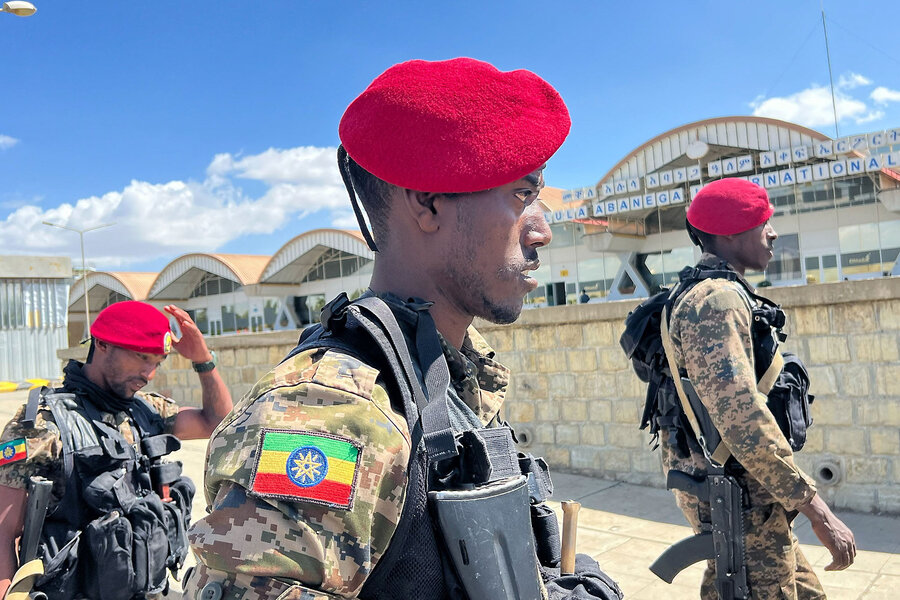
When Ethiopian army troops captured the city of Mekelle earlier this month from rebel forces, they got a surprising reaction from many residents: a palpable sense of relief. In 2021, the same government troops were routed from the same city – the capital of the northern region of Tigray – and seen as invaders. Residents celebrated with a kind of impromptu, citywide street party for the rebels who drove the army out. They cheered as thousands of captured Ethiopian soldiers were paraded through the city. The contrasting scenes speak to how much has changed since the end of the civil war in Tigray four years ago. A peace agreement silenced the guns, but never evolved into a comprehensive political settlement. Underlying issues were left unaddressed. As a result, the region is now sliding into another war between Ethiopia’s federal government and a patchwork of rebel groups. And this time, many Tigrayans don’t know what side they fall on.On Friday, the Prime Minister’s Office announced the establishment of a six-month caretaker administration in Tigray, but it is unclear how these new leaders will ultimately be received by Tigrayans. “There seems to be no road map moving forward” for the warring parties, says one Mekelle resident named Assefa. Like other Tigrayans quoted in this story, he is being referred to only by his surname for fear of retaliation by armed groups. “Nobody has clearly articulated what is going to be built on what has been discarded.” ReutersRickshaw taxis and motorists drive through Mekelle, Ethiopia, Sept. 23, 2026. A fragile peaceFor 27 years, the Tigray People’s Liberation Front was the ruling party in Ethiopia. When the TPLF was unseated in 2018, friction with the new administration of Prime Minister Abiy Ahmed began immediately. In 2020, tensions erupted into a civil war that in just two years left at least 100,000 people dead, with some estimates rising to more than half a million. In 2022, the TPLF and the Ethiopian government inked a deal in Pretoria, South Africa, to stop the fighting. Tigrayan rebels agreed to disarm, and the federal government agreed to restore basic services, help displaced people in the region return home, and ensure that Eritrean forces who fought alongside the government left Tigrayan territory.But the deal failed to guarantee that Tigrayans could elect their own local government like other regional states in Ethiopia.What’s more, two groups that fought alongside the government – Eritrea and the Fano militia from the neighboring Amhara region – bristled at being excluded from peace talks. “Although the Ethiopian government maintained that it represented the coalition that fought on behalf of Addis Ababa, Fano and Eritrea did not see it that way,” says Faisal Roble, a political analyst focused on the Horn of Africa. As a result, that alliance quickly splintered. The Fano and militia forces from Amhara refused to give up control of the areas in western Tigray they took by force during the war. Meanwhile, the relationship between the national governments in Asmara and Addis Ababa eroded further over Mr. Abiy’s push for landlocked Ethiopia to have access to the Red Sea via Eritrea’s coastline. ReutersWreckage of an abandoned truck damaged by a drone strike during fighting between the Ethiopian military and the TPLF is shown in Adi Mesno, in the Tigray region, Oct. 9, 2026. At the same time, the TPLF itself was fracturing. On one side were the interim leaders appointed by Mr. Abiy’s government, and on the other, a hardline faction that saw cooperation with Addis Ababa as betrayal. Because the two sides refused to hold a party conference, the national government barred the TPLF from the 2026 elections. A return to warAll of this put stress on the region’s fragile peace and opened the door for new and unexpected military alliances to take shape in Tigray. These partnerships were built less on shared values than on the old adage, the enemy of my enemy is my friend. On Sept. 21, the Fano announced that it had joined its one-time enemy, the TPLF, and five other regional rebel groups in an alliance aimed at overthrowing the national government. Two days later, on Sept. 23, Tigrayan troops launched an offensive against federal forces in Tigray and the neighboring Afar and Amhara regions, effectively pulling the plug on the 2022 peace deal. Eritrean troops have also crossed the border into Tigray, according to Reuters, the AFP, and the conflict monitor ACLED. The government in Asmara denies it has deployed soldiers there and says Ethiopia is using the issue to justify a future attack on Eritrea. Meanwhile, the national army is advancing alongside the Tigray Peace Force, a group of former TPLF fighters now allied with Addis Ababa. The two groups took control of Mekelle in early October and have expanded control of the region since then. Gebrehans, a resident of Mekelle, says he is grateful to the national government for returning law and order to Mekelle. “Frankly, there is very good progress in all aspects,” he says. “The early days of federal control were scary and uncertain,” says Assefa. “Now, things are getting back to normal again.” Deepen your worldviewwith Monitor Highlights.Politics with respectGet political stories with respectful analysis.There‘s a world of new ideas in everyBooks newsletter.There‘s more to life, enrich yours withCulture & Learning weekly.Follow humanity‘s discoveries withScience & Nature stories in your inbox.Gain a spiritual perspectivefrom the stories in your inbox.Want to understand the deeper impact of critical events? Learn the Monitor‘s insight.Already a subscriber? Log in to hide ads. But normal is relative here. Assefa says government offices and schools are still closed. For many here, indeed, the situation remains as uncertain as ever. ALREADY A SUBSCRIBER? LoginReal news can be honest, hopeful, credible, constructive.The Christian Science Monitor was founded in 1908 to lift the standard of journalism and uplift humanity. We aim to “speak the truth in love.” Our goal is not to tell you what to think, but to give you the essential knowledge and understanding to come to your own intelligent conclusions. Join us in this mission by subscribing.
A broken peace deal is reigniting war in Ethiopia’s Tigray region
Full Article
Original Source
Read the full article at Csmonitor →KhanList aggregates and links to publicly available news content. We do not host full articles from third-party sources. Always verify important information with original sources.