
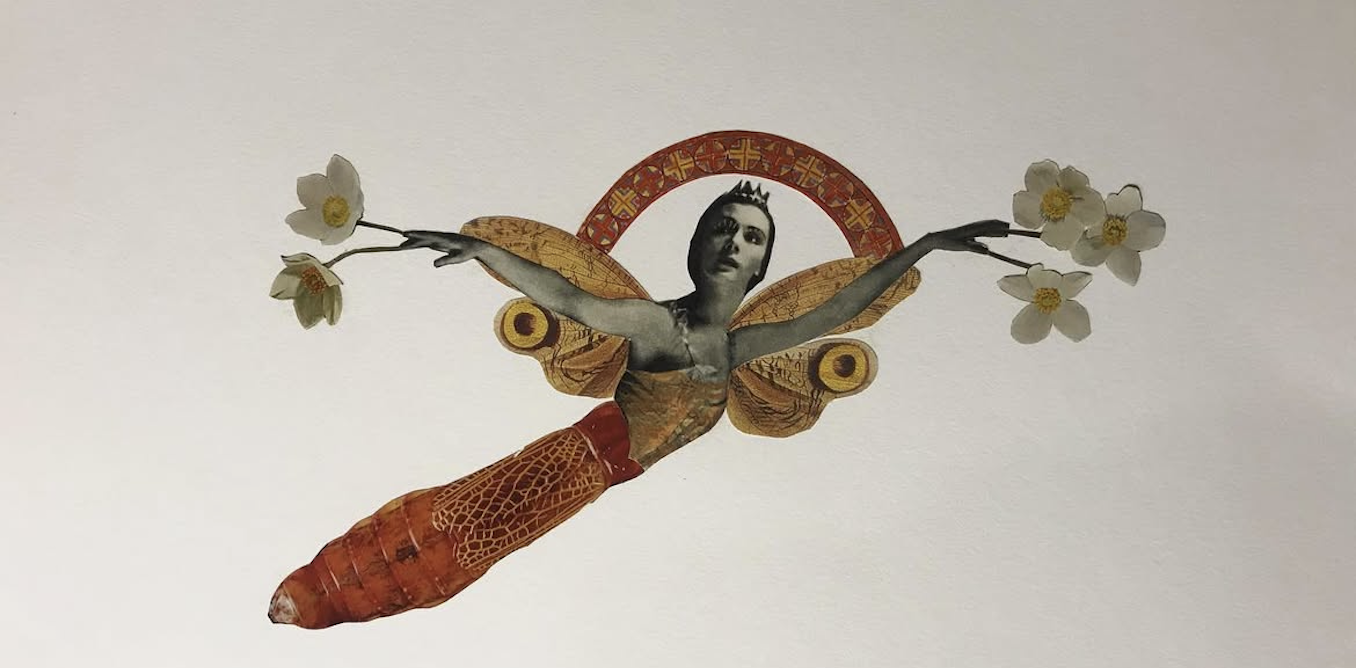
Collage is ancient, with roots going back to the invention of paper in East Asia. In 12th century Japan, paper was used for calligraphy, and artists pasted different papers, fabrics and torn elements alongside their writing. They were interested in how calligraphy could be amplified or accentuated through different graphic compositions. This example of paper from Japan, dating to the 12th century, shows how different coloured pieces of paper were joined together. Association of Cultural Properties, Tokyo/Wikimedia Commons Paper was introduced to Europe during the late Middle Ages, when texts were painstakingly copied onto paper by hand. Around 1440, Johannes Gutenberg’s invention of movable type for letterpress printing created a huge demand for paper. Over the next few hundred years printing on paper spread around Europe. By 1702, the world’s first daily newspaper was published, the Daily Courant, so cheap it could be thrown away – or, perhaps, used in creative ways – at the end of the day. The word collage is from the French coller, “to glue” or “to stick together”. The artform was popularised by European artists in the early 20th century responding to the chaos of war such as George Braque, Hannah Höch and Pablo Picasso. When they saw newspapers, propaganda posters and flyers, they saw art materials. Rearranged on a canvas, this work could subvert fascism and critique totalitarian regimes. Collage is relatively cheap, fast and easy, so it moved between various distinct waves of Modern Art during the 20th century, including Surrealism, Dada, Cubism and Feminist Art. While artists generally made individual works, it was a technique that was socialised through groups of thinkers and makers. In Germany, playwright Bertolt Brech collaborated in collage with his friends and visual artists such as George Grosz and John Heartfield. Artists such as Man Ray and Elemérné Marsovszky cut and pasted photographs to bring a fragmented cultural landscape into view. Joseph Cornell represented shared experiences of anxiety and dislocation by challenging distinctions between painting and sculpture through collage. Collage was an integral piece of the Dada art movement. This is Johannes Theodor Baargeld’s Venus at the Game of the Kings (1920). Fine Art Images/Heritage Images/Getty Images Collage was a way for artists to reject the unachievable perfection of naturalism and realism, focusing on the messages communicated by the words and images already around them. Confronting reality and rearranging its material representations could create new meanings from fragments. The world has not become less complex since these avant guard artists began reinterpreting what they saw. Australian collage artists are as committed as ever to confronting the world by cutting and pasting what they find in it. Collage in Australia today Contemporary Australian artist Deborah Kelly is known for her colourful, eclectic, activist art. She uses collage extensively in her work to create posters, postcards, banners, billboards, installations, videos and performances. In her recent project, C.U.L.T (Collaging Using Library Things), Kelly explored how materials discarded by libraries — books, journals and ephemera — could be repurposed into something new, meaningful and transformative. Through her workshops, she gently invites participants to think differently with the materials in front of them. A participant might amplify the contours of a bodybuilder with butterfly wings; cut out the perfectly painted lips of a women’s magazine and recomposing them; create a “Dog Women with Alligator Fetus”. Deborah Kelly runs collage workshops, inviting participants to think differently with the materials in front of them. UTS Library This process disrupts gender norms and power structures. It encourages participants to write their own histories from their own perspectives. And rather than starting with a blank page, they can start with what they find around them, what makes them feel weird or uncomfortable, or what offers a sense of whimsy. The Social Glue of Sydney is also focused on communal collage practice. They are committed to taking away barriers to serious art-making: time, space and money. trying something new, Mia Ardianto. Their approach is to sit around a communal table and simply make collages. There is no leader and there are no constraints. The collective recently held a major survey exhibition at the Chrissie Cotter Gallery, and works from the exhibition can now be viewed online by artist, or by themes such as “skulls, bones and anatomy”, “hands” or “tourist albums, pianola, etc.”. The collective includes Mia Ardianto, whose surreal combinations of transnational family archives and magazines reflect years of playful experimentation in Australia and Indonesia, and Kathryn Baird, the self-proclaimed “devotee of medieval weirdness”. Getting started on collage Collage can be very therapeutic, providing a low-barrier outlet for self-expression. And for those who are feeling othered by the injustices and chaos of the world, it offers a medium for social commentary. While the Social Glue of Sydney is unique, there might be collage collectives near you. And if you can’t find an existing group, you can go it alone, or start your own collective. You are going to need a base to build on, such as a piece of cardboard or paper, some printed material, scissors and glue. Begin with cutting out images or words that make you feel something: curiosity, anger, love or humour. Then combine these elements in new ways. Intuition is important – there is no wrong way to compose a collage.
A brief history of collage from 12th century Japan to Sydney today – and your own kitchen table
Full Article
Original Source
Read the full article at Theconversation →KhanList aggregates and links to publicly available news content. We do not host full articles from third-party sources. Always verify important information with original sources.