
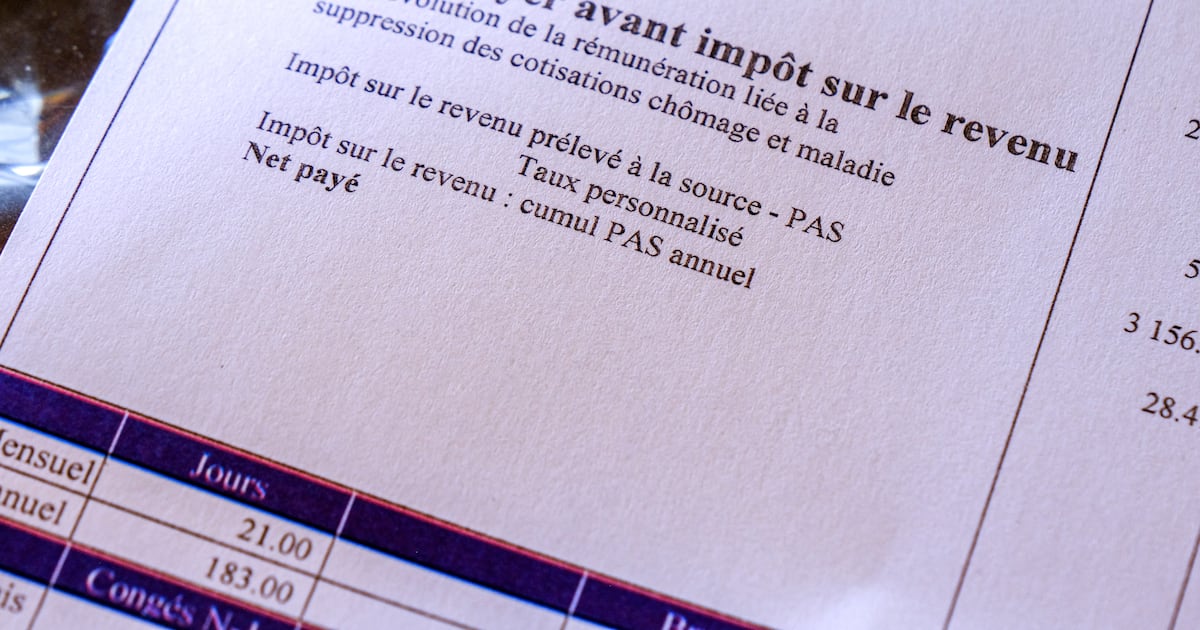
Looking closely at their payslips, teachers in France can spot something strange. The columns of figures show a pension contribution figure, “Contrib PC”, that is greater than their take-home pay.Once little-noticed, the accounting practice is in the spotlight for what it reveals about a generational imbalance in state spending and France’s deep financial troubles, as hundreds of thousands of young people protest across the country over conditions in schools.“We think we’re paying for schools, but we’re paying for pensions,” sums up Gabriel Lattanzio, an associate professor at the Panthéon-Sorbonne University who has been posting his payslips online to highlight the issue.The French pension system is a direct transfer system: current contributions by workers are paid out directly to fund today’s retirees, rather than being saved into a fund.READ MORE“Contrib PC” is a transfer from the education ministry into the bank account that pays out the pensions of retired civil servants. The expense is categorised in the French budget as spending on education, but is actually going to today’s retirees.In August, Lattanzio’s take-home pay was €2,662.27. The direct contribution to pensions by his employer – the French education ministry – was €2,896.08. An additional €351.63 was also deducted from his pay for pensions as well.Lattanzio published an analysis comparing the French budget of 2006 to that of 2026 and concluded that although spending on education appeared to have risen over time, in fact the vast majority of the increase was to pay for pension payments to retired civil servants.The issue sheds light on the complaints by protesting school students of teacher shortages and poor conditions, even as France appears to rank relatively well when education spending is compared to other developed economies.Gabriel Lattanzio, an associate professor at the Panthéon-Sorbonne University who has been posting his payslips online to highlight the issue France appears to be “spending more on education than it is actually”, says Todor Tochev, a senior economist at the Institut des Politiques Publiques who began to draw public attention to the issue with a paper he co-authored last year.“Hiring an additional teacher does not reflect the expenses incurred by hiring that teacher, but also incurs the expenses of paying pensions for people who are not teachers,” he explains.[ France’s school protests: What lies behind the angerOpens in new window ]So, why is the system this way? “The fundamental problem is that there’s a demographic problem,” Tochev says: current retirees now outnumber working people paying into France’s civil servant pensions system.This has been caused by a decline in the birth rate, but also by government policy.There has been a shift towards hiring public servants on fixed-term contracts, which means they don’t become contributors into the system.The privatisation of services, like France Telecom, also reduced the overall number of contributors, while the state retained the responsibility for paying the pensions of their retirees.Teachers and students taking part in protests over education funding earlier this week. Photograph: Antoine Jaussaud / Hans Lucas / AFP via Getty Images Finally there is a “general policy of pay freezes” for public servants, with pay frozen most years since 2010, while pensions are automatically indexed to inflation. This means that salaries and pensions have steadily diverged.As students emptied from their high schools to march in protest at education conditions this week, the finance ministry published an annex to its proposed national budget for the first time. A protester waves a French flag during school demonstrations on Tuesday last in central Paris. Photograph: Tom Nicholson/Getty Images The annex contained figures, never released before, showing the percentage of spending on retired civil servants’ salaries per ministry.It revealed that 32 per cent of the education ministry’s budget, €28.5 billion, is transferred straight back into the bank account that pays out civil servants’ pensions. It was the greatest share spent on pensions of any ministry.“It’s a bombshell,” the economist Maxime Sbaihi, of think tank Institut Montaigne, wrote on social media.[ France’s school protests: What lies behind the angerOpens in new window ]The interior ministry, which employs police officers, spends 30 per cent of its budget on pensions, while the justice ministry spends just over 20 per cent.“So, more than 11 per cent of the central government budget, or almost €50 billion annually, is allocated to pension funding without being recorded as a pension expenditure. Staggering,” Sbaihi wrote.It remains to be seen whether the revelations will affect France’s presidential campaign ahead of an election in April 2027. There is an “omertà” about pensions in French politics, according to Renaud Foucart, an economist at Lancaster University. “No politician dares to address the question.”The front-runners on the left and right are presenting “fantasy budgets”, Foucart says, that “claim to fix everything with vague promises of efficiency, or by ending all kinds of fraud and blaming foreigners and billionaires”.Some centre-right candidates acknowledge the issue, but their proposed solution is to make “current workers pay for the imbalance”, Foucart says.They “want to reform the system while preserving the privileges of the boomers, whose pensions are putting the country on the verge of financial collapse”.[ Inside the school protests in France that have spiralled into arson and street violenceOpens in new window ]Macron abandoned an initial attempt to introduce a points-based pension reform when Covid-19 hit. He oversaw a highly controversial increase of the statutory retirement age from 62 to 64 in 2023, but its implementation is currently suspended.Foucart notes that students were also at the forefront of protests against the increase to the retirement age.“They demonstrated to protect pensions and now demonstrate to defend education, and I cannot blame them for not understanding that the former is the cause of most of their problems,” Foucart says. “They are correct to be angry, the adults have failed them.”
‘A bombshell’: French teachers spot something on payslips that reveals scale of funding crisis
Full Article
Original Source
Read the full article at Irishtimes →KhanList aggregates and links to publicly available news content. We do not host full articles from third-party sources. Always verify important information with original sources.