
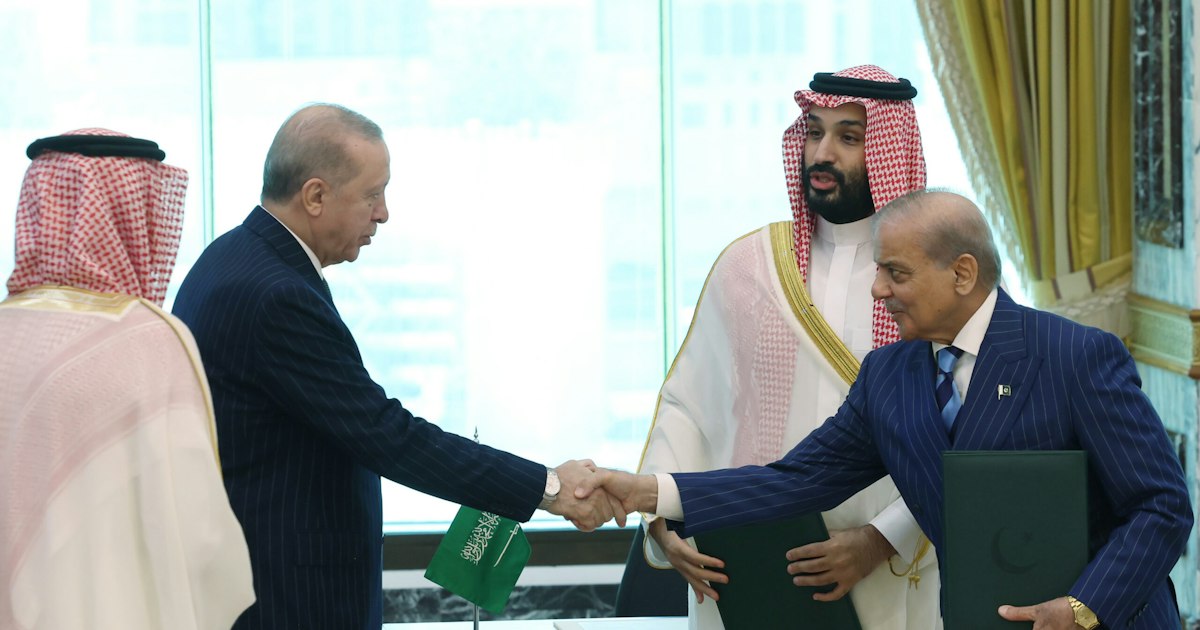
Foreign Affairs The Middle East needs a security architecture that includes Tehran. Photo by TUR Presidency /Murat Cetinmuhurdar/Anadolu via Getty Images Senior representatives of Saudi Arabia, Pakistan, and Turkey—the three members of the recently formed Mecca defense alliance—gathered in Tehran early this week for an unprecedented meeting with Iranian officials. Their immediate purpose was to prevent another devastating confrontation involving Iran (especially important for the Gulf states who would likely bear the brunt of renewed hostilities). Yet the meeting also points toward something potentially far more significant: the initial phases of a new security order in the Middle East, in which regional powers, rather than the United States, assume primary responsibility for managing their affairs. As such an architecture comes into being, one logical, if politically bold, step would be to invite Iran to join the Mecca Pact. Of course, that probably won’t happen anytime soon, especially given tensions between Riyadh and Tehran. Yet Iran has responded positively to the Mecca alliance, and the talks this week appeared constructive. And the experience of the past five decades or so shows that no regional security arrangement can succeed if it permanently excludes a country of Iran’s size, capabilities, and geopolitical importance. Given that the regime in Tehran shows few if any signs of crumbling even under extreme military and economic pressure, it should be clear that perpetual enmity offers diminishing returns. Accommodation is the only viable path forward. The leaders of Saudi Arabia, Turkey, and Pakistan seem to realize that. A regional nonaggression arrangement was reportedly discussed in the meeting in Tehran—the kind of common-sense diplomatic proposal that is both necessary and long overdue. The circumstances surrounding the Tehran meeting underscore both the urgency of regional diplomacy and its limitations. The meeting took place under the shadow of a looming “round three” of the American-Israeli war on Iran that started in June 2025. The inconclusive result of this week’s elections in Israel has created a political deadlock that incentivizes Prime Minister Benjamin Netanyahu to escalate with Iran. President Donald Trump has apparently come to despise the Islamabad Memorandum—the framework peace agreement that he signed with Iran in June, but which quickly fell apart—as a deal too favorable to Tehran. Trump appears to be seeking a face-saving way out of the current stalemate, which for him may mean another, more devastating bombing campaign, seemingly divorced from any clear and achievable strategic objectives (other than demonstrating American military might). The fear in Riyadh and other Gulf capitals is that Tehran would retaliate by hitting their energy infrastructure to cause maximum pain to the global economy. This rising danger comes at a bad time for Saudi Arabia. Yemen’s Houthi rebels, who are aligned with Iran, have already been striking energy targets in Saudi Arabia and blocking the Bab-el-Mandeb Strait for critical Saudi oil shipments. Riyadh wants Tehran to use its influence over the Houthis to stop these attacks, and Iran has seemingly been signaling a certain willingness to help, but there are limits to what it can do. The Houthis are a Yemeni movement, with their own history of grievances with Saudi Arabia. From 2015 to 2022, the hard-bitten militia fought the Saudis to a standstill at significant cost; its leaders are therefore unlikely to lay down their arms at a word of command from Tehran. Even assuming the Iranians had this leverage, though, it’s unclear whether they have sufficient incentives to restrain the Houthis—particularly given the threat of another U.S.-Israeli attack. At a time when Tehran aims to signal its preparedness for another round of fighting, what would it gain in exchange for expending political capital to rein in an allied militant group with demonstrated capabilities to strike targets in the region? A promise from Saudi Arabia to distance itself from any renewed American military campaign against Iran would help. But how would such a promise be implemented and verified? Tehran won’t squander its perceived leverage over the Houthis in exchange for vague, reversible promises from Riyadh. Nevertheless, the Tehran meeting featured substantive discussions that reflected the growing realization that regional security is indivisible: No country can feel safe in an architecture predicated on the exclusion of others. This realization is a necessary precondition for building a more inclusive arrangement. Even with mutual trust still lacking, the expected withdrawal of the U.S. from the region and decline of American hegemony have spurred the Mecca alliance countries to change their approach to Iran. Saudi Arabia has learned its own lessons the hard way. When the Houthis closed the Bab-el-Mandeb and struck targets inside the kingdom, the U.S. did not come to Riyadh’s rescue. To the contrary, influential voices in Washington wanted to use the Saudi Crown Prince Mohammad bin Salman’s predicament to push him to join the Abraham Accords with Israel. Not only would such a move have been politically unpalatable for MbS given Israel’s treatment of Palestinians, but it would have also cemented Saudi Arabia’s subordination to the U.S. and Israel, and entrenched a regional organization centered on the exclusion of Iran. Similarly, Turkey and Pakistan—which have their own complicated relationships with Iran—are not seeking confrontation. They understand that the destabilization that would surely ensue would cause severe ripple effects across the region: refugee flows, ethnic separatism, and major economic disruptions, all at a time when both countries already face significant security and economic challenges. Moreover, Ankara and Islamabad must take into account public opinion in their countries, and are loath to be seen as fighting America’s and Israel’s wars. Subscribe Today Get daily emails in your inbox The Tehran meeting is therefore best understood not as an ad hoc diplomatic initiative, but as a possible first step towards a redefined security order in the Middle East. Mutual nonaggression commitments and confidence-building measures should be treated as the beginning of a long process of diplomatic engagement and, ultimately, integration of Iran with the Mecca alliance. After the threat of U.S.-Israel strikes subsides, Iran’s membership would help address one of the region’s most persistent security concerns: Tehran’s alliance with the Houthis, Hezbollah in Lebanon, Iraqi militias, and other militant groups. Attempts to eliminate these groups using military force have failed. With a stake in regional stability and a valuable partnership with key countries in the region, Tehran would be more likely to use its leverage over these groups to rein them in. Washington should welcome such an evolution. It would enable the U.S. to disentangle from the Middle East, to adopt a superior strategy—off-shore balancing—and to pursue a narrow, well-defined list of priorities: preventing a regional hegemon from rising, securing freedom of navigation, and dealing with terrorism if American vital interests come under threat. President Donald Trump has promised non-interventionism in the Middle East but failed to deliver. The Mecca pact offers him an unexpected pathway to fulfilling that pledge and focusing on the interests of the American people.
A Bold Proposal: Iran Should Join the Mecca Alliance
Full Article
Original Source
Read the full article at Theamericanconservative →KhanList aggregates and links to publicly available news content. We do not host full articles from third-party sources. Always verify important information with original sources.