
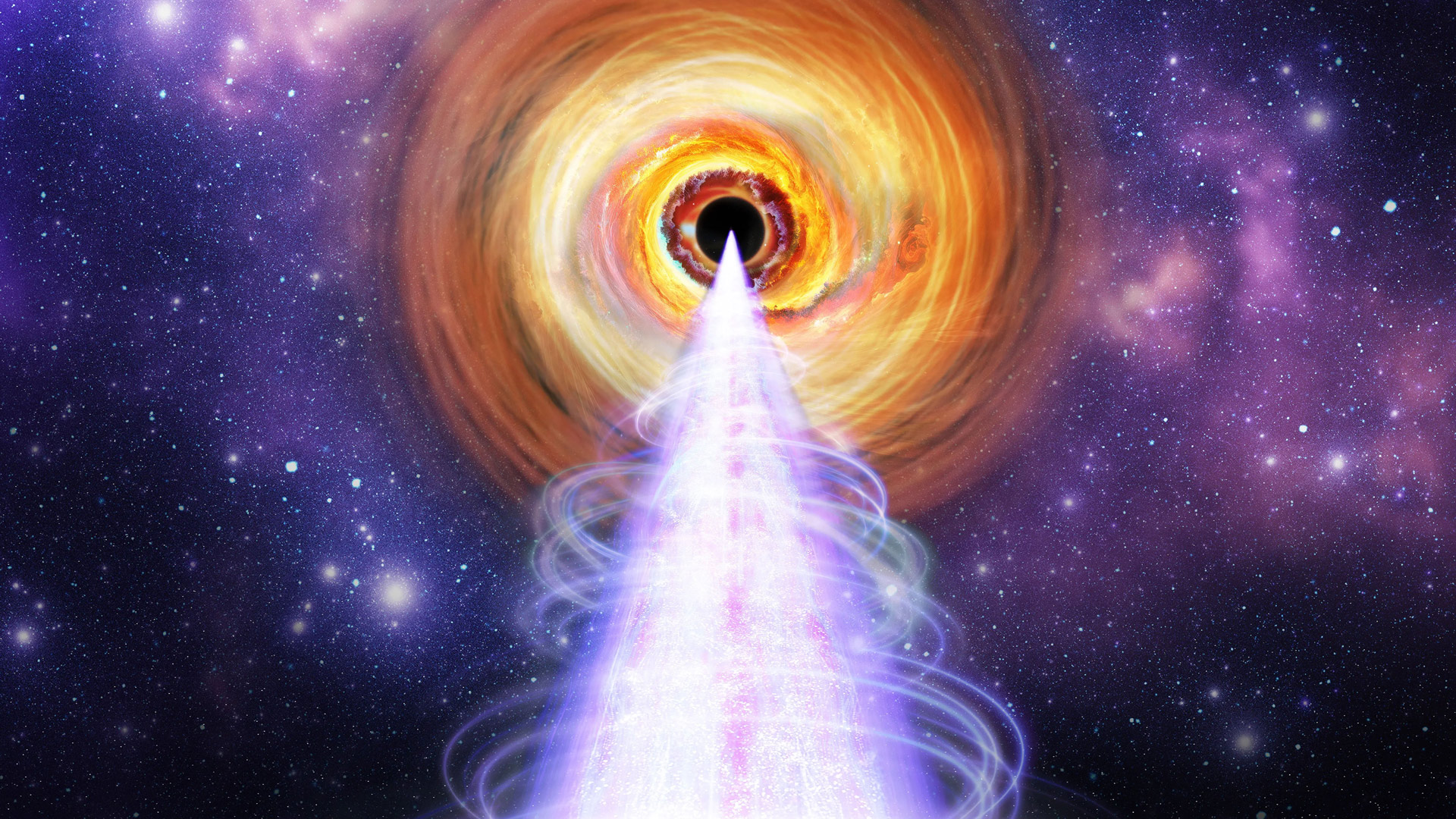
Black holes can launch matter into space at nearly the speed of light, but how these enormous jets form, accelerate, and change direction remains a major astrophysical mystery. Now, astronomers have used the Event Horizon Telescope (EHT) to observe a black hole’s jet that appears to bend toward Earth within a fraction of a parsec. The discovery could explain why some parts of these outflows appear unusually bright while moving more slowly across the sky, Closer look at black hole’s jet The object behind the discovery is 3C 279, a blazar in the constellation Virgo. It hosts a supermassive black hole with an estimated mass of 800 million Suns, which powers a jet of electrically charged particles moving at relativistic speeds. Blazars are useful for studying these outflows because their jets point almost directly toward Earth. This orientation makes them appear exceptionally bright through relativistic beaming. It also complicates observations: plasma moving almost directly toward us can appear to travel slowly across the sky, despite its tremendous actual speed. Other blazars have also offered clues to the magnetic fields and particle acceleration within these jets. An international team of researchers analyzed EHT observations collected in 2021. Their findings reveal a compact structure extending almost perpendicular to the larger jet, suggesting that the inner outflow bends toward the observer. Uncovering the bend The Event Horizon Telescope (EHT) combines radio observatories around the world into a virtual Earth-sized telescope using very long baseline interferometry (VLBI). Its 2021 campaign used the largest array configuration published at the time, with the 12-meter Kitt Peak telescope in Arizona and the Northern Extended Millimeter Array (NOEMA) in the French Alps joining the network. This technique, which enables the EHT to capture black hole images, gives astronomers extraordinary resolution by combining observations from widely separated radio telescopes. The researchers examined observations from April 13, 17, and 18 at around 230 GHz. Three independent imaging algorithms—Comrade, DoG-HiT, and kine—were applied across three observing days and two frequency bands, producing 18 image reconstructions. Their agreement helped establish that the unusual structures were likely real rather than imaging artifacts. The researchers also compared the results with observations at 43 and 86 GHz and earlier EHT images from 2011 and 2017, finding that the structure recurs across different observations. The EHT’s improving resolution is also evident in its later high-resolution black hole observations. Speed nearly 10X light By tracking individual components, the team found apparent speeds approaching 10 times the speed of light. This does not mean the plasma actually exceeds light speed. It is an apparent effect of relativistic motion viewed at an extremely small angle, similar to the superluminal motion observed in other black hole jets. The researchers calculated that the jet’s bulk Lorentz factor must be at least 10.3, meaning its plasma moves extremely close to light speed. Their model also produced progressively tighter upper limits on the viewing angle, reaching less than 0.3 degrees for one component. This geometry could explain why some downstream features appear brighter while moving more slowly across the sky. “Because the plasma is moving close to the speed of light, its radiation is concentrated in the direction it’s traveling. When that direction lines up more closely with Earth, we see brighter emission,” Hendrik Müller, first author of the study and a scientist at the National Radio Astronomy Observatory (NRAO), told Universe Today. At the same time, features in the jet are moving more nearly straight toward us, so they can appear to move more slowly across the sky. Think of a car coming almost head-on: it can be moving fast while barely shifting left or right in your field of view,” Müller added. The observations also suggest that the jet accelerates rapidly near its apparent base, where some features already show apparent speeds comparable to those farther downstream. However, the true launching point remains uncertain. The researchers treated a faint feature called C0 as the stationary reference point, but the actual jet origin could lie farther upstream, too faint for the EHT to detect. A brighter region farther along may be a recollimation shock, where the narrowing flow concentrates the plasma. Both this shock and the jet’s changing orientation could contribute to the brightness. “As the fast flow narrows again, it may form a shock that adds to the brightness we see near the bend,” Müller said. Moreover, the researchers measured intrinsic brightness temperatures of around 1 billion to 10 billion kelvin, consistent with optically thin emission at 230 GHz. Exploring jet bending The observations do not yet reveal what causes the bend. Possibilities include interactions with surrounding gas, instabilities within the jet, magnetic reconnection near the black hole, or changes in orientation caused by a possible binary black hole system. The available observations cannot distinguish between these explanations. Understanding how magnetic fields behave near black holes may help researchers investigate some of these processes. The EHT also has limited sensitivity to faint, extended emission, making it difficult to reconstruct the entire jet. Longer-term observations at different frequencies will be needed. Müller said: “This paper is just the beginning. We have EHT observations from several years, as well as observations at other frequencies that we scheduled around the same time that are currently being analyzed. “Observing at different frequencies lets us see different parts of the jet. Taking those observations close together helps us tell which differences come from the frequency we’re using and which come from the jet itself changing.” Together, these observations could help astronomers understand how black holes launch jets, accelerate matter to nearly light speed, and shape some of the Universe’s most powerful outflows. The study is published in the journal Astronomy & Astrophysics. Get the latest in engineering, tech, space & science - delivered daily to your inbox.Rupendra Brahambhatt is an experienced writer, researcher, journalist, and filmmaker. With a B.Sc (Hons.) in Science and PGJMC in Mass Communications, he has been actively working with some of the most innovative brands, news agencies, digital magazines, documentary filmmakers, and nonprofits from different parts of the globe. As an author, he works with a vision to bring forward the right information and encourage a constructive mindset among the masses.
A black hole jet moves at near-light speed but barely shifts across the sky
Full Article
Original Source
Read the full article at Interestingengineering →KhanList aggregates and links to publicly available news content. We do not host full articles from third-party sources. Always verify important information with original sources.