
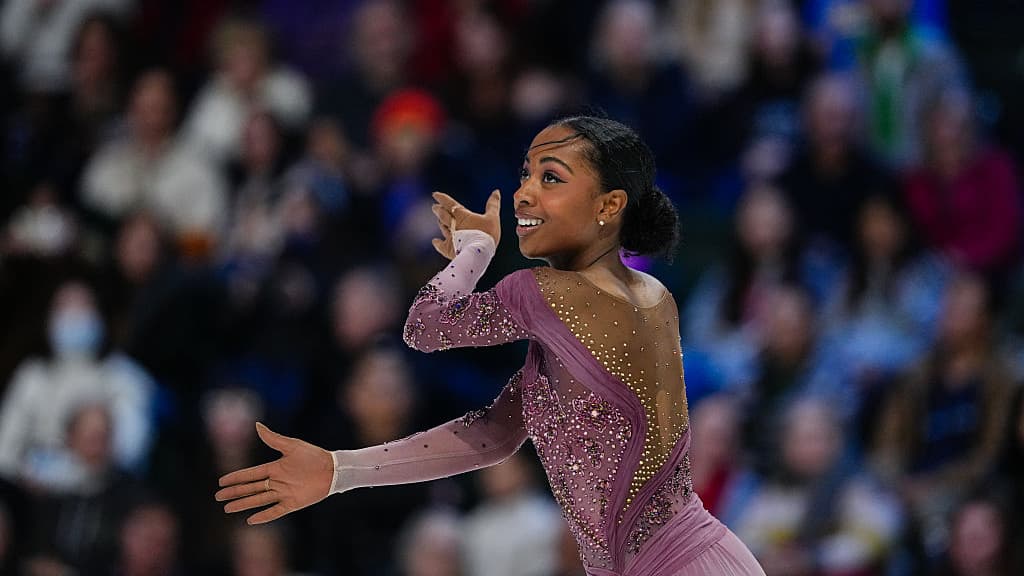
Last weekend, American figure skater Alexa Gasparotto made history as the first Black woman ever to land a triple axel at the International Skating Union Grand Prix. This jump is symbolic of something far larger. While Black competitors in Olympic figure skating are still few and far between, we exist vibrantly. Gasparotto’s triple axel was a byproduct of a long effort in a small, expensive sport for more visibility and support for skaters of all marginalized backgrounds. And her success shows how far Black athletes have come in winter sports.To understand the meaning of this, we have to look at the past. In women’s singles figure skating, Debi Thomas remains the only Black Olympic medalist, winning bronze at the 1988 Calgary Games. Twelve years before Thomas’ medal, American Tai Babilonia became the first Black figure skater to compete at the Olympics. Other Black figure skaters—including French skaters Surya Bonaly and Maé-Bérénice Méité and Canadian skater Vanessa James—competed in later Games but did not win Olympic medals. In 2002, bobsledder Vonetta Flowers became the first Black athlete to win Winter Olympic gold, as part of the U.S. two-woman team. Four years later, speedskater Shani Davis became the first Black athlete to win an individual Winter Olympic gold. In 2022, speedskater Erin Jackson became the first Black woman to win an individual Winter Olympic gold. All of these medals matter deeply to Black athletes like myself who compete. More recently, Starr Andrews and Emmanuel Savary made headlines in the last Olympic cycle. Andrews cemented her place in history by becoming the first Black female singles skater to medal on the Grand Prix circuit. Andrews was also an official alternate for the Milano Cortina 2026 Winter Olympic Games in women’s singles, but has since switched to pairs skating.These achievements have not come without their challenges. In a 2023 interview, Andrews and Gasparotto noted that their identity presented unique obstacles when navigating the sport. For Andrews, she recalled feeling “a bit overwhelmed” with her status at the pinnacle of representation for Black people within the sport—a sentiment expressed by many marginalized folks in similarly competitive, at times isolating spaces. However, knowing that other Black skaters looked up to her as a role model was “encouragement” to keep going. Similarly, Gasparotto remarked that “when Black kids see me, maybe that will inspire them to try the sport.”But it’s not just kids who are inspired. The Black skating community is evolving at all levels of the sport, whether it be intercollegiate, the competitive adult league, or everyday recreational practice.This topic is personal to me. I currently compete in the U.S. Figure Skating (USFS) Intercollegiate League. In our league, Howard University made history in 2024 as the first Historically Black College and University to have a registered collegiate club with USFS.And it’s not all about medals. When interviewed for National Public Radio in 2024, team co-captain Cheyenne Walker noted that even despite obstacles to accessing ice time due to Howard’s lack of an ice arena, the act of “diversifying the sport” is what makes the existence of Howard’s team a victory in itself.Notably, the inspiration for Howard’s club also came from a program in a historic Black neighborhood, Harlem, where I grew up. Figure Skating in Harlem and its partner program, Figure Skating in Detroit, have expanded early access to training and competition for Black and brown youth. The program also doubles as a space for academic advancement and tutoring in science, technology, engineering, and math.Walker herself was introduced to skating through Figure Skating in Harlem, a place where year-round access to ice time also remains a financial obstacle, especially as outdoor ice is increasingly limited by rising global temperature patterns. And for Black skaters who grew up competing, discrimination adds an additional barrier to their rink experience. Still, Black athletes are finding a way. Joel Savary founded Diversify Ice to provide scholarships and clinics for racially marginalized skaters of all levels, including his younger brother Emmanuel. And when we have the chance, we push the sport forward. Skaters like Elladj Baldé regularly execute backflips, just as three-time world championship medalist Surya Bonaly successfully did at the 1998 Nagano Winter Olympic Games. Even more powerful, it was a fellow French skater of color who successfully advocated to unban the backflip in 2024: Adam Siao Him Fa.With continued investment in U.S. Figure Skating programs such as the Mabel Fairbanks Fund, named after the renowned African-American professional skater, younger underrepresented skaters will have the funds to continue to succeed in the sport without cost barriers. And, of course, this sentiment is not limited to only Black skaters: it’s for everyone who did not see themselves represented on ice growing up. Whether it be openly queer skaters like Olympic Gold Medalist Amber Glenn and 2022 Olympian Timothy LeDuc, skaters with physical disabilities like Stef Reid, or Alysa Liu’s outspokenness as a proud Asian American and daughter of immigrants, the accomplishment of any marginalized skater creates a pathway for everyone. Gasparotto powerfully reaffirmed that figure skating is a sport for everyone, one international triple axel at a time.
A Black Figure Skater Just Made History. Here’s Why It Matters
Full Article
Original Source
Read the full article at Time →KhanList aggregates and links to publicly available news content. We do not host full articles from third-party sources. Always verify important information with original sources.