
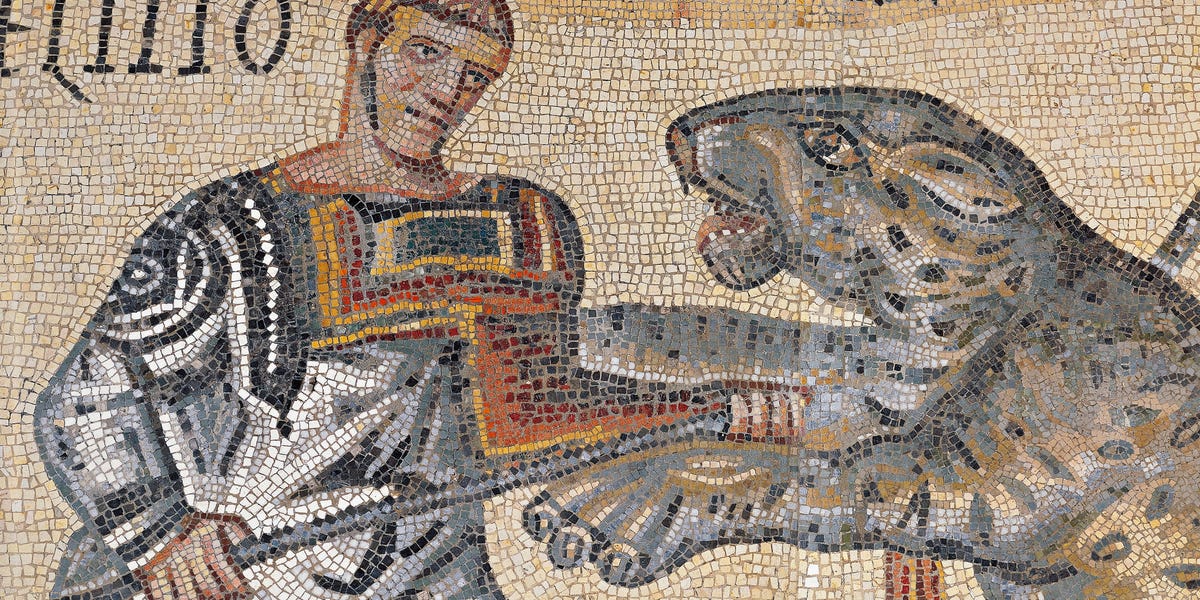
3 min readHere’s what you’ll learn when you read this story:The incredibly popular amphitheater animal hunts of the Roman empire, known as venationes, required careful planning.Ancient Roman law documents show the emperor had a monopoly on lion usage to create the spectacles. Efforts to circumvent the law with fraud were met with fines—in gold. Romans flocked to amphitheaters throughout the empire—including the famous Colosseum—to witness “venationes,” or staged animal hunts. The Roman army thrilled audiences as they went up against fearsome beasts, the highlight of which were lions. But ensuring that there were enough of those beasts to stage the brutal entertainment throughout the empire required the government to establish a monopoly on the kings of the jungle.A group of researchers led by Rosa M. Carreño Sánchez of Carlos III University of Madrid analyzed ancient Roman law documents covering the capture, transport, and safety of animals used during the hunts—which were even more popular than gladiatorial combat. “These texts suggest the possible existence of an imperial monopoly on the capture of lions and reveal some of the practical problems arising from the organization of venatorial spectacles,” the authors wrote in a study published in the Revista General de Derecho Romano.Roman amphitheaters filled with crowds clamoring for the venationes—the hunt of exotic animals that sometimes featured a range of animals alongside lions. Getting the animals in place was a tricky process that required careful planning. In a statement, Carreño Sánchez explained that her team analyzed two imperial constitutions preserved in the Theodosian Code and later carried into the Justinian Code to understand how imperial power exercised strict control over the animals from capture to spectacle.“In late antiquity, faced with the growing scarcity of big cats, a state monopoly on lions was established to guarantee the supply of animals for the emperor’s spectacles and to prevent competition from private individuals,” Carreño Sánchez added. “In other words, all lions belong to the emperor.”The staging of hunts lasted centuries longer than gladiatorial combats, which eventually came under fire from Christians hoping to promote the equality of all humans and eliminate the morally degrading contests. That shift didn’t impact the venationes, however, with the animal-forward displays growing in popularity and spreading beyond Italy into Hispania. Italica, near modern Seville, had one of the empire’s largest amphitheaters—built to host venationes and more—in a city of barely 8,000 people.Ancient texts show that the Roman army assigned soldiers to track, capture, and guard wild beasts throughout the empire. Once captured, though, getting the lions to the shows proved problematic. The imperial government required its provinces to supply transport personnel out of their local budgets, and any delays could indicate that locals used the beasts for their own fraudulent and unauthorized spectacles. To discourage such acts, the imperial administration imposed severe fines—in gold, mind you—to any military commanders unable to meet the timeline.“Unlike literary sources or films, which only show us the final outcome in the arena, an analysis of Roman law allows us to understand what went on behind the scenes,” Carreño Sánchez said, “the management of resources, territorial conflicts, and the enormous logistical effort required by one of the most popular spectacles of antiquity.”Tim Newcomb is a journalist based in the Pacific Northwest. He covers stadiums, sneakers, gear, infrastructure, and more for a variety of publications, including Popular Mechanics. His favorite interviews have included sit-downs with Roger Federer in Switzerland, Kobe Bryant in Los Angeles, and Tinker Hatfield in Portland.
A Bizarre Discovery Has Revealed the Secrets of the Roman Empire’s Most Shocking Spectacle
Full Article
Original Source
Read the full article at Popularmechanics →KhanList aggregates and links to publicly available news content. We do not host full articles from third-party sources. Always verify important information with original sources.