
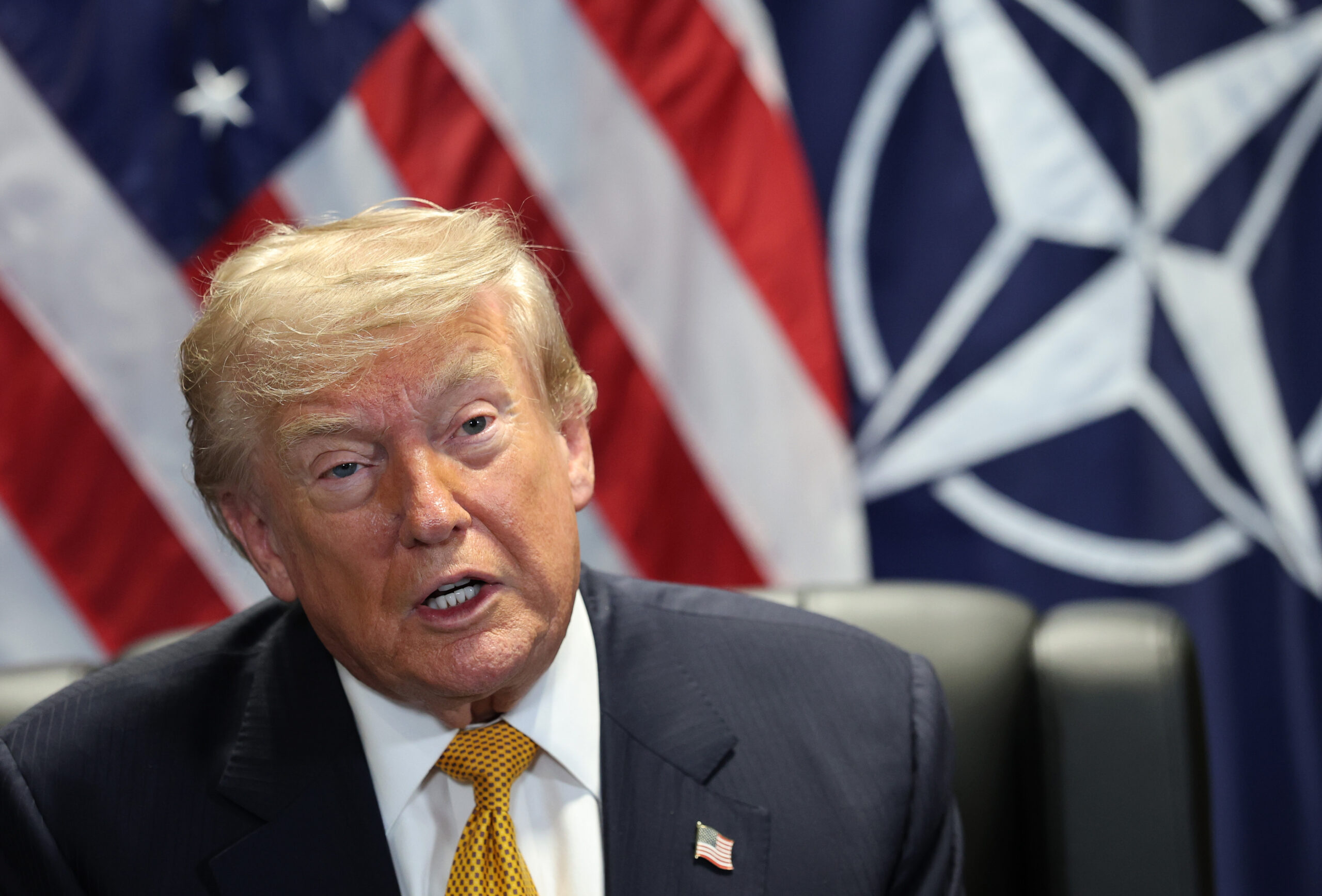
Foreign Affairs President Trump should tell Western allies what the U.S. will do and let them decide how to respond. (Photo by Win McNamee/Getty Images) President Donald Trump wants the Europeans to spend more on their militaries. A lot more. His hectoring—and, more important, Russian President Vladimir Putin’s threats—have spurred continental defense efforts. Many NATO officials sound confident about Europe’s capabilities, even defiant. In September, Secretary General Mark Rutte grandly announced that “if the Russians want to do something against Finland or one of the Baltic nations or Poland or whichever country in NATO, we will see a build up… [and] if there is a build up, we will see it and we will deal with it, if anything happens.” Gen. Alexus Grynkewich, the supreme allied commander for Europe, said something similar a couple weeks later: “Let there be no doubt: should war come, we will block, blunt any attack, and then, if it does not cease, we will break the forces conducting aggression against us.” Yet Europe’s defense remains largely dependent on the United States. And despite Washington’s demands, increasingly tumultuous political dynamics are limiting European military outlays. In the UK, the new prime minister, Andy Burnham, is looking at a $47 billion budget gap. The dicey fiscal situation is exacerbated by rising interest rates, which threaten a fiscal “black hole” and bond crisis. Despite promises to spend more on the military, the British government announced this week it was cutting some $2.7 billion from front-line army equipment, as Burnham’s chancellor tries to balance the budget by trimming defense. Other countries face even greater challenges. France’s Marine Le Pen, the right-wing leader favored to win next year’s presidential election, recently said of aid to Ukraine: “Financially, we can’t do it anymore.” And over the weekend, France endured a wave of rioting and violence that is likely to bring severe economic as well as political consequences. Reports the Telegraph: France is bracing for a fresh sell-off in government debt after a wave of violent protests erupted across the country… Higher borrowing costs will pile more strain on the country’s troubled public finances, while also stoking fears that the violence will lead to a more populist, free-spending candidate coming to power. Nor is France alone in confronting domestic turbulence. The populist right is rising across the continent, and it is generally critical of devoting more resources to the military. According to Politico Europe: “In France, Italy, Belgium, Germany, Poland and Romania, [populist] parties are looking to turn voters’ cost-of-living concerns into opposition to aid for Kiev, and rejection of higher national defense budgets and a greater role for the EU in defense.” Protests against higher security outlays have spread across the continent. In many European nations, including France, Germany, Italy, Poland, and Spain, discontented publics oppose increasing taxes to spend more on the military. The frustration of the Trump administration is therefore likely to grow, and it may respond by applying greater pressure to recalcitrant governments. For instance, Washington has recently taken to playing NATO favorites, holding exclusive meetings with “model allies.” Elbridge Colby, the Pentagon’s policy chief, claimed “the idea is to pull the whole alliance along.” However, last month Trump sounded less welcoming when he declared, “Hundreds of Billions of Dollars was given to Ukraine and NATO, free of charge, that Europe would have paid for—If they were only asked, but we will be asking for that money, though somewhat belatedly!” Yet Washington’s European allies are ever less inclined to heed the president. In a recent Politico Europe piece, Italian parliamentarian Lia Quartapelle was quoted offering a blunt assessment: “We realize [Trump] cannot be trusted and we are on our own.” Former Ukrainian foreign minister Dmytro Kuleba explained that the Europeans “have got used to him” and, moreover, are “drowning in their own problems.” And Daniel Fried, a former U.S. diplomat and assistant secretary of state, noted: Trump wants Europe to do more militarily, but it must buy American… But we can’t sell to the Europeans because of our needs, so they will have to wait even though they can’t build it themselves. Nonetheless, they have to carry the load in Ukraine without us. That’s utterly inconsistent, and they are exasperated by it. The president once threatened to pull U.S. forces from the continent—a move that is long overdue eight decades after the end of the Second World War. The Cold War was a unique moment, but it too has now passed. Russia is much less threatening than the Soviet Union; Europe is now capable of providing for its own security. As Poland’s Prime Minister Donald Tusk admitted, it makes no sense for some (adjusting his numbers) 540 million Europeans to expect 350 million Americans to defend them from 140 million Russians. He concluded: “We must rely on ourselves, fully aware of our potential and with confidence that we are a global power.” However, many European governments have continued to resist U.S. pressure and slow-walk their response to Trump's demands. His oft-hostile rhetorical flourishes notwithstanding, the president has done little to press his point, instead using European defense dependence to engage in economic extortion and demand painful commercial concessions. And the Europeans seem to have basically accepted this state of affairs, admitting that complying with the administration’s trade and investment demands is the price of preserving the American defense dole. The result is a bad deal for everyone. Although the Europeans get a cheap defense ride, they remain dependent on an increasingly unhappy, irascible, inconsistent, and unreliable ally. They can’t be certain that America will race to the rescue in an emergency, especially if it blames them for being ill-prepared. Yet Uncle Sam's protection still encourages confrontation with Russia, making a crisis more likely—even though the U.S., an ocean away, might actually choose to stay out of a conflict. Subscribe Today Get daily emails in your inbox The United States continues to underwrite Europe’s security, forcing Washington to maintain an oversize military and risk American lives and wealth on behalf of prosperous, populous allies able to defend themselves. Yet the Europeans are ever less willing to follow American geopolitical dictates, despite enjoying a de facto subsidy for their more generous welfare states. And Trump’s commercial extortion hurts Americans more than it helps them, raising prices, distorting trade, and inflaming conflict. Washington should instead encourage the emergence of Europe as a friendly, if at times competitive, geopolitical player, able and ready to promote shared economic, political, and other international objectives. To do so, the administration should stop trying to micromanage European military efforts. Instead, Washington should explain what it intends to do and offer to assist Europe in adapting its policy accordingly. If the U.S. reduces its commitment to the continent’s defense, European governments will have to assess security threats and implement appropriate policies, including the creation of sufficient military forces. That means balancing perceived international threats with domestic imperatives. How Europeans respond should be up to them, not Washington. Should the United Kingdom and other European NATO members spend more on their militaries? That is their decision, and their decision alone. Should Washington force Americans to subsidize the Europeans? No, irrespective of what the latter are willing to spend. Both sides should respect each other’s interests. In doing so, Washington should treat European governments as allies, not dependents. That would be a worthwhile agenda for a president who promised to put America first.
A Better Way Than Bossing Europe
Full Article
Original Source
Read the full article at Theamericanconservative →KhanList aggregates and links to publicly available news content. We do not host full articles from third-party sources. Always verify important information with original sources.