
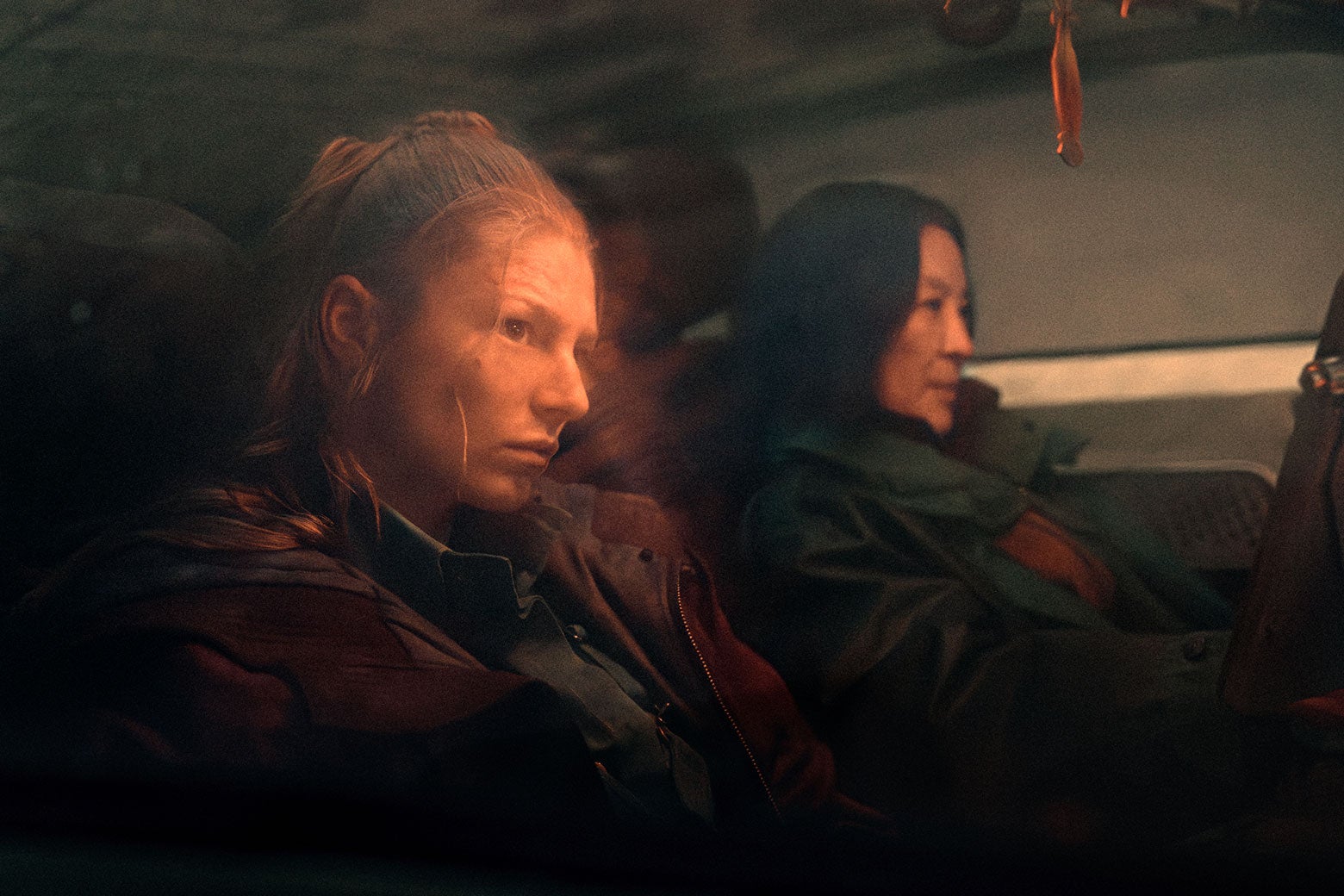
Television Blade Runner 2099 flips the dynamic between humans and replicants By Enter your email to receive alerts for this author. Sign in or create an account to better manage your email preferences. Unsubscribe from email alerts Are you sure you want to unsubscribe from email alerts for Rebecca Onion? Nov 25, 202611:01 AM Prime Video Sign up for the Slatest to get the most insightful analysis, criticism, and advice out there, delivered to your inbox daily. A Blade Runner story, all atmospherics aside, is always about the violent police enforcement of boundaries between humans and human-created intelligent beings, called replicants. In Ridley Scott’s 1982 cult favorite Blade Runner, based on Philip K. Dick’s Do Androids Dream of Electric Sheep?, Rick Deckard (Harrison Ford) is a “blade runner,” tasked with finding and “retiring” rogue replicants. An enforcer in a world where replicant labor is subjugated to human will, his mission is to find and “retire” four replicants who have rebelled against their masters on an off-world colony and returned to Earth to try to force their creator to lengthen their lifespan. In Denis Villeneuve’s gloomy, beautiful 2017 sequel, Blade Runner 2049, Ryan Gosling’s replicant character K is also a blade runner, working for a human boss hunting down fellow replicants. K becomes involved in the uncovering of a secret: A replicant has given birth, something that’s not supposed to happen. In each of these movies, the humans act none too admirably, and the mood has been one of moral ambiguity. Now, in the new Prime Video miniseries Blade Runner 2099, the humans are getting their comeuppance. This latest addition to the franchise, created by Silka Luisa, is set in the same world as the two movies. But there’s something remarkably different here: There’s been a replicant uprising, and in a major reversal of the dynamic Blade Runner is known for, the humanoids have the upper hand, and are making humans do all the dirty work they once reserved for artificial beings. “Blade runner,” in an act of reclamation, is now the name given to replicant police officers who track down and arrest rebellious humans. Michelle Yeoh plays Olwen, a blade runner. Euphoria’s Hunter Schafer is Cora, a human who’s pretending to be a replicant while in pursuit of yet another secret that will shift the balance of power between the two parties: In 2099, replicants, while dominant, still have the vulnerability of built-in expiration dates—but what if they didn’t? It’s hard not to sigh when you hear of a beloved movie franchise becoming television, but this show works more often than it doesn’t. Here we have eight hours of classic Blade Runner vibes, with the show heavily indebted in its approach to the production designers and cinematographers of the first two films. Bleak landscapes, monumental architecture, flying cars, rain in Chinatown, replicants born out of oversize envelopes in a gush of goop—this show will make you swear off LED lighting for good, recalling this degraded world’s tech-y pinks and oranges shining through the smog. The show’s composer, Shōgun’s Leopold Ross, follows Vangelis’ score for the original film, using moody synthesizers and heavy hits of saxophone, for the noir. The costumes play along—nobody will ever cut a better figure than Schafer does in a wide-shouldered, padded jacket and puffed pants that nip in at the ankle. Every scene brings a new look: the replicants staffing a training center for human children who are learning to administer Voight-Kampff empathy tests are dressed in jackets with epaulets that jut outward, making for ’80s silhouettes approaching “David Byrne in Stop Making Sense” territory. Eight hours of this admittedly puts the show at the risk of becoming too much. That’s a problem, because Blade Runner, as a universe, is at its best when it withholds, then reveals. Ryan Gosling’s K busting through a wall while fleeing his fellow blade runners in Villeneuve’s film is a good example—of course a replicant has that ability, but the movie lets you forget he’s got this power, get lulled by his apparent humanity, then be bowled over in the moment when it happens. Blade Runner 2099, by comparison, has a replicant straight-up manhandle a bench anchored in concrete in Episode 1, and by the end of the season, you’re watching a battle between replicants where walls are coming down left and right, like it’s an HGTV home renovation show. Likewise, the two films were spare in their delivery of emotional moments, reflecting both the dire nature of the environment and the fact that half the people onscreen were replicants whose questionable ability to feel and express emotion is part of the plot. Here comes a nine-year-old spoiler for Blade Runner 2049, which you really should watch: In that film, there’s a devastating scene when K realizes that his hopeful suspicion that he might, himself, be the one replicant child who was born instead of made, was incorrect. In 2099, often to the show’s detriment, we’re getting a big revelation like this every episode or so. Who’s a replicant, who’s a human, who’s an old-style replicant with an expiration date, and who’s something new; this is television, and things must move along. Still, 2099’s actors commit and ultimately pull this off. Schafer has the perfect balance of delicacy and strength—she’s fun to watch in the action scenes and moving in the emotional ones. Yeoh, a trench-coated and severe figure, is, by turns, convincingly maternal. Matthew Needham, who plays the unctuous and scheming Larys Strong in House of the Dragon, is excellent as a fellow blade runner who’s far too effective at his job, and becomes a danger to the undercover Cora. A character who appears in the latter episodes, Clothilde (Amy Lennox)—a replicant working with the show’s primary antagonist—is manic and dangerous, like Daryl Hannah’s Pris character in the 1982 original, and offers some moments of actual comic relief. Humor, in Los Angeles, in the year 2099? It’s a rare, and welcome, thing, a little bit like this series. Amazon Movies Science Fiction TV
A Beloved Sci-Fi Franchise Has a New TV Sequel. Surprisingly, It Works.
Full Article
Original Source
Read the full article at Slate →KhanList aggregates and links to publicly available news content. We do not host full articles from third-party sources. Always verify important information with original sources.