
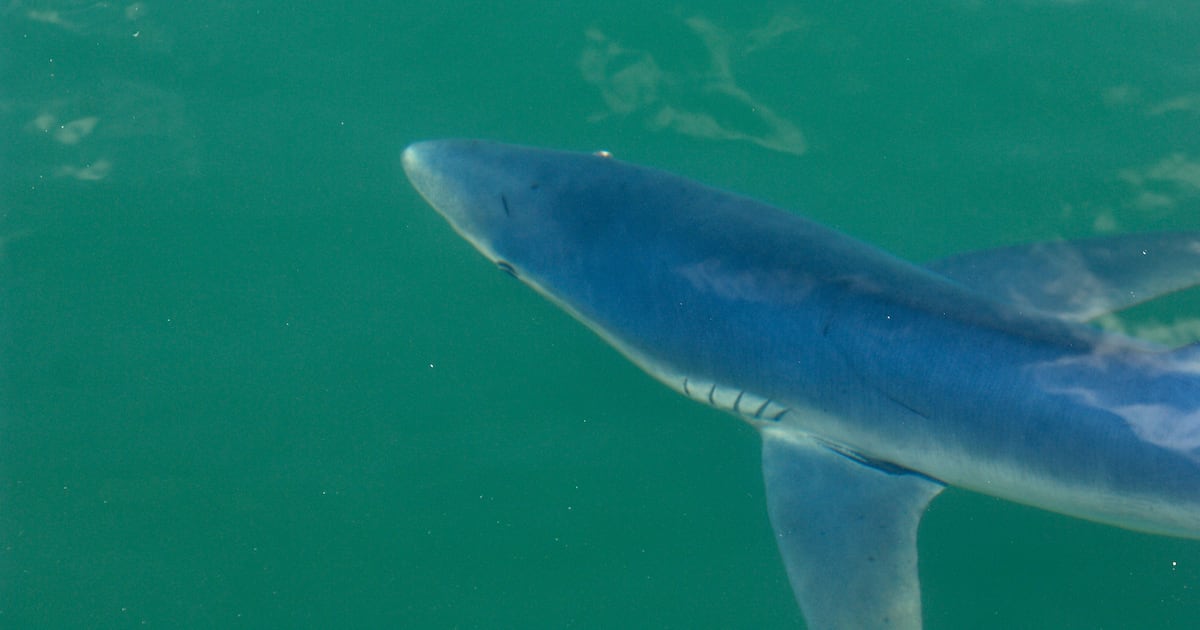
Irish Wildlife Trust has moved to reassure the public that most sharks are “not aggressive” and there have been no documented unprovoked attacks on humans in Irish waters. The trust was speaking following an incident on Tuesday in which an angler was bitten by a blue shark on the deck of a boat off the coast of Co Waterford.Experienced angler Sebastian Achim was fishing with four others about 6.5km from Ram Head, Ardmore, when a shark he had caught lunged for him on the deck and bit his calf, causing significant injuries.Speaking to The Irish Times, Achim said no one was at fault for the incident, especially not the shark, and hoped the incident raised awareness.READ MORE“It could happen to anyone,” he said. “Myself, I will stop fishing for [blue shark], because I got my lesson. I got my shark anyway ... but I’m not telling anyone to stop, just to be more careful.”Blue sharks can grow to 3m in length and are present in Irish waters between June and October, according to Inland Fisheries Ireland.Grace Carr, marine advocacy officer for the Irish Wildlife Trust, said shark bites were “not common at all” in Ireland and “there’s no documented shark bites happening whenever someone’s in the water swimming ... [or] any sort of unprovoked attack”.She said there were about 35 species of sharks in Irish waters.She described the pelagic blue sharks as “absolutely stunning”, with the “beautiful blue colour” on their topside.She said they were “very slender ... like a torpedo shape”.A former scuba diving instructor, she has swum with blue sharks and intends to do so again next week.She said the shark involved in Tuesday’s incident had been put in a “very stressful situation” by being caught and taken out of the water.“I think anybody would react that way. Any animal and any human would react that way,” Carr said. “It’s not the shark’s fault ... they’re a beautiful animal to see in the water and their temperament is very non-aggressive.”She said recreational shark fishing was legal in Ireland, mostly on a catch-and-release basis. She added that this did not apply with basking sharks, which are protected.Carr said she had met anglers who were “very conservation-minded” and “do care about the animals and their safety”.However, she said: “That’s not everybody. There’s going to be anglers out there that don’t care and aren’t being responsible.”She said shark fishing should be “more strictly regulated” and people planning to do it should have to go through “special training”.“For example, some of the photos that you see of people holding the sharks, they’re not actually supporting the animal’s body ... you really need to hold it the correct way to support its organs. Otherwise, you’re going to be causing damage,” she said.Carr also said there was “a lot of post-release mortality, with no way of knowing if the animal will have suffered injuries or if it will then die”.She said there were some “great operators out there” who “really care” about the animals and work with marine biologists“It’s important to definitely go with an operator who has that experience and that knowledge and that care.”She added anglers, “the ones that are responsible and that have done training”, have contributed “a lot” to research in Irish waters.She gave the example of Inland Fisheries Ireland’s marine sport fish tagging programme and said anglers had to be trained for this and learn to properly tag and release an animal safely.She said programmes such as this gave information and data on animals, which she said could help for conservation “so we can identify where there’s really important areas for sharks”.She said it had been noted globally that there were several important shark and ray areas in Irish waters.“Anglers do help with scientific research,” she said, but added “people should have to go through the training and licensing procedure”.Blue sharks are near threatened in the North Atlantic, she said. Despite this, there are “a lot” of blue sharks in Irish waters.She said the decline in numbers was “definitely a concern”.She said if people did not have sufficient knowledge and expertise, they might not realise they have caught a critically endangered species.The Irish Wildlife Trust is advocating for marine protected areas where activities would be restricted to certain levels so “animals have this place of refuge and habitats can grow healthy”.Carr added that the Government needed to look at introducing regulations on recreational activities such as shark fishing.“If you’re going to be handling wild animals ... people should be trained appropriately for the safety of the animal and for themselves.”
‘A beautiful animal’: Shark fishing needs more regulation and training, expert says
Full Article
Original Source
Read the full article at Irishtimes →KhanList aggregates and links to publicly available news content. We do not host full articles from third-party sources. Always verify important information with original sources.