
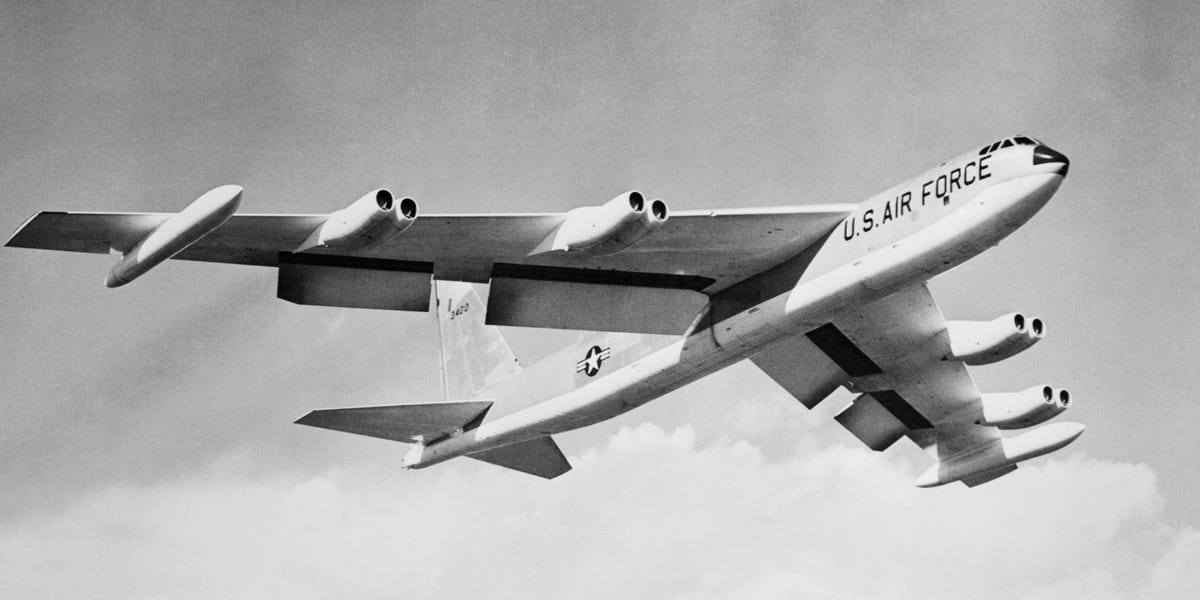
11 min readJUST AFTER MIDNIGHT on January 24, 1961, 18-year-old Billy Reeves came home from his late shift, kicked off his boots, and looked up just in time to see a B-52 falling out of the sky.Reeves lived with his parents in a small, narrow house on Big Daddy’s Road in Faro, a tiny community in North Carolina so close to Seymour Johnson Air Force Base in Goldsboro that military aircraft were part of the landscape. But this one was different. From his bedroom window he watched the bomber roll over the tree line and plummet toward the ground, somewhere frighteningly close.“It turned over twice, and then it landed and exploded,” Reeves recalls. “The fire went up higher than 100-foot pine trees.”Soon a military helicopter was circling overhead in the early hours of January 24, ordering everyone out. By morning, Reeves and his neighbors were still trying to make sense of what had fallen around them: burning wreckage scattered across the fields, debris hanging from trees, the heavy smell of fuel in the air. The aircraft, they learned, was a B-52 Stratofortress, a massive eight-engine military bomber that had broken apart in flight just miles from the base.But something else had come tumbling out of the B-52 before the aircraft finally dropped in a field close to Big Daddy’s Road: two thermonuclear bombs.One bomb landed in a thicket of gum trees, its parachute tangled in the limbs, just yards from Reeves’s house. The other, whose parachute did not deploy, slammed into a tobacco field at roughly 700 miles per hour, leaving a crater six feet deep and 15 feet wide. Each of these hydrogen bombs packed a destructive power 250 times that of the atomic bomb that annihilated Hiroshima. These two “broken arrows”—military parlance for lost nuclear weapons with the potential to detonate—were suddenly stuck in rural North Carolina.They hadn’t fallen there by accident. Not exactly, anyway. They were there because of a Cold War strategy that kept nuclear-armed American bombers in constant flight. And now, one terrifying question hung over Faro and far beyond it: Just how close had the United States come to detonating a nuclear weapon on its own soil?“We’ll never know with any precision exactly how close we came to the worst catastrophe imaginable—but it was damn close.”BY 1961, THE B-52 Stratofortress had become the bomber the United States trusted to carry its nuclear threat into the sky. The aircraft had first flown less than a decade earlier, in 1952, and it would prove so durable that the Air Force still relies on it today as the backbone of the bomber fleet. As the U.S. military continues work to bring a new stealth bomber, the B-21 Raider, into service, it still relies on its 76 Stratofortresses, which are expected to remain in service for close to another 40 years.“Based on longevity alone, it is probably the most successful and versatile military aircraft ever designed,” writes Joel Dobson, a veteran of the U.S. Air Force, in The Goldsboro Broken Arrow, a definitive account of the 1961 crash and its aftermath in North Carolina.But at the height of the Cold War, the B-52’s purpose was brutally specific: to keep American thermonuclear weapons close enough to strike back if the Soviet Union struck first.Pilots gave it the nickname BUFF, for “Big Ugly Fat Fellow,” although to some, the second “F” often stood for something saltier. Developed by Boeing, the B-52 was 160 feet long with a wingspan of about 185 feet. Fully loaded, it weighed nearly 488,000 pounds, carried fuel for eight jet engines, and could haul up to 70,000 pounds of bombs. It could deliver destruction at an intercontinental scale.The B-52 entered service in a country bracing for a surprise Soviet nuclear attack. In the 1950s and early ’60s, fallout shelters and “duck and cover” drills, where students would huddle beneath their desks, turned nuclear fear into part of American life. The U.S. military was also worried about the so-called “bomber gap,” the fear that the Soviet Union had gained an advantage in long-range bombers and with it, the ability to strike first.Public DomainAir Force teams excavate the remains of a hydrogen bomb that slammed into a North Carolina tobacco field at roughly 700 mph. Investigators eventually recovered much of the weapon—but part of it remains buried underground today.“U.S. military and U.S. civilian policymakers were extremely concerned, sometimes to the point of panic, about whether and how the Soviet Union could launch a sneak attack upon the United States,” says Stephen Schwartz of the Bulletin of the Atomic Scientists. “And that was all predicated on assumptions about the size and the capabilities of the Soviet nuclear arsenal.”The B-52 became part of the answer: a long-range bomber that could be refueled in midair, carry a payload of thermonuclear weapons, and remain ready to retaliate even if Soviet missiles destroyed American bases on the ground.The Stratofortress became the foundation of the military’s Strategic Air Command (SAC), the force built to deliver America’s nuclear response. Under General Curtis LeMay, SAC became what Dobson describes as a “powerful machine” built for a new kind of war: “total annihilation of the Soviet Union.”In 1961, the U.S. military announced a new program called Airborne Alert. No fewer than 12 bombers would be in the air at all times, flying nuclear deterrence routes over Canada, Greenland, and to the Mediterranean. Every plane was always armed with at least two hydrogen bombs. If the Soviets launched a nuclear strike, the U.S. wanted aircraft already airborne and ready to retaliate. Those airborne-alert missions would soon evolve into what became known as Chrome Dome, and the B-52 became their defining aircraft.“The B-52s at that time were painted the nuclear blast reflection pattern: light gray on top, brilliant white on the bottom,” writes Dobson. “And supposedly there would be so many of them flying overhead that from below it would look like an aluminum overcast, hence the name Chrome Dome.”At its peak, SAC’s fleet was made up of 2,921 bombers and refueling tankers, all trained on at least 2,600 targets, equipped with an arsenal of 22,229 nuclear bombs, according to Dobson. The Soviets at that time possessed only 1,060 nuclear bombs, his research found. “Many people in the 1950s and 1960s believed with almost religious fervor that it was SAC alone that kept them safe from the Soviets,” Dobson writes.Some of those nuclear-armed B-52s took off from Seymour Johnson Air Force Base in Goldsboro, North Carolina. At 10:56 a.m. on January 23, 1961, one of them lifted off with two hydrogen bombs in its bay. It would never return to base.“All the engineering in the world can’t save you all of the time.”READINESS CREW R-10, part of the 4241st Strategic Wing at Seymour Johnson Air Force Base, had been preparing for the flight for days. The eight-man crew was scheduled for a 25-hour nonstop qualification mission, according to Dobson: a long loop over the Atlantic, just off the coast of North Carolina, meant to prove they could fly the kind of long-range airborne-alert route that would soon become part of Chrome Dome.The B-52 isn’t exactly the most comfortable of rides. Dobson, in his book, compares being aboard the gas-guzzling bomber to “taking a very long trip in a very small car without windows” and experiencing “tilting, shaking, dropping, and climbing” forces the entire time. In the bomb bay sat two Mk 39 Mod 2 hydrogen bombs. Each weighed 6,750 pounds, stretched 11 feet long, and carried a yield of 3.8 megatons. The bomb dropped on Hiroshima was about 16 kilotons—almost 240 times less powerful.A thermonuclear bomb wasn’t supposed to arm because it fell out of an airplane. The crew had to follow an exact checklist of at least half a dozen steps before launch could be confirmed. Only after those steps would the radar navigator break a safety wire, a control Dobson describes as the only device on the aircraft that required both hands to operate. Once that wire was broken, a 28-volt electric current would be sent to the MC-772 Arm/Safe switch on each bomb. That switch would matter enormously in the field outside Goldsboro.Walter Tulloch, the B-52’s aircraft commander, and his crew were having a routine flight up until 9 p.m. on January 23. Their B-52 was flying at 29,000 feet over Columbia, South Carolina, when it approached its second refueling. A tanker moved ahead and above the bomber, lowered a 40-foot telescoping boom, and connected with an opening at the top of the fuselage. During the refueling, the tanker’s boom operator saw a fuel leak coming from the B-52’s right wing. The fuel began to flood the wheel well of the plane, covering the bottom of the hull and the electrical equipment inside.Then Tulloch discovered another problem: The fuel pumps weren’t working. Rather than attempt an emergency landing with full tanks, he took the B-52 out over the ocean, about 30 minutes east of Wilmington, North Carolina, to burn up excess fuel by flying one loop after another. After radioing with the wing commander at Seymour Johnson, Tulloch turned back toward the base.What Tulloch didn’t know was that a hole was forming in the right wing of the plane. Weeks earlier, the Air Force and Boeing realized that fitting the B-52’s wings with fuel bladders made for a “wet” wing that might cause fatal cracks or tears. (Tulloch’s aircraft was scheduled for future maintenance.) According to a classified document made public in 2014, this was the critical event. “While in the act of burning up the excess fuel in the aircraft, the hole in the right wing apparently became a major rupture,” reads the report.Just 15 miles from the base, Tulloch made a final turn to set up his approach. Then came what Dobson describes as “a loud cracking and thumping noise.” The bomber rolled uncontrollably to the right. There was an explosion. Then the right wing began to fold on itself. The plane was lost.“Bail out!” called Tulloch into the B-52’s interphone. Of the eight men aboard, five made it to the ground alive. A sixth escaped the aircraft but didn’t survive the landing. Two others died in the crash. As the bomber disintegrated in the air, both Mk 39 Mod 2 hydrogen bombs separated from the aircraft. It was 12:35 a.m. on January 24. The nightmare on the ground was just beginning.APAs a young Air Force explosives officer, Jack ReVelle led the team that recovered and disarmed the hydrogen bombs after the 1961 Goldsboro accident. Decades later, he remained convinced that the United States came frighteningly close to catastrophe.IN THE FIRST hours after the crash, Reeves’s bedroom filled with red light from the burning wreckage barely a quarter mile away. Pieces of the B-52 lay on the ground inverted, demolished, and on fire near Big Daddy’s Road. In the next room, he could hear his mother praying. She thought the end of the world was upon them.His neighbors were just as disoriented. Kerosene fumes filled the air, smoke billowed, and burning debris hung from trees. Flames shot up hundreds of feet into the air. One man, Rudolph Tyndall, rushed home to his parents’ house in Faro after a friend told him what had happened. “My daddy said when he looked out the window that all he could see was fire,” Tyndall told Dobson. “He said he thought the whole world was on fire, and my mama, she said she thought it was the end of the world.” Though the Tyndall house stood dangerously close to the wreckage, the only thing that broke that night was a single windowpane.Over on nearby Shackelford Road, a different scene was playing out. Charles Davis, a local cotton and tobacco farmer, was riding shotgun with an Air Force major when they approached a large object nose-down in the soil, tangled by its parachute in a cluster of trees. It was one of the Mk 39 Mod 2 bombs. The other was in a cratered hole, underneath soil and dirt, on the other side of Big Daddy’s Road.“I wasn’t scared that night,” Reeves says. “I got scared afterwards—after I found out that it was a nuclear bomb on the plane.”Help was already on the way. Jack ReVelle, a young first lieutenant in the Air Force and commander of an explosive ordnance disposal squadron, reached Seymour Johnson Air Force Base by 8:30 a.m. on January 24 after being flown in from Ohio. A few hours later, his 14-man technical team arrived. Their job? Disarm and secure both nuclear bombs.The bomb in the trees was the easier one. When ReVelle inspected it, the Arm/Safe switch was still in the Safe position. The weapon was intact, unarmed, and stable enough to remove from the scene.The second bomb was different. It had hit the ground without a parachute and buried itself in a crater. A local excavation company began digging. Water seeped into the hole and had to be pumped out. As ReVelle and his technicians worked through the mud, they began finding pieces of the weapon. This wasn’t the kind of bomb that was dropped on Hiroshima; it was a thermonuclear device that contained a typical atom bomb and plutonium and hydrogen isotopes on the inside. The atom bomb triggers the thermonuclear explosion.“In a week’s time, it was like a small city,” says Reeves. “They had put lights all around that burned day and night while they were trying to get the bomb.”On the fifth day of the excavation, ReVelle climbed down into the muddy pit and found the bomb’s primary, the fission component that contained the plutonium and uranium needed to start the nuclear reaction. He carried it out wearing gloves.Then a technician found the bomb’s Arm/Safe switch. A red triangle marked with the letter “A” was visible. To the men in the field, the weapon appeared to be armed. Future analysis showed that three of the four safety devices in this bomb had been activated. One more, and it would have completed the arming and firing sequence.Speaking at East Carolina University in 2013, ReVelle told the audience that if that bomb had exploded, “it would have created a crater eight football fields wide.” He continued: “It would have destroyed every structure within a four-mile radius. There would have been a 100 percent kill zone for eight and a half miles in every direction.” ReVelle, who died in 2020, also noted that a cloud of radiation would’ve spread far and wide.“We’ll never know with any precision exactly how close we came to the worst catastrophe imaginable,” he told the audience. “But it was damn close.”“In this case, it was a matter of just dumb luck.”DECADES LATER, THE Goldsboro broken arrow incident became more complicated. While the Arm/Safe switch that ReVelle and his team found appeared to indicate that the second bomb was armed, it’s more likely that the indicator may have malfunctioned after impact, rotating into a position that made the weapon look armed even if the switch itself remained in Safe.One part of the accident remains buried—literally. By January 30, 1961, the excavation crater was 22 feet deep, 50 feet wide, and 70 feet long. But still, ReVelle and his technicians couldn’t locate the secondary fissile component to the Mk 39. Eventually the military filled the hole and left an unrecovered secondary component of the bomb 180 feet underground, paying the farmer who owned the land $1,000 for rights to the area.Goldsboro wasn’t the only broken arrow of the Airborne Alert era. In 1964, a B-58 Hustler with five thermonuclear weapons aboard caught fire at Bunker Hill Air Force Base in Indiana. During the recovery, the secondary core of one of the bombs caught fire and had to be extinguished with sand.The practice of arming bombers with thermonuclear weapons ended in January 1968 after another B-52 crashed near Thule, Greenland, while carrying four thermonuclear bombs on a Chrome Dome route. All four nukes were destroyed in the ensuing fire, spreading radioactive material above the sea ice where the crash took place. Within a day, an internal Strategic Air Command memo circulated with a blunt order: “Terminate the carrying of nuclear weapons aboard airborne alert aircraft.”Declassified reports examining the 1961 event were unsparing in their criticism of what took place that fateful night and why it happened. “The Mk 39 Mod 2 bomb,” reads the report written in 1969, “did not possess adequate safety for the airborne alert role in the B-52.” Without that low-voltage Arm/Safe switch, it’s likely both bombs would have detonated—killing all 80,000 residents of Wayne County, North Carolina, as well as carving off a chunk of the state itself.“All the engineering in the world can’t save you all of the time,” says Schwartz, of the Bulletin of the Atomic Scientists. “In this case, it was a matter of just dumb luck.”Reeves, now 83 years old, chalks up the fortune of Faro’s residents that night to a higher power. “By the grace of God,” he says, “those that are still living and hadn’t passed away from actual death or whatever else, were saved by the grace of God.”Andrew Zaleski, a writer based near Washington, D.C., covers science, technology, and business.
A B-52 Accidentally Lost Two Hydrogen Bombs Over North Carolina. One Nearly Detonated. One Is Still Buried.
Full Article
Original Source
Read the full article at Popularmechanics →KhanList aggregates and links to publicly available news content. We do not host full articles from third-party sources. Always verify important information with original sources.