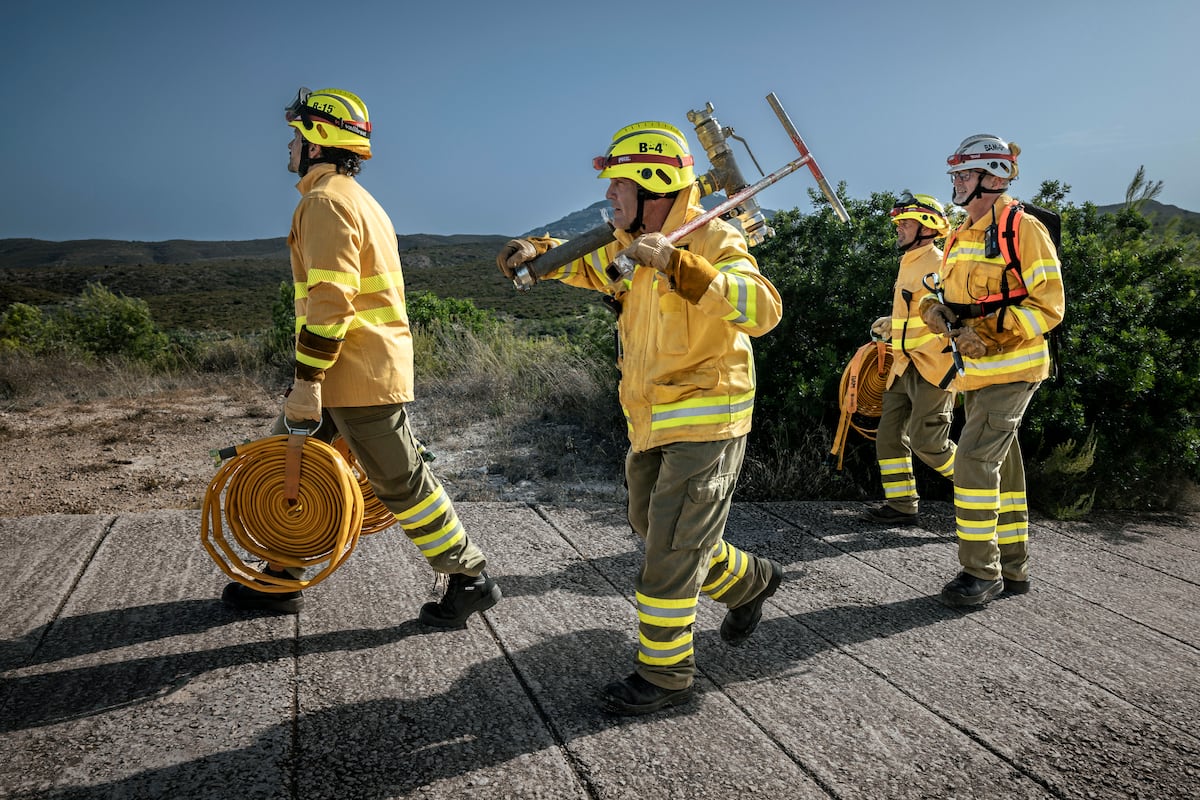
Twenty-five years ago, Adam Lake took part in rescue operations after the attacks on New York’s Twin Towers. There he lost 11 members of his unit. Now, nearly 4,000 miles away, the retired firefighter pulls on his fireproof pants and jacket, straps on his boots and grabs his gloves and helmet. He has lived in Jávea (Alicante) for two years. Beside him, three other volunteers — an Englishman, a Colombian, and an Irishman — finish gearing up before climbing into the vehicle they will use to patrol the municipality. It is Wednesday, July 15, and one of the hottest days of the summer so far. The wildfire risk alert is extreme and they patrol daily.The four are part of Balcón de Mar, a group of 23 volunteers founded in 1981 by Swiss residents of Jávea to assist the town council with wildfire prevention and other emergencies. The mission remains the same, but the town has changed. Dozens of single-family housing developments spill across the pine-covered hills in a maze of steep streets, which complicate firefighting teams’ work if a blaze breaks out. The population also rises from 30,000 to 120,000 in summer, and a large share of these residents do not speak a word of Spanish.This is a situation repeated across much of Spain’s holiday destinations, many of which still lack the wildfire prevention plans required by the 2003 Forestry Law — though only places that regional governments identify as high-risk are obliged to prepare them.Jávea’s local wildfire prevention plan was initiated two years after the 2016 fire in the Granadella natural park that marked the town: it burned 812 hectares, affected more than 300 houses, and destroyed seven. “That was hell; the fire ran through the hedges of the houses, jumping plot by plot; we weren’t attending to the blaze, only the houses, evacuating people, because there were fires everywhere. We realized our vulnerability,” recalls José Antonio Monfort, chief of the town’s local police.They had already suffered another large fire in 2014, in the Montgó massif natural park, Jávea and Dénia’s most emblematic mountain, which also has housing developments nearby and is one of the highest-risk areas. They now have the plan and a new map of the rural-urban interface, an area where woodland and houses practically touch. They have also restored abandoned water tanks to supply helicopters, acquired drones with thermal cameras, and created WhatsApp groups among housing developments. They also clear the scrub to reduce fuel loads in strategic areas — for which they employ a herd of goats during winter. Jávea covers 68 square kilometers (26 square miles), a third of which is forested, and 54% of the population lives in dispersed housing.Self-relianceWhat Jávea still has not achieved is a year-round fire station of its own; the nearest is in Dénia, about 20 kilometers (12 miles) away. “They only send one [crew] from June 15 to September 15, from 10.00 a.m. to 10.00 p.m.,” laments Mayor Rosa Cardona (PP). She also warns that despite all the effort, which includes self-protection measures, “zero risk does not exist.” The experience has taught them “not to rely on supra-municipal organizations,” she adds.But what really makes a difference in this municipality compared with others are the volunteer firefighters and the 48 members of Civil Protection (30 of them trained to intervene in fires), trained and equipped by the town council, who divide the municipality up to carry out patrols. “This collaboration allows fires to be put out when they are just starting,” says Ferrán Dalmau, a forest engineer and wildfire prevention expert. With his company, MediXXI, he has drafted more than 200 plans of this type, including Jávea’s.They divide the town among themselves. Lake, 59, is equipped to leave from the base and start the patrol around Cabo de la Nao. He says he joined the corps to “help his new community” and, in a way, return to a job that he has always been passionate about.He and his wife fell in love with Spain after doing the Camino de Santiago in 2019. They decided to keep traveling around the country and went from Valencia to Estepona. When it came time to choose where to settle, Jávea was their choice. They were won over by the surroundings, but also by the friends they made. “I contribute my experience in city fires in New York and they teach me how wildfires are here. We all learn from each other,” he says. He still does not speak fluent Spanish, but he is learning.Alongside him, Colombian Steven Muñoz, 30, a martial arts instructor and photographer, nods: “I’ve only been doing this seven months and one of the things I like most is that I have colleagues with years and years of experience. We’re not just four guys from the neighborhood.” Irishman Terence Curran, an ex-serviceman and now a real estate agent, has been the group commander for nine years and is particularly pleased that Spaniards are joining. Both climb into the off-road vehicle equipped with hoses bound for the Granadella forest park. Curran, 59, explains that they watch over the southern part of the territory while observing how vegetation has regrown since the fire 10 years ago.Neighborhood watch via WhatsAppRoman Sotnikov has lived in Jávea for 11 years and manages the WhatsApp group that connects residents with the local police in the Tesoro Park development, in the south of the municipality. Surrounded by pine forests and single-family homes, it is one of the high-risk fire zones. Sotnikov is head of safety and fire prevention for the neighborhood association, which comprises about 80 homeowners.In the past month they have had two fires near the development that were extinguished quickly. “The person who sees the fire calls 112, where you have the option to speak English; I inform the residents through a WhatsApp group we have just for important matters,” he says. After that, they must wait for instructions from the authorities. “I tell them what to do, because here 90% of us are foreigners, people speak little Spanish and my role is to ensure communication,” Sotnikov says, in good Spanish.“Of course we are afraid, we live near the woods and we see temperatures rising,” he says. One problem they face is rented houses, where owners should inform tenants about the strict rules. “When we are on red alert, you can’t light a barbecue even in your own garden,” he cites as an example.“It’s very important that they call immediately, because fires start with a tiny flame,” adds Miero Serra, head of Civil Protection in the town, while showing the vehicles they use to patrol. When they receive an alert, they leave immediately. If the firefighters have not yet arrived, they begin to act until the fire service takes command. Their lighter vehicles and local knowledge allow them to arrive first and tackle many blazes when they are still just embers. They also have pumps they can operate with private swimming pools — there are more than 9,000 in the area.Dalmau warns that “in this context of climate change, municipalities that are preparing themselves have more guarantees, especially if they involve the population so it is part of the solution, not the problem.” Jávea is an example of a town that has decided to boost its response to fire. “Working together is the way to manage what is coming. You have to choose between improvisation or planning, and that is the difference between some places and others.”Sign up for our weekly newsletter to get more English-language news coverage from EL PAÍS USA Edition
A 9/11 firefighter in the Mediterranean: The volunteer brigade on the front line of Spain’s wildfires
Full Article
Original Source
Read the full article at English →KhanList aggregates and links to publicly available news content. We do not host full articles from third-party sources. Always verify important information with original sources.