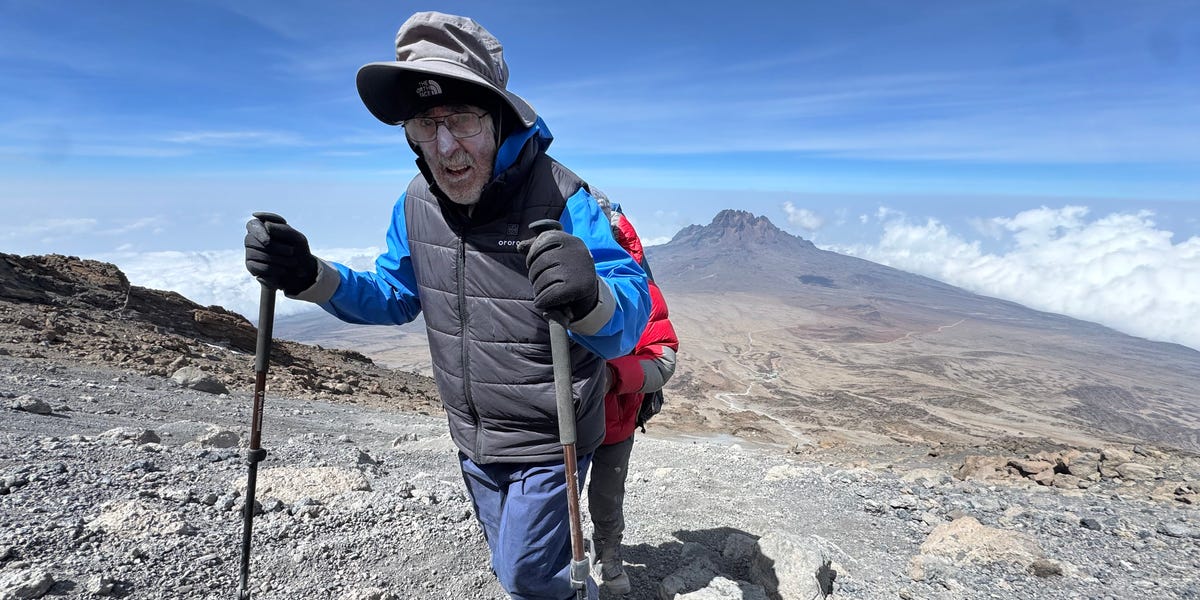
Turning 90 years old is a huge deal, which is why 90th birthday celebrations tend to go big: a massive family gathering at the Cheesecake Factory, an official shoutout at a concert or sporting event, a parade float throne … Or, if you’re Dr. Art Ulene, you could celebrate your 90th by breaking a world record and becoming the oldest person ever to climb Mount Kilimanjaro, the highest peak on the African continent. And, he told Runner’s World, he ultimately did it to inspire others in his age group and younger to challenge themselves in the name of health and longevity.“I climbed Kilimanjaro trying to be a role model,” he said. “I'm not telling people they should climb Kilimanjaro, but I am telling people they should get out of their front door, walk around the block, find a hill in town.”Early in his career, Ulene worked at the University of Southern California as a professor and in the hospital as “a very traditional obstetrician-gynecologist.” But when he started to notice the prevalence of preventable health problems, he started to shift his focus to health education and prevention, leading to a 23-year career on television. “I think I was able to accomplish more, prevention wise, than I could have in 100 years of medical practice,” he said.After an early retirement, he’s found himself back to work, just with a slightly different focus. “Now that I'm 90, I've decided to concentrate on health promotion for older people. We're dealing with tens of millions of older people, many of whom are ill, or not as well as they could be, in significant part because they're not doing the things that would keep them well.” In collaboration with the organization CareScout, Ulene hopes to inspire people to continue living life to the fullest as they age.Below, Ulene shared how he prepared for his big climb, what it was like getting to the summit, and his advice for increasing your “peak span.”The IdeaIt’s not the first time Ulene has embarked on the Kilimanjaro climb. In fact, it’s the fourth. He and his wife first reached the summit about 15 years ago, when they were in their seventies. “I was looking for adventure; a guy challenged me to climb Kilimanjaro,” he remembered. “This is a friend of mine who has climbed Everest. And it took on a life of its own.”Soon, his wife had decided to join him, and the pair of them started to train at the gym. They reached the peak together twice, and a friend told them then that they were probably the oldest couple ever to climb Kilimanjaro. The two of them never got around to applying for that particular record, but the idea stuck.“Somehow this came up again recently, and someone said, ‘Do you know the world record is 89 years old and 27 days? Why don't you do this for your 90th?’” said Ulene. “It was almost like a joke. And I said, ‘Fine, I'll do that.’”Courtesy World Wide TrekkingThe PreparationUlene attributed his record-breaking achievement not just to his training plan leading up to the climb, but also to his longstanding healthy habits—despite a general distaste for the actual experience of exercise. He recounted a recent conversation he’d had at the gym with a fellow gym-goer during one of his three or four workouts a week.“He said, ‘I just love doing this. I get an adrenaline rush,’” he remembered. “And I said, ‘Well, I get my adrenaline rush when I get down to the parking lot and get to leave.’ I don't like exercise, but I love the way it makes me feel.”When he started training for Kilimanjaro, he didn’t change much, since he already uses 10 different machines in a single workout at the gym. He simply increased his time spent on the Stairmaster: “I started with 10 flights of stairs and got up to 50 flights of stairs, three times a week.”The one thing he does every single day, though, is put one foot in front of the other. “Do I run? Yeah. I run very, very slowly,” he joked. A casual runner in his younger years, Ulene can no longer run because he badly injured his back in a motorcycle accident years ago. Instead, he goes out and walks three or four miles in his neighborhood.The Washington Post//Getty ImagesUlene works on his balance while training for the climb.“At the end of every block, I pick up the pace,” he said. “I get to huffing and puffing a little bit. I get to where I can't sing, and at the age of 90, that's enough.” It’s a reminder that running can look different at different stages of your life, especially because older people are at much higher risk of serious injury in the case of a fall. Still, if you can run, he sees no problem with it. After being banned from skiing for five months because of a hip surgery, Ulene has already purchased his seasonal ski pass for this upcoming winter. “I make a practice of not falling,” he said.The HikeIn addition to his physical preparations, Ulene planned the hike carefully and realistically with a guide from the worldwide trekking company he hiked with. Past Kilimanjaro climbs had taken him a total of nine days, but he knew that at age 90, he would need to take it significantly slower. They planned for a 15-day hike: 11 days up, and four days down. He also got special permission to set up his campsite anywhere along the trail, as soon as he was too tired to go on.But more than anything, Ulene attributes his success to the team of 20 people that his guide put together. His guides carried supplies like food, camping gear, and even a toilet, and when they stopped to camp each evening, there was singing, dancing, and fun.“The social support from these young, strong, energetic, joyful young men kept me going,” said Ulene. “They called me Babu. Babu in Swahili means grandfather, and it was a term of endearment and respect, and that flows both directions.”When he finally reached the peak, the guides threw him a birthday party. “That joy, those pleasant memories, have erased all the pain,” he said.And to be clear, there was pain. Although he described Mount Kilimanjaro as “not a technical climb,” Ulene didn’t exactly glide over the rocky terrain. For one thing, a medication he has to take affects his balance, so he had to be extra careful not to fall when looking around at the stunning views or turning around to speak to someone.“Rocks aren't easy when you ask your leg to lift 160 pounds up two feet over a rock,” he said. “It gets tired quickly.”Camping wasn’t easy, either; inside his tent, it was often so cold that the water in his water bottle froze solid. In fact, he’s not sure he would’ve embarked at all if he’d remembered how hard it was—and after this final great challenge, he’s done with extreme climbs for good.“But we went up, we plodded on, we went very slowly,” he said. “I want to point out that 90-year-old legs are not the same as 75, and certainly not the same as 50. But those legs, if you just keep moving them … people say, ‘How'd you do it?’ Well, you put your left foot in front of your body, your right foot in front of your left foot, you repeat it 55,000 times.”Raimondo Borea//Getty ImagesUlene (left) is a former correspondent on the Today Show.Longevity and the “Peak Span”Ultimately, Ulene’s goal was to prove to people that aging doesn’t have to mean the end of challenging yourself physically and mentally. If you can take one step, you can take another, and another, and if you can walk out of your home, you can probably walk to the end of your block. He believes in breaking it up, step by step, instead of letting yourself be intimidated by an end goal that feels unachievable.“That's the start of a program that can increase your lifespan, increase your health span—that's the amount of time you spend in good health while you're alive—and for me, the issue is increasing my peak span,” Ulene said. “Peak span,” as he described it, is the span of your life during which you’re operating at or near your peak. “I want to operate as close to my peak potential as I can until the day I die. When I die, I want people to say, ‘What’d he die of? He looked great yesterday.’ That's how I want to go out.”Ulene believes that physical activity is the most important, most evidence-backed way to improve your health and increase your lifespan. But that doesn’t mean he’s ignoring other aspects of well-being. Here are his top six pieces of advice for living a long and healthy life:Good nutrition. “I have blueberries for breakfast. Sometimes I have salmon for breakfast.”Sufficient sleep. “You need to turn off the television set and go to bed.”Manage your stress. “Most of us live with so much unnecessary stress. And it's not hard to get rid of if you decide. People say, ‘Hey, can you do this for me next week?’ I used to say, ‘Sure, of course.’ Now, I've learned to say no. And the other thing is to get rid of clutter. I find clutter really stressful, even if it's not important clutter, you know, stuff lying around the desk.”Social connection. “You want to really be healthy, you need to be socially engaged with other people.”Cognitive challenge. “You need to challenge your brain, and if you don't use it, the research is pretty clear, you're going to lose it.”Avoid toxins. “I've started doing this myself. People will drink alcohol, and they'll tell you they feel groggy afterwards. Of course you feel groggy. It's a toxin. It puts your brain to sleep.”His main advice is to set realistic goals that make sense for your specific situation and health conditions, and to be willing to invest time, even just 45 minutes a day, in your health. You don’t need to do all of these things perfectly all the time; Ulene himself occasionally stays up late, eats something unhealthy, or skips a workout. “But if you put all those things together, you end up healthier,” he said. “It's a no-brainer.”Katja Vujić is a freelance writer based in Brooklyn whose work has appeared in Runner’s World, The Cut, Allure, Architectural Digest, The Boston Globe Magazine, and more. You can find more of her work on her website.
A 90-Year-Old Doctor Became the Oldest Person to Climb Mount Kilimanjaro. His 6 Rules for Life Got Him There
Full Article
Original Source
Read the full article at Runnersworld →KhanList aggregates and links to publicly available news content. We do not host full articles from third-party sources. Always verify important information with original sources.