
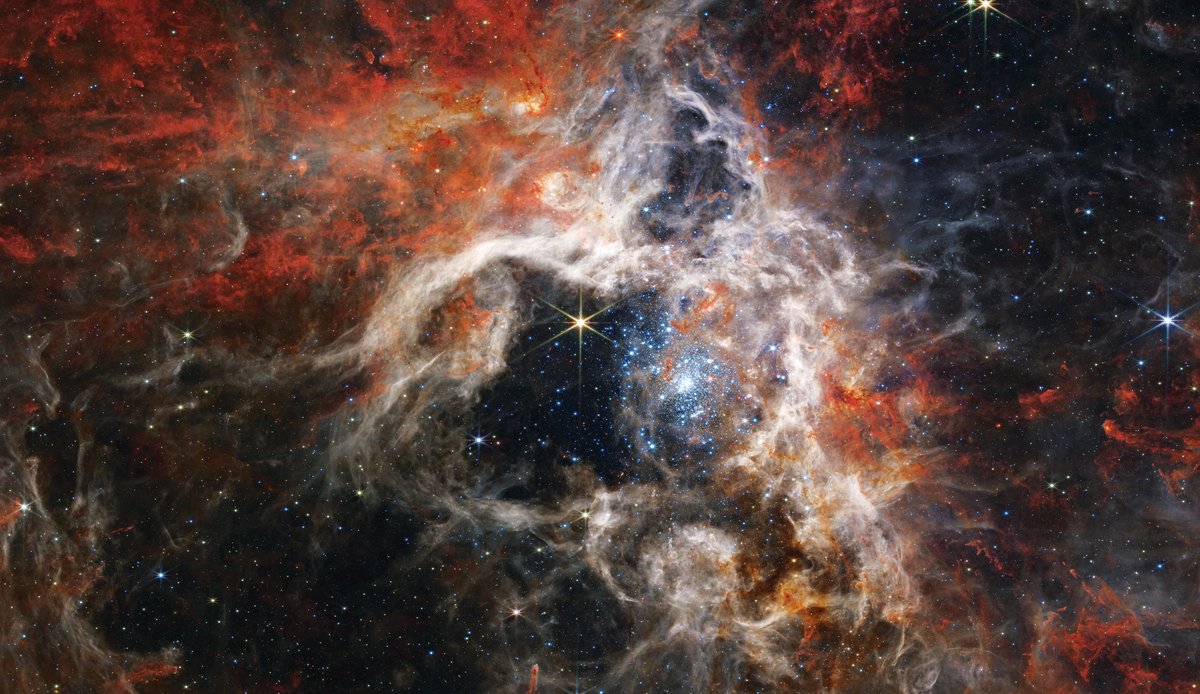
About 52,000 years ago, around the time the first humans arrived in what we now call Australia, something baffling and violent happened in the Large Magellanic Cloud, a dwarf galaxy orbiting the Milky Way. Within the cloud, some of the biggest stars in our cosmic neighborhood got into a scuffle. Some of them fled the scene at breakneck velocities. Those first Australians might have gazed up at the soft, fuzzy glow of the Large Magellanic Cloud, unaware of the clash playing out there.For many years the story behind this skirmish was a mystery. The trajectories and velocities of the fleeing stars were unusual and puzzling. But in 2013 the European Southern Observatory (ESO) launched its Gaia satellite, which mapped the nearby heavens with unprecedented precision until January 2025. The observatory has provided the first precise measurements of the positions, masses and velocities of these fugitive stars.Recently my colleagues and I used this trove of new data to piece together the history of this altercation and reconstruct what happened not so long ago in a galaxy not so far away. The answers resolve a cosmic mystery and offer new insights into the intricate dynamics of stellar clusters, the origins of runaway stars and the history of our corner of the cosmos.On supporting science journalismIf you're enjoying this article, consider supporting our award-winning journalism by subscribing. By purchasing a subscription you are helping to ensure the future of impactful stories about the discoveries and ideas shaping our world today.Most stars, including the sun, roam the galaxy at a leisurely speed. A few stars are different, zipping through the universe in a surprising hurry. They have intrigued astronomers since the 1950s, when Adriaan Blaauw, then at the Yerkes Observatory in Illinois, realized that the star AE Aurigae, about 20 times more massive than the sun, was traveling at a velocity of just under 460,000 kilometers per hour (the sun, in comparison, moves at around 64,800 kilometers per hour relative to the local standard of rest). Since then, astronomers have spotted many runaways, which make themselves known through either their apparent movement on the sky or the bow shock they form when the stellar wind blowing off them sweeps up the interstellar medium.But the origin of their extreme speeds remains debated. Their high velocities cause them to leave their birthplaces quickly. That makes tracing their orbits back to their origins difficult. It’s like looking at a car zipping by and trying to figure out where it started.The other problem is that most runaway stars are massive, and such huge stars are extremely rare. In the entire galaxy there are only about 100 stars that weigh more than 100 times the mass of the sun. Roughly a dozen of those are located in a single stellar cluster in the 30 Doradus region of the Large Magellanic Cloud, which shines just at the edge of the arc of the Milky Way in the sky.Melnick 34, a binary star system, was ejected from the star cluster R136 in the Tarantula Nebula.NASA, ESA, CSA, STScI, Webb ERO Production TeamAstronomers call this region the Tarantula Nebula. At its center lies the stellar cluster R136. The brightest stars in its center are more than a million times brighter than the sun. If Earth lived in this cluster, the night sky would be filled with thousands of stars, each only slightly dimmer than the noon sun. The Tarantula Nebula, however, is more than 160,000 light-years away from us. The entire cluster contains some 100,000 stars, and it is just visible with a small telescope.In the late 2000s, Hugues Sana of KU Leuven in Belgium started using the Very Large Telescope at ESO’s Paranal Observatory in Chile to observe the Tarantula Nebula, aiming to measure the masses and velocities of its stars. It was only two years ago, though, that Mitchel Stoop of the University of Amsterdam’s Anton Pannekoek Institute for Astronomy managed to precisely measure the velocities, masses and ages of 55 runaways within 1,500 light-years of the Tarantula Nebula, using data from Gaia. These measurements provided the key breakthrough in our scientific detective story.The observations revealed that 52,000 years ago, an object named Melnick 34 was ejected from the Tarantula Nebula with a velocity of 46 kilometers per second—at that speed it could fly from Amsterdam to Istanbul in less than a minute and a half. Mel 34, as it’s commonly known, is actually not one star but two: a binary pair of stars that are 140 and 130 times more massive than the sun, respectively. They orbit each other every 155 days. Mel 34 isn’t the fastest runaway known, but it sure is the most massive. Imagine a Formula 1 race where the fastest “car” is actually a pair of giant dump trucks chasing each other.We knew that Mel 34 had probably been kicked out of the stellar cluster by a gravitational rumble with another star. We looked at the Gaia measurements to find the culprit. The only reasonable candidate is the star VFTS 590 because it was ejected around the same time. The star is “only” 47 times the sun’s mass, but its orbit traces back to precisely the location we think Mel 34 was ejected from 52,000 years ago. VFTS 590 is twice as fast as Mel 34 and therefore twice as far from the cluster where both stars are likely to have originated. We then considered a few possible altercations between the two stars.Simon Portegies Zwart and Jen ChristiansenOur clues are not footprints, murder weapons and witness reports but the fundamental conserved quantities in physics: energy and linear and angular momentum. Using these laws, we were able to reconstruct the events that led to the ejection of the stars and calculate the trajectory they must have followed. This calculation revealed that VFTS 590 can’t be solely responsible for kicking out Mel 34 because it’s insufficiently massive, it’s too slow, and it moves in the wrong direction. If the encounter involved only these two objects, none of the three quantities would be conserved, which cannot be possible.VFTS 590’s velocity and its weird angle of 70 degrees with respect to Mel 34’s ejection path suggest that another star must have been involved. This third object could have interacted with the binary Mel 34 and the lone VFTS 590 at the same time in the central region of the Tarantula Nebula. We knew the moment of the interaction and the direction in which this mystery star must have been shot to conserve angular momentum. We also were able to calculate the kinetic energy of the runaway star. This told us the relationship between mass and speed that needed to be satisfied by the mystery star.Simon Portegies Zwart and Jen ChristiansenAfter realizing we were on the hunt for a missing star, I contacted Stoop, and we spent a day searching for the fugitive along the calculated trajectory while conserving energy and angular momentum. We found no candidates that satisfied our criteria. But then I pointed at a fuzzy smudge on the screen a ways off from where we had searched. We realized this smudge could be a perfect match for our missing object, but only if it were another stellar pair rather than a single star. Two orbiting stars in a binary would be able to store angular momentum and energy, equalizing our bill of conserved quantities.The smudge wasn’t in the Gaia archive, however, and we figured there were two possible explanations. Maybe it was a blend of light from multiple stars, or maybe it was starlight obscured by clouds or dust. It turned out to be the former. We found a 2020 paper from Paul Crowther of the University of Sheffield in England, who has been studying the Tarantula Nebula for the past decade, confirming the binary nature of the object without directly observing the companion star. The object, called Mel 39, contains an observed star of 140 times the sun’s mass, as well as a hint of a companion star. Could this object be our missing binary?Based on its distance of around 28 light-years from the cluster center, and assuming it was ejected around the same time, we calculated its velocity as 64 kilometers per second away from the center of the stellar cluster. The total energy and angular momentum budget would be consistent if Mel 39’s unseen companion had a mass of 80 suns and orbited the primary star every 92 days.Now we had all the components of the scene. We speculated that 52,000 years ago a total of five stars had a close interaction, resulting in the ejection of two binaries and a single star.This scenario was a surprise. In an earlier study with Michiko Fujii, now at the University of Tokyo, I had argued that this kind of encounter could produce runaway stars but could involve only three or four stars (including two binaries) at most. The chances of a fifth star participating in the interaction seemed unrealistically small.Around the same time, Ataru Tanikawa, then at the University of Tsukuba in Japan, demonstrated that when a developing star cluster is at its densest, six or seven stars may mutually interact, leading to the ejection of one or two of them. Now we had two contradicting theories and an observation that didn’t match either of them. Had we all misunderstood the intricate dynamics of stellar clusters, or had something unique happened in the Tarantula Nebula?To further address the problem, we performed gravitational computer simulations to try to reconstruct the details of the encounter. In an “N-body” calculation, we solve Newton’s equations of motion for N number of stars. The solutions give us trajectories over time. N-body calculations are among the most reliable astronomical calculations that we can carry out.In this case, we knew the result of the gravitational interaction: we had the masses of all five stars, the orbital periods of the two binaries, and the stars’ velocities. We didn’t know the positions and velocities of the stars before the encounter, however. They could all have been single stars that happened to meet one another in the cluster center, as Tanikawa would argue, or they might have been distributed in pairs and triples to begin with.After much experimentation, the best solution we found was an interaction that started with two binaries, composed of the four most massive stars (Mel 39a, Mel 34b, Mel 34a and Mel 39b), and with VFTS 590 as a single object that was coincidentally nearby when the two binaries came together. But this encounter made sense only if VFTS 590 had an incoming velocity exceeding the speed required to escape the cluster’s gravity.That didn’t seem very likely. Once a star has an escape trajectory, it generally stops interacting with other stars because it moves by so fast. Then the solution occurred to us: What if VFTS 590 were orbiting one of the two binaries, forming a triple star system? When a tertiary star encounters another object, it can move along with the inner binary toward the new object, doubling its relative speed as the two systems draw near to each other. This scenario could explain why VFTS 590 had a velocity exceeding the cluster’s escape speed.Simon Portegies Zwart and Jen ChristiansenWe headed back to the computer to study this hypothesis. After some more experimentation, we established that the most probable interaction resulted from an encounter between the binary Mel 34 and a triple system composed of Mel 39 and VFTS 590 in a 40-year orbit.My colleagues and I felt satisfied with this conclusion. An encounter between a triple and a binary star is fairly probable as long as there are many triples around. In hindsight, the interaction itself is not so special, either. The masses of all the stars involved are extreme, but it is an extreme environment; there is only one such cluster in the local group of galaxies.Now that both binaries and the single star are escaping the cluster, the chance that they will interact again with other stars on their sojourn through intergalactic space is negligible. Their futures will now be driven by the evolution of the stars themselves.The single star, VFTS 590, will continue its journey through interstellar space until it eventually explodes in a supernova after some 2.3 million years, forming a single black hole. But before this happens, the star will have traveled about 650 light-years, bringing it to the edge of the James Webb Space Telescope’s image of the Tarantula Nebula.Astronomers now think that five stars in three systems interacted to cause their own ejection from the cluster R136.NASA, ESA, CSA, STScI, Webb ERO Production TeamThe two binaries, now coasting through the Large Magellanic Cloud, will soon enter intergalactic space. While traveling at blistering speeds, the stars in both binaries will continue to evolve. The most massive star in each will die first. Once they exhaust their central stores of hydrogen, the stars will grow to enormous sizes. As a consequence, their companions will feel the swell, and the outermost parts of the expanding giant stars will accrete onto their smaller neighbors. Astronomers call this process binary mass transfer. Eventually, after transferring mass in several phases, each of the four stars will collapse into a black hole via a supernova explosion. These stars are so massive that they will all reach this fate in less than four million years. In that time, the binaries will have traveled some 650 to 1,000 light-years, and the stars will explode far from their birthplaces in the Tarantula Nebula.The black holes born in these supernovae will probably remain binary companions, but their orbits will be wide. Unlike the many black hole mergers discovered by gravitational-wave detectors, these objects won’t collide anytime soon—it’s likely to take another 14 billion years, a doubling of the universe’s current age.Star clusters are often considered a major source of gravitational-wave events. If these encounters are as frequent as we anticipate, however, clusters such as this one in the Tarantula Nebula may be losing a considerable fraction of their potential black holes by kicking them out. That’s too bad for the gravitational-wave folks but nice for astronomers studying runaways.We’ve learned a lot about Mel 34 and its friends. But there’s still more to know. Our simulations have let us calculate configurations for the two binaries, but current observations are insufficiently precise to confirm them. We hope the next release of Gaia data, and possibly future observations from the Extremely Large Telescope under construction in Chile, will be up to the job.We also want to understand more about how this happened. The only way an encounter can kick out two binaries and a single star with masses many times greater than the sun’s is if the central cluster experiences a short-lived high-density phase in its evolution. We would expect to see such a phase in ancient globular clusters, but this cluster is only two million years old. That we witnessed such a short-lasting era in such a young cluster seems lucky and defies our current understanding of cluster formation.Another mystery is the absence of the most massive stars in the Tarantula Nebula (R136a1, R136a2, R136a3, R136b and R136c) from the conflagration. These five stars were bystanders in the neighborhood at the time of the interaction but apparently didn’t participate. They should have acted as bullies, tossing around the other stars, but they had no discernible role in the ejection of Mel 34. We will have to revise our understanding of the formation of this cluster and the role of the most massive stars.In the end, we solved a captivating crime by using fundamental physics. Unlike forensic investigations, however, scientific research often leads to new questions rather than convictions.
A 52,000-year-old runaway star was a long-standing cosmic cold case. Now scientists think they’ve cracked it
Full Article
Original Source
Read the full article at Scientificamerican →KhanList aggregates and links to publicly available news content. We do not host full articles from third-party sources. Always verify important information with original sources.