
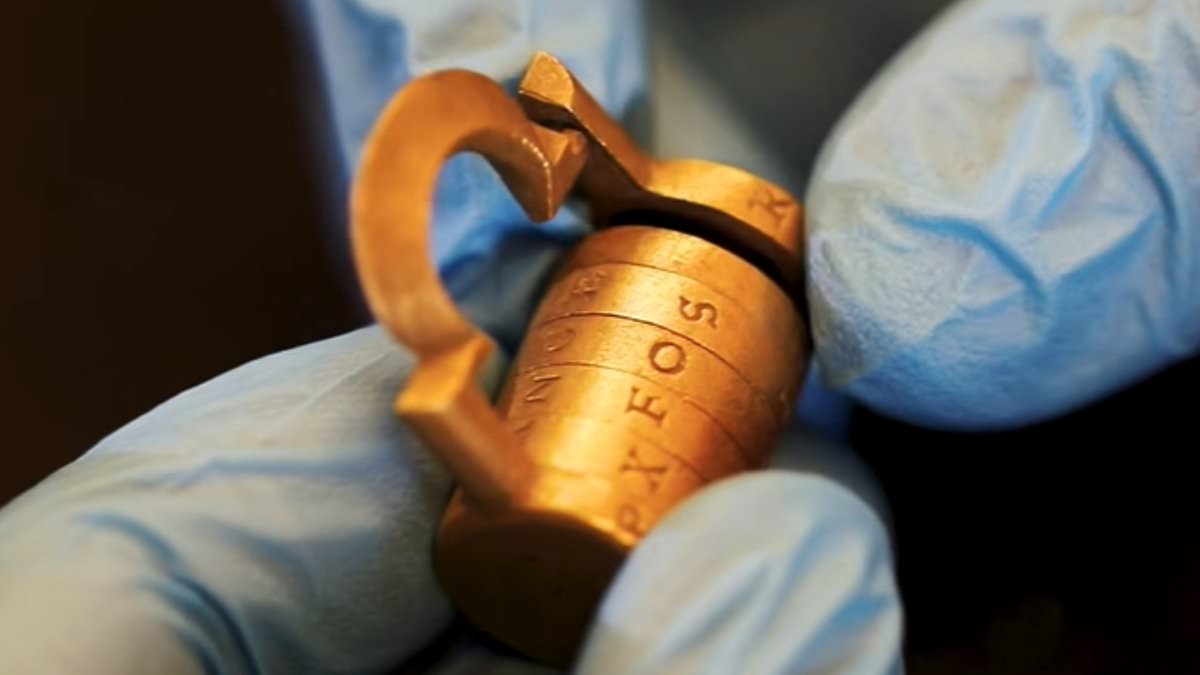
For over 400 years, this brass padlock has remained firmly sealed at the bottom of the sea.But scientists have finally cracked its code, after using cutting-edge CT technology to solve the four-letter sequence that has kept it locked since 1583.A team from Cardiff University were able to peer into the lock's internal mechanism without causing any damage.They identified the correct letter combination – ANCE – and successfully opened the historic artefact.Dr David Williams, a research associate at Cardiff University, said: 'Micro-CT scanning allowed us to look inside the lock without damaging it.'It's not every day you get to solve a 400-year-old mystery!' For 400 years, this brass padlock has remained firmly sealed at the bottom of the sea off the coast of Wales Scientists have finally cracked its code, after using cutting-edge CT technology to solve the four-letter sequence that has kept it locked since 1583 A team from Cardiff University were able to peer into the lock's internal mechanism without causing any damageExperts believe the lock once secured a treasure chest containing valuable possessions aboard the Ann Francis, a ship that was wrecked during a violent storm.The vessel was heading to King's Lynn from Spain on December 28, 1583, when it was blown off course and ran aground on Margam Beach near Port Talbot.Its cargo lay buried beneath the sand for centuries before being uncovered by metal detectorists.Now, more than 440 years later, scientists have been able to peer inside the lock without damaging the precious artefact.Museum specialists worked alongside researchers from Cardiff University to analyse the mechanism using micro-CT scans.The high-resolution images produced a detailed three-dimensional model of the interior workings, allowing the team to see exactly how the internal notches aligned with the rotating lettered dials.By reconstructing the mechanism, they were able to identify the correct combination and unlock the centuries-old puzzle. The high-resolution images produced a detailed three-dimensional model of the interior workings, allowing the team to see exactly how the internal notches aligned with the rotating lettered dials By reconstructing the mechanism, they were able to identify the correct combination and unlock the centuries-old puzzleResearchers suspect the lock may have protected a cache of silver coins or other valuable objects carried aboard the ship.The device was found near a collection of Spanish coins and two coin weights were recovered from the wreck site.However, any chest it once secured has long since disappeared, leaving behind only tantalising clues.'The lock is believed to have secured a small chest containing valuable possessions, although we don't know exactly what it may have held,' Dr Williams told the Daily Mail.'It may have been used to protect money or other valuables. It could also have secured documents or textiles that have not survived.'The team said one of the most remarkable things about the lock is that it is still in such good condition that its lettered dials can still be turned.After entering the correct code, museum staff said they became the first people known to have opened the lock since the ship sank. Other artefacts from the ship include about 870 gold and silver coins, as well as personal belongings, ship’s equipment, and cooking, eating and drinking utensils, all dating to the late-15th to 16th century'Elizabethan combination locks are known in Britain, but this one is in exceptionally good condition and is associated with a dated wreck, making it a unique find and the code a tantalising mystery to solve,' Alastair Willis, senior curator of coins and Welsh economic history at Museum Wales, said.'Of course, now we've solved it, we are left wondering if the code meant something to its owner.'Peter Hughes, a metal detectorist who initially found the hoard, said: 'When I found the lock I was immediately astonished by the incredible workmanship and its astonishing condition.'When I moved the ring dials of the combination they turned with ease after over 400 years beneath the sands and I was left in disbelief.'I also remember being left excited at the prospect of finding wonderful things from the treasure chest it once locked.'The remarkable lock is now on display alongside other treasures from the Ann Francis hoard at the National Waterfront Museum in Swansea.
A 400-year-old secret unlocked: CT scans crack the four-letter code on a brass lock recovered from a shipwreck off the coast of Wales in 1583
Full Article
Original Source
Read the full article at Dailymail →KhanList aggregates and links to publicly available news content. We do not host full articles from third-party sources. Always verify important information with original sources.