
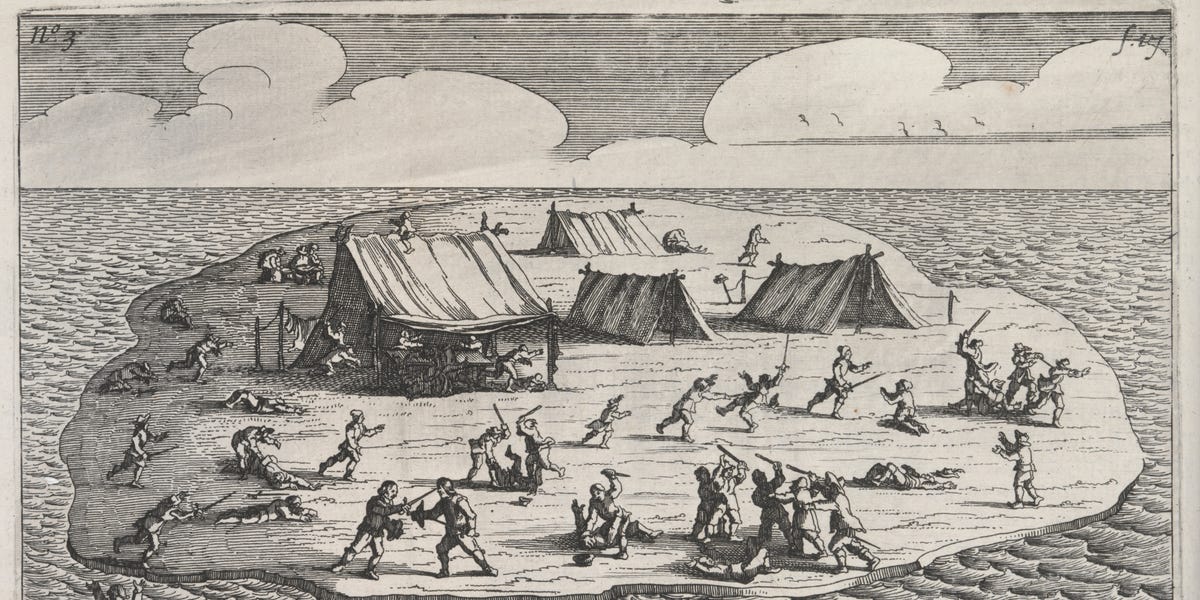
When you try to envision a “corporate psychopath,” the kind of individual who blends charm towards their superiors and sadism towards their subordinates to rise through the corporate ranks, who comes to mind?Actually, don’t say a specific name. These guys can be very litigious, so let’s just focus on the vague and the deceased. You’re probably picturing a man in an expensive business suit, maybe having a loud, hyperbolic conversation on an oversized 1980s cell phone. Maybe he’s monologuing about how “greed is good,” or how they’re “gonna need to send the National Guard to take him out, ‘cause he’s not goin’ nowhere.” Perhaps the corporate psychopath you have in mind is busy fretting about whether his business card has lettering in Romalian or Silian Rail.In other words, short of someone you’ve seen on the news, or in your own boardroom, your mental image of a corporate psychopath probably comes from the movies.You may want to revise that. That’s because a new study suggests that the original corporate psycho predates the 1980s stock market antiheroes of the movies you love. He actually predates movies entirely. In fact, he died before the city of Boston was ever founded.In a study published in the Asian Journal of Business Ethics, Clive Roland Boddy, an author and pioneer in the study of corporate psychopathy, has identified Jeronimous Cornelisz of the Dutch East India Company as perhaps the earliest documented example of a corporate psychopath. To understand why, one must delve into the dark story of the 1629 Batavia shipwreck and its mutinous aftermath.The Vereenigde Oostindische Compagnie, translated as Dutch East India Company and abbreviated as VOC, was a fairly unique venture in the business world at the dawn of the 17th century. At the time, expeditions for goods and resources were often funded individually, and the companies behind them lasted only as long as a single voyage. The VOC changed that by merging 12 existing “pre-companies” within the Dutch Republic into a permanent company that would not only fund spice expeditions but also manage supply and stabilize the market. Shares of the VOC could be publicly purchased and traded by Dutch citizens at various aftermarkets throughout the Republic, including the predecessor to the Euronext Amsterdam, arguably making the VOC the world’s first multinational corporation.In some ways, the VOC resembled the multinational corporations we know today, with the same ruthless efficiency. Yet the world around it lacked the kind of laws and regulations that are at least supposed to keep the corporations of our modern world in check. In fact, the Dutch government backed the VOC entirely, allowing the company to have a monopoly over the Asian spice trade. It was an environment that favored the bold, the ambitious, and the unscrupulous. It was an environment that allowed a man like Jeronimus Cornelisz to seize his moment.“Psychopaths have a narcissistic and grossly inflated view of their self-worth and importance,” Mike Dash writes in his book Batavia’s Graveyard: The True Story of the Mad Heretic Who Led History’s Bloodiest Mutiny, “...a truly astonishing egocentricity and sense of entitlement, and see themselves as the centre of the universe, as superior beings who are justified in living according to their own rules.” It’s unclear exactly when Jeronimus Cornelisz created his own set of rules to live by, whether in his poorly-documented childhood, or when he took up his apothecary trade some time in the 1620s and began battling with his local town council.What we know is that by 1628, the death of his child and the subsequent scandal it invited (the three-month old had died of syphilis, and Cornelisz tried to argue the child had contracted it from a wet nurse rather than his own wife) led to the Dutchman selling his business and taking a job with the VOC. In October 1628, the Batavia left port in the Netherlands on a trip to the Dutch East Indies, with commodore Francisco Pelsaert as its commander, Ariaen Jacobsz as its skipper, and Cornelisz as a junior officer.Pelsaert’s journal recounts that on June 4, 1629, “I was lying in my bunk feeling ill and felt suddenly, with a rough terrible movement, the bumping of the ship’s rudder, and immediately after that I felt the ship held up in her course against the rocks, so that I fell out of my bunk.” The vessel had run aground on Western Australia’s Morning Reef while Jacobsz was at the helm, and roughly 100 of the 340 people aboard the ship were killed in the collision. To date, there’s still fierce debate over whether the Batavia crashed “by design or accident,” as by this time, Cornelisz had charmed his way into Jacobsz’ esteem, and in doing so, had convinced him that a mutiny was necessary to depose Pelsaert.Either way, as some of the roughly 180 survivors disembarked for the nearby islands, leaving only 70 (including Cornelisz) aboard, an opportunity arose for the original “hostile takeover.”Cornelisz had originally been among the 70 or so who remained aboard the Batavia, but after nine days, he made his way to nearby Beacon Island. He found the survivors stranded there to be starving, dying of thirst, and feeling abandoned, since Pelsaert had left with the other officers in search of supplies and aid. Seizing his moment, Cornelisz stepped into the leadership vacuum, amassing a group of loyal enforcers, and stripping the now subordinate survivors of any means by which to fend for, or defend, themselves.Cornelisz began a reign of terror that lasted more than two months, overseeing the execution of those deemed “too weak,” as well as those he thought capable of overpowering him. Supplies were hoarded for his loyalists, while those outside of his circle were dispatched in ever more public and brutal ways. His roughly 40 man cadre killed an estimated 100-125 men, women, and children, and the survivors didn’t fare much better.“Furthermore, when the most murders had been committed,” Pelseart would write in his journal, “...they shared the women who remained, or rather whom they had meant to stay alive.” Cornelisz, who had singled out Lucretia Jansz for his own ill-intent, “made several articles to which the women had to be put on oath if they wanted to remain alive, that they had to be obedient to the men in all that they should desire of them.”While all of this may read like the barbaric horrors of a bygone age, befitting a pirate’s pillaging more than a modern boardroom, Boddy’s study found that when Cornelisz’s actions are viewed through the prism of The Psychopathy Measure–Management Research Version (PM–MRV), a ten-item model he previously developed to identify contemporary corporate psychopaths, the mutinous, murderous junior officer of the VOC checked off every box.Boddy’s article doesn’t recontextualize Cornelisz’s crimes to exonerate the man; there’s little debate that Jeronimus was a psychopath of some stripe. Nor does Boddy suggest that the existence of the VOC created or caused Cornelisz’s monstrous urges. Rather, it emphasizes that the profit motive built into the structure of the VOC “would have been too great, even for a careful primary psychopath” to resist. This analysis demonstrates that corporate psychopaths as we know them today “have been active since the start of the World’s first stock exchange, and first multinational shareholder-owned corporations.” What unites Cornelisz with the less-overtly-murderous corporate psychopaths we encounter today is the manner in which they both “utilise a similar modus operandi across the centuries and are motivated by greed, self-aggrandisement, and the desire to hurt, dominate and control others.”In other words, to subvert a quote lamented by another lunatic, Billy Loomis in 1996’s Scream: corporations don’t create psychos. Corporations make psychos more creative.Michale Natale is a News Editor for the Hearst Enthusiast Group. As a writer and researcher, he has produced written and audio-visual content for more than fifteen years, spanning historical periods from the dawn of early man to the Golden Age of Hollywood. His stories for the Enthusiast Group have involved coordinating with organizations like the National Parks Service and the Secret Service, and travelling to notable historical sites and archaeological digs, from excavations of America’ earliest colonies to the former homes of Edgar Allan Poe.
A 400-Year-Old Mass Murderer Led a Brutal Mutiny—and Became the First Corporate Psychopath
Full Article
Original Source
Read the full article at Popularmechanics →KhanList aggregates and links to publicly available news content. We do not host full articles from third-party sources. Always verify important information with original sources.