
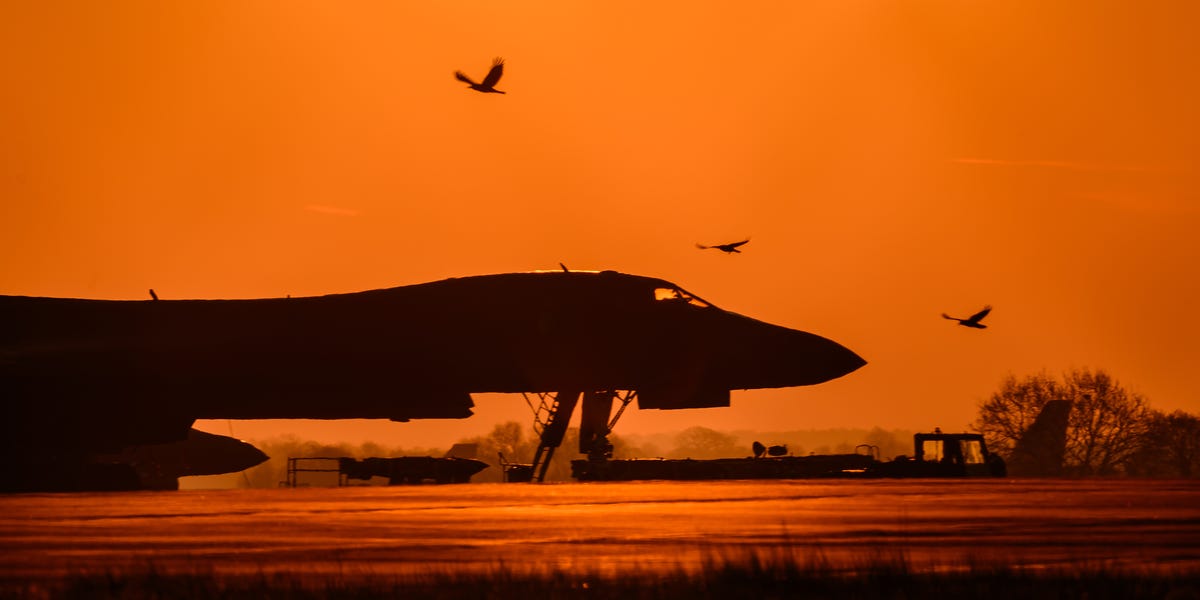
3 min readThe Bones could have been caught in the Spider’s Web.That might read like a sentence from a Stephen King novel on the surface, but if you parse through the military parlance, what it says is far more haunting.The “Bones” in question are the U.S. Air Force’s Rockwell B-1 Lancers, a supersonic bomber that airmen affectionately call a “Bone” (as in “B One”). In early October, the USAF had to quickly evacuate a contingent of 12 B-1s from an English airbase when the Pentagon suspected they were vulnerable to an attack modeled on Ukraine’s Operation Spider’s Web.The Air Force moved so fast that there wasn’t even time to pull together a refueling plan, according to a Carnegie Endowment for International Peace commentary by Steven Feldstein. The aircraft represent “one-quarter of Washington's B-1 arsenal”— an estimated $3.8 billion in hardware. The concern was that these supersonic bombers were acutely vulnerable to a threat parked just outside the fence: unmarked vans.Specifically, unmarked vans filled with drones, parked within range of the airfield, armed and ready to reign havoc down on not just the highly valuable bombers, but also the hundreds of airmen and other personnel stationed at the base. The Pentagon’s intel indicated that the Islamic Revolutionary Guard Corps of Iran was behind this specific drone attack plan, as part of the ongoing conflict between the United States and Iran.But the strategy behind the attack wasn’t the IRGC’s. In fact, similar strikes have been successfully carried out by a number of U.S. allies in their own ongoing conflicts, a reminder both that war always evolves, and that the weapons wielded by your friend will inevitably find their way into the hands of your enemies too.In June 2025, Ukraine launched Operation Spider’s Web, a drone attack the New York Times described as “a signature event on par with sinking the Russian flagship Moskva early in the war.” Instead of vans, Ukraine used “custom-made wooden modular cabins,” per a West Point report, concealing 150 drones and 300 explosive payloads in their roofs. Operators controlled the drones through Russian mobile networks, using the country’s own cell service against it. Launched from Russia’s Chelyabinsk, the drones struck four airbases across Russia in a single afternoon, from Murmansk to Irkutsk, destroying Tu-95 and Tu-22M3 bombers that Russia can no longer build. Kyiv claimed 41 aircraft hit; Western estimates ran closer to 10 destroyed. Ukraine dismantled billions of dollars in strategic aviation with hardware that ran about $2,000 a unit.That same month, Israel undertook a similar operation against Iran dubbed Operation Rising Lion. The armed conflict that stretched from June 13-24 has been dubbed by some as the Twelve-Day War, in reference to the infamous Six-Day War of 1967. Yet, Operation Rising Lion shows how much modern warfare has shifted in the last half-century. The Six-Day War was fought with Sherman M-50s and Uzis, while Operation Rising Lion relied in part on the same tech that’s in a child’s birthday present.According to the Center for Strategic and International Studies, Operation Rising Lion began with “swarms of small explosive drones that Israeli commandos had reportedly pre-positioned inside Iran months earlier,” which took out air defense radar and communication tech while serving as a misdirection for Iran’s defenses. As the decoy drones did their damage and distracted security personnel, “over 200 Israeli fighter aircraft—many of them F-35 Adirs carrying standoff munitions—conducted precision strikes against more than 100 nuclear and military targets across Iran, including senior military leaders.”The U.S. decision to clear Fairford suggests the Pentagon has absorbed this lesson in wartime innovation. But it also suggests how little else has changed. Feldstein’s commentary posits that the United States seems “wedded to high-cost, exquisite platforms” instead of adapting to, let alone being at the forefront of, this new style of waging war.“Organizations can now access knowledge and expertise in rapid fashion,” Feldstein argues, “They can download drone designs from the web or use an AI model to generate tailored blueprints and then feed those plans into a 3D printer to produce customized weapons.“The result is that a wide range of actors increasingly have the means to challenge the dominance of major powers.” The United States remains a military giant, no doubt. But is that giant Goliath? And if so, who's holding the slingshot?Michale Natale is a News Editor for the Hearst Enthusiast Group. As a writer and researcher, he has produced written and audio-visual content for more than fifteen years, spanning historical periods from the dawn of early man to the Golden Age of Hollywood. His stories for the Enthusiast Group have involved coordinating with organizations like the National Parks Service and the Secret Service, and travelling to notable historical sites and archaeological digs, from excavations of America’ earliest colonies to the former homes of Edgar Allan Poe.
A $3.8 Billion Supersonic U.S. Fleet Was Almost Wiped Out By a Glorified Child’s Toy
Full Article
Original Source
Read the full article at Popularmechanics →KhanList aggregates and links to publicly available news content. We do not host full articles from third-party sources. Always verify important information with original sources.