
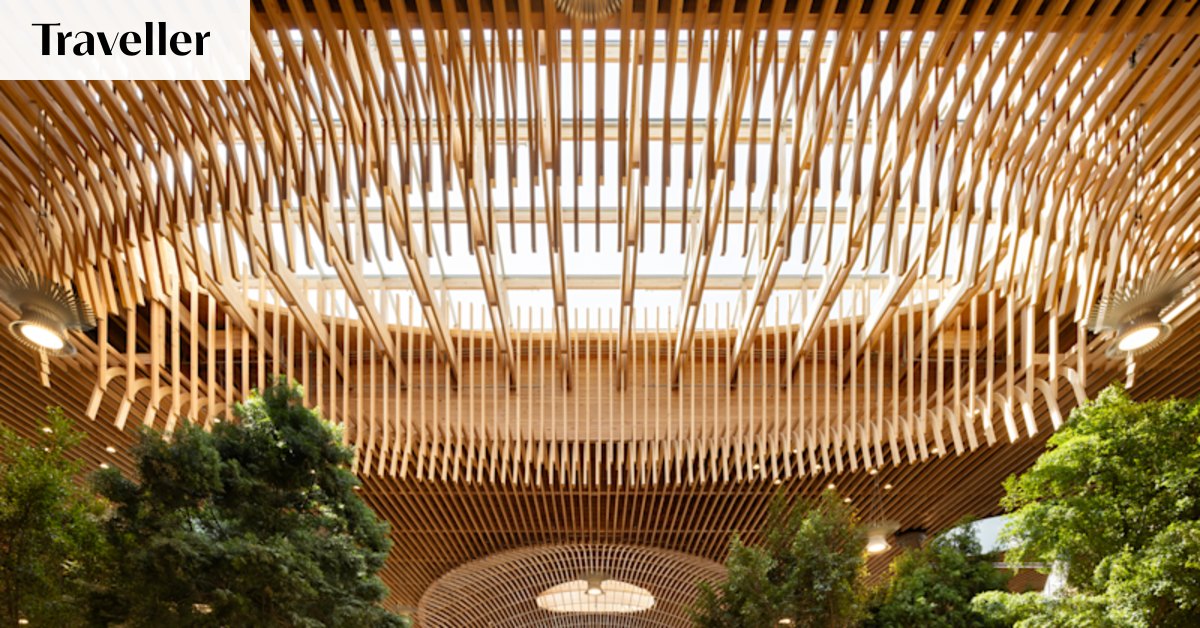
Billions of dollars are poured into redesigning and building new airport terminals around the world. But what should an airport really be?Portland International Airport gave its answer when it unveiled the final stage of its $US2.15 billion ($3.1 billion) transformation this month. The main airport for Oregon, in the Pacific Northwest of the US, highlighted legendary local retailer Powell’s Books, indigenous art, Oregon timber and even recreated its cult-status carpet – a geometric representation of the intersection of the north and south runways as seen by air controllers – for some areas. In other words, it made the airport unmistakably “Portland”.The newly expanded main terminal at Portland International Airport was designed by ZGF Architects.Ema PeterIn Australia, Western Sydney International will welcome its first passengers later this year, Melbourne Airport is in the middle of an expansion and major redevelopment works are nearing completion at Sydney Airport.The world’s best airports are built on the premise that simply moving passengers from check-in to gate, with an unpleasant purgatory in between, is no longer enough. They’re creating places where travellers don’t mind spending time and might even enjoy staying awhile.No airport has embodied that philosophy more successfully than Singapore’s Changi Airport. Its indoor gardens, waterfall, walking trails, cinemas and swimming pool have made it a destination in its own right. It attracts visitors who aren’t even catching a flight.Sign up for the Traveller newsletterThe latest travel news, tips and inspiration delivered to your inbox. Sign up now.The airport’s design has cascading indoor greenery and escalators leading to baggage carousels.Ema PeterElsewhere, Seoul’s Incheon International Airport has become a vehicle for Korean culture, from traditional performances to Korean cuisine and design, while Copenhagen Airport reflects the understated elegance, natural materials and clean lines associated with Scandinavian design.It’s this model that Portland has embraced. The redevelopment introduces dozens of local retailers and food outlets, while a restored 1958 mural by Louis Bunce, one of the Pacific Northwest’s best-known artists, connects the new terminal with the airport’s history. But its most striking feature isn’t a shop or a restaurant. It’s overhead.Designed by Seattle and Portland-based ZGF Architects, in collaboration with HOK, the terminal is sheltered beneath a 3.6-hectare undulating timber roof, the first of its kind at a major US airport. Forty-nine skylights filter daylight through the timber lattice, creating an interior that evokes a walk beneath the forests of the Pacific Northwest rather than through an airport terminal.The soaring, column-free spaces create long sight lines that make the terminal easier to navigate, while new north and south exit routes shorten the walk from gate to baggage claim.The newly expanded main terminal at Portland International Airport features a 3.6 hectare mass-timber lattice roof and indoor landscaping.Ema PeterContinuous terrazzo flooring makes it easier for passengers travelling with luggage, wheelchairs or prams, while generous waiting areas and large all-user toilets reflect an emphasis on comfort alongside efficiency.Sustainability is woven into the design in a way that feels unmistakably Oregon. Almost all the timber was sourced from forests within 480 kilometres of the airport, including tribal lands, community forests and family-owned timber operations practising sustainable forestry.Rather than demolishing the existing terminal, much of the original structure was retained, dramatically reducing the project’s embodied carbon while doubling passenger capacity. Natural daylight, high-performance glazing and an electric ground-source heat pump further reduce the building’s environmental footprint.The all-user restroom corridor at Portland International Airport.Ema PeterOf course, airports are businesses as much as transport hubs. Around the world, retail and hospitality have become an important source of revenue that helps fund the cost of modern aviation infrastructure. That creates an inevitable balancing act.The indoor garden landscape was designed to evoke a Pacific Northwest forest.Ema PeterPassengers want intuitive terminals where they can move quickly when they’re running late, but they also appreciate somewhere they can dine and browse. Airport operators, meanwhile, hope travellers will spend – that’s where much of their non-aviation revenue is generated.But as Portland shows, the drift towards international terminals filled with ubiquitous brands and eateries isn’t the only way to build an airport.See flypdx.comJulietta Jameson is a freelance travel writer who would rather be in Rome, but her hometown Melbourne is a happy compromise.Connect via email.From our partners
A $3.1 billion revamped American airport sets a new standard
Full Article
Original Source
Read the full article at Smh →KhanList aggregates and links to publicly available news content. We do not host full articles from third-party sources. Always verify important information with original sources.