
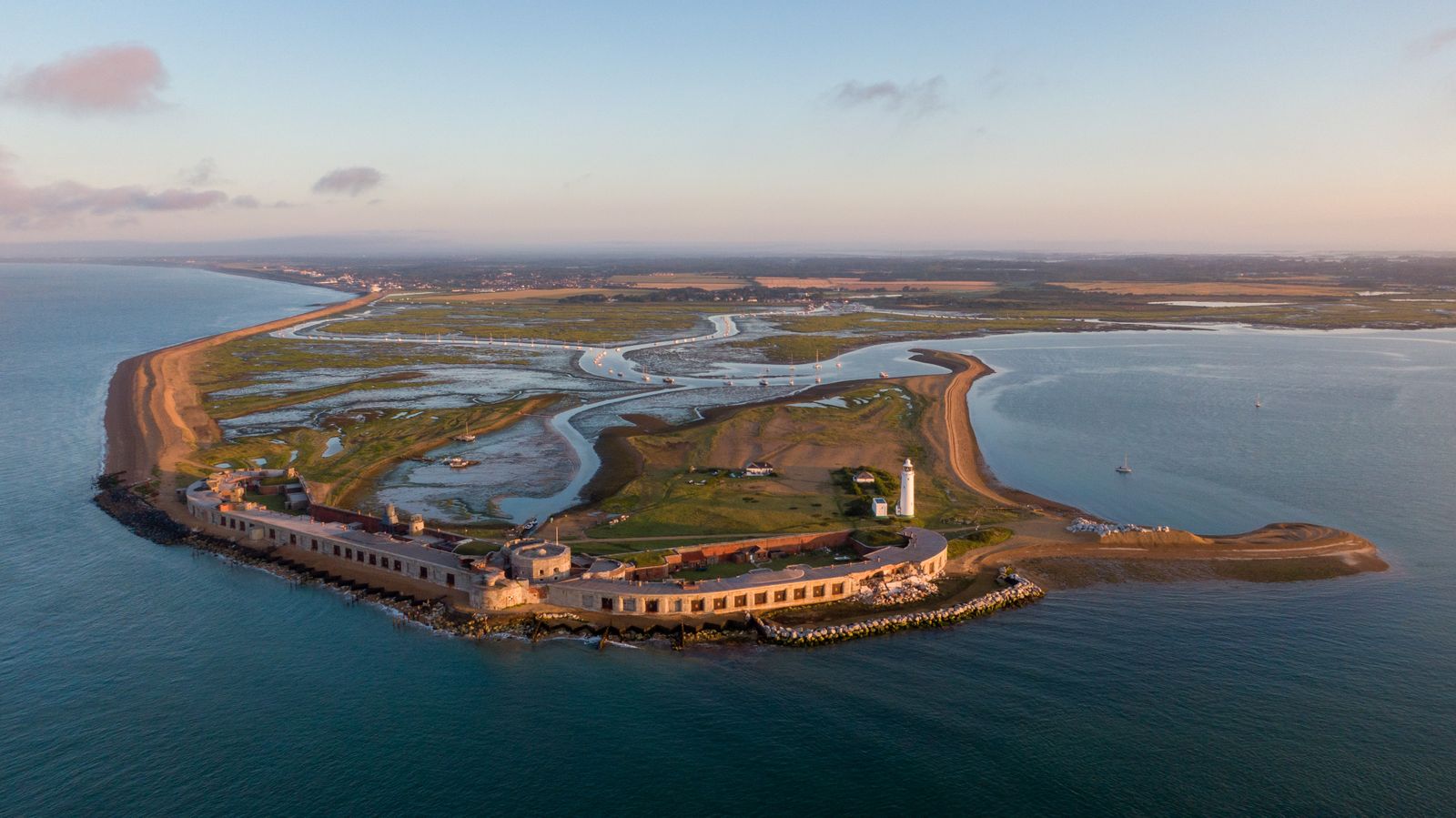
Hurst Castle was erected to stave off threats from armies foreign and domestic, but it may be facing a fatal blow from forces of nature itself November 16, 2026 2:45 p.m. On February, 26 2021, the wall of Hurst Castle's eastern wing partially collapsed during a severe winter storm. Preservationists cite the damage as a consequence of intensifying storms and sea-level rise driven by climate change. Finnbarr Webster / Getty Images For centuries, Hurst Castle, built on England’s south coast by Henry VIII in 1544 to protect the passage to Portsmouth, was unassailable. Through Tudor spats with France and the Holy Roman Empire, the English Civil War, skirmishes with Napoleon and both world wars, the squat artillery fort was garrisoned and at the ready, but never once attacked. After sitting almost at sea level for four centuries unchallenged, the castle is now under attack from a different sort of enemy, one even more pernicious than the French. Climate change, in the form of rising tides and worsening storms, is washing out the rocky beach from underneath Hurst’s walls. As the beach gradually eroded away, the castle’s foundations first started to poke through the rocks in 2017, growing weaker each year. Then, in 2021, its east-facing wall collapsed. Standing on the eroded shore in front of Hurst on an overcast morning in 2024, castle keeper Jason Crane recalled the calm February day of the breach. He pointed to a gash of rubble where the east wing used to face the waves. “The whole of that wall ejected,” he said. “It puked right out into the sea” and left a 38-ton cannon rolling down onto the beach. Crane has known Hurst since he was a child, playing with crab shells through its halls while his grandfather was castle keeper, so the destruction was wrenching to watch. “The noise was something really low and horrible,” he remembered. “I definitely took it to heart.” Crane means that literally: a month after the collapse he suffered a heart attack from stress. In all likelihood, that 2021 collapse was just the opening salvo in a slow siege which could eventually destroy entire sections of the castle. That would mean the end of one of Britain’s most fascinating historical mosaics: 20th-century concrete bunkers built on a Victorian extension of a Tudor venture in castle making. If you go: Other Tudor castles worth visiting Hampton Castle: Built by Henry VIII, the palace was inspired by Venice’s Renaissance-era edifices. Located on the Thames, it’s known for its chapel with a blue-and-gold ceiling. Thornbury Castle: Situated in South Gloucestershire, this centuries-old castle operates today as a hotel. Visitors can retrace the steps of Henry VIII and Anne Boleyn and even sleep in their bedchamber. Sudeley Castle: The last wife of Henry VIII, Catherine Parr, lived here and is even buried here. It remained derelict for two centuries until it was restored in the 1800s. Crane, working in concert with English Heritage, the charity that runs England’s historic monuments, has worked on several plans to save the site before the waves come crashing through. After coastal modeling and 3D surveys of the castle’s foundations, engineers estimate they can buy Hurst another few decades. But the work would cost more than £6 million (around $7.5 million), and time is already short. After the first collapse, engineers wired dozens of sensors through the precarious east wing to watch for signs of the next break. “You can’t just leave a pile of rocks,” said Crane. “It’s definitely going to be a painful process.” Hurst therefore presents a fork in the road for English Heritage: fight to preserve a jewel in the country’s historical crown or start curating its transition from a castle into a ruin. Rob Woodside, who joined Crane in the quest to solve this problem, showed me around the site in October 2024. For the seven years he spent as a director at English Heritage, Woodside worried about Hurst. “It’s a race against time,” he said. Hurst sits on a small headland. The spit connecting it to the mainland is not as reliable as it used to be, so like most visitors we took a small boat, the Henrietta Rose, steered by a beanie-wearing pilot. As the castle’s outline came into focus, Woodside got nervously animated. “It always feels a little bit like a school trip … really exciting,” he said. “And then on the way back I’m more depressed,” he shrugged, “because, oh God, all that we’ve got to do.” From the roof of the Tudor keep—now ringed with World War II anti-aircraft swivels—Woodside’s voice was almost drowned out by an ominously churning patch of water at the foot of the castle walls. Once inside the castle, Woodside walked me up a flight of stairs: “This is the global classroom,” he said, opening the door to Hurst’s old barracks. On the large, wood-paneled floor, we encountered a big, dark puddle. “A leak,” he muttered, craning his neck at the ceiling. “Oh God, please not more.” Subsequent monarchs after Henry VIII added to Hurst to protect it against new advances in warfare, not from waves. Each of the Victorian wings is built from heavy Norwegian granite to protect canons and their crews from enemy fire. In the 20th century, the Ministry of Defense added anti-aircraft turrets—all on top of a brick foundation built directly on the beach. Since its first Tudor incarnation, Hurst has become more than a little top-heavy. As the foundations wore away, in fact, the entire west wing started to rotate under its own weight, spinning slowly and gloomily out toward the sand. From the central keep, I saw a snaking crack along the roof where the structure was beginning to tear away into the water. An aerial view showing the damage at Hurst Castle on August 10, 2021. Finnbarr Webster / Getty Images Woodside had wanted to be more proactive than previous government stewards of the castle. In 2019, a couple of years into his tenure, English Heritage spent more than $900,000 replenishing the sand and installing wooden barricades to stabilize the castle. But the beach kept disappearing, and those barricades appear to have backfired, casting up particularly aggressive torrents of water during storms. Two years later, of course, the wall collapsed anyway. It became clear, Woodside said, that the only way to protect Hurst in the long-term was to try to hold back the sea itself. First, engineers suggested dropping huge boulders underwater to break up tidal surges. The catch: boulders big enough to do the job (20 tons each) would have to be shipped from Norway. This plan, which Woodside called the “gold-plated” approach, would likely have protected the castle for around a century, at a cost of more than $137 million. That would’ve been a landscape-changing feat of engineering that Woodside simply said was “not for us.” Plan B still involves big boulders—but slightly smaller and strategically placed at the surf line. These rocks would disrupt the flow of water approaching the castle, creating a calmer area where sand doesn’t wash away so quickly. They would protect the castle for only a few decades, engineers estimate, before the rocks would need maintenance themselves. But an imperfect plan is better than no plan, said Woodside, and crucially, the smaller rocks cost only the equivalent of roughly $7.5 million. Through most of our interviews, Woodside remained cautiously optimistic about raising that sum. Saving the castle for decades would cost about as much as running the British health service for 15 minutes—his point being that the work might be expensive by heritage standards, but only a drop in the bucket of overall public finances. Then, a month after I visited, the British government’s body for protecting heritage sites rejected Woodside’s pitch. “We had a bit of a crunch, really,” he said when we caught up later. Not long after the news, he left English Heritage. The decision didn’t just mark the end of Woodside’s hopes of saving Hurst, but the beginning of a strange, liminal time for the castle. Britain has historically important buildings, and it has historical sites where buildings used to be. As the destruction slowly continues, Hurst is sliding into some uncomfortable middle ground between the two. Engineers predict that water will finally enter the castle via the first wall that collapsed. “Eventually you’ll have to start to close the western end, then the property entirely, on safety grounds,” Woodside said. Woodside left emergency instructions behind for when the water starts to break through: which artifacts to remove first; how to shut down the site’s generator. “Basically, you’re in a process of ruination. You’re going from a structure to an archaeological monument.” An illustration by William Mossman of boats in front of Hurst Castle in the mid-19th century. Public Domain That means taking stock of the castle “block by block,” said Matt Thompson, a curator at English Heritage who has taken responsibility for Hurst since Woodside left. Archaeologists and curators will give the castle a complete “family history,” after which Thompson wants to bring in locals to build an oral history of the site. “If you think you might lose something, capturing its memory is really important,” he said. “It’s like a grieving process.” Meanwhile engineers will monitor the sensors to gauge when health and safety concerns start to override this memorialization; parts of the castle will gradually grow unsafe and be cordoned off. After the first collapse and his heart attack, Crane entered counseling to deal with the stress and, he said, guilty feelings. Now he is finished with grieving. “I probably took too much to heart,” he said. “You have to detach; I step back from it a lot more emotionally now.” He is even prepared to be merciless about how to save the castle, suggesting tearing down the newer Victorian wing before it falls in a storm and damages the Tudor parts in the process. “The same gun emplacements are replicated a number of times through the castle,” he said. “How do you choose which part of history is important?” Thompson was keen to stress that English Heritage has not committed to a single plan nor to letting Hurst simply “fall into the sea.” Still, he offers a different view on the changes shaking the castle. “You can’t stand there and turn the tides,” he said. “[But] there are lots of things you can do to try and preserve the idea of a place, even if its actual fabric is under severe pressures.” A view from the top of Hurst Castle. Lewis Clarke, CC BY-SA 2.0, via Wikimedia Commons Hurst will not be the first ruins wrought by climate change. From old slave-trading forts in Ghana to Ernest Shackleton’s Antarctic expedition hut on Ross Island, conservationists are working to save waterfront monuments from warming and rising oceans. Droughts brought the Cambodian city of Angkor to its knees in the 15th century, while in modern-day Scotland, some historians think sea level rise, not Vikings, may have displaced Pictish settlements in the sixth century. Nor will Hurst be the last climate ruin: In August, academics from the United Kingdom, Greece and South Africa published a list of nearly 400 coastal World Heritage Sites that are at risk from erosion, storms and rising seas. Perhaps Hurst will still be a flagship for coastal monuments, just not in the way English Heritage first thought: not a model of preservation, but the herald of a newer, more sweeping era of curated ruination. “We can choose to see that as something we want to arrest … or we can begin to embrace the beauty that comes with the different stages of the life of a place, a thing, a person,” Thompson said. “Impermanence is actually quite a beautiful thing.” You Might Also Like Get the latest History stories in your inbox. More about: British History Climate Change Conservation England England Travel Renovation and Restoration Tudors
A 16th-Century Castle in England Is Falling Into the Ocean, Sparking a Debate Over Whether It Should Be Saved or Allowed to Disintegrate With Dignity
Full Article
Original Source
Read the full article at Smithsonianmag →KhanList aggregates and links to publicly available news content. We do not host full articles from third-party sources. Always verify important information with original sources.