
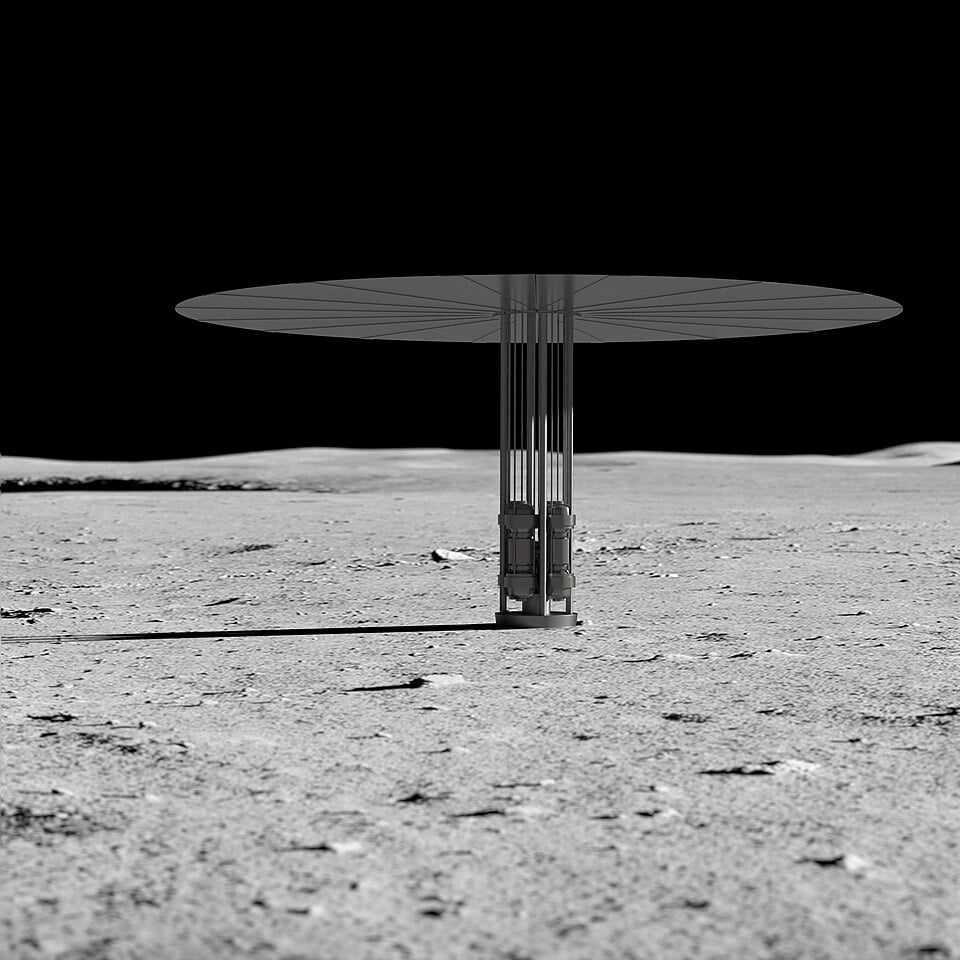
As humanity continues to move towards a permanent settlement on the Moon, we still have at least one big hurdle to face - the lunar night, which lasts for roughly fourteen days straight and can drop temperatures to a bone-chilling -223°C. In order to survive those conditions, we need a power source that doesn’t come and go with the Sun, or rely on non-existent stock of coal, gas or wind. In other words, we need nuclear power, and a new paper, available in pre-print on arXiv by Julius Mercz of the Technical University of Munich and his co-authors, describes a new type of nuclear reactor that wouldn’t just power a habitat’s environmental systems, but also enable its materials extraction technologies as well. “Living off the land” on the Moon (or in-situ resource utilization - ISRU - as space exploration fans like to call it) is going to be critical to any long-term lunar base. Shipping all the necessary supplies to build and maintain a lunar base up from Earth is prohibitively expensive, costing tens of thousands of dollars per kilogram. Luckily, much of the material we would need to build those bases are actually available on the Moon itself - they’re just locked up in the fine dust on the surface that we call regolith. To extract oxygen and useful industrial materials from regolith, scientists have turned to a process called Molten Salt Electrolysis. This works by dissolving moon dust in liquid salt, running an electrical current through it, and stripping out oxygen, which leaves behind metallic alloys that are useful in building structures. However, it is notoriously energy hungry, requiring temperatures upwards of 900°C to work correctly. Fraser talks about the Kilopower reactor - NASA's answer to supplying power on the Moon. In traditional lunar base plans, those temperatures are supplied by electric heaters, powered by some sort of electrical system - typically nuclear or solar. In the process of converting energy into electricity, though, approximately 60% of it is lost as waste heat, severely crimping the efficiency of such systems when attempting to power energy-hungry processes. Enter the Microreactor Utilisation for Lunar Exploration (MULE) reactor - which could be a reference to either the Foundation Series or Starcraft - though it's unclear if either of those sci-fi worlds had any influence on the system’s name. There are a couple of unique aspects about the MULE reactor, so first let’s concentrate on its thermal chain. Instead of directly converting the thermal energy generated by the nuclear fission reactions that power it, MULE intentionally implements a “cascade” of its thermal energy. The first step in that cascade is powering the MSE reaction that is critical for the long-term survival of any permanent moon base. The temperatures coming out of the plant are expected to be around 1000°C, making it in the range necessary to power the MSE reaction. In addition, the system would add a thermal storage bank - similar to a battery that stores heat instead of electricity - to even out the thermal load supplied to the reaction, and maintain it if the MULE is shut down for some reason. Fraser talks about how to improve nuclear reactors for space exploration. The next step in the cascade is electrical power generation, which the paper authors expected to take place around 750°C. This uses a closed-loop Brayton cycle - basically using the expanding gas to power a turbine, which then generates electricity as per normal. After shedding most of its thermal energy into the turbine, the gas is cooled to a still blistering 150°C, but this temperature is intentionally used to heat the habitats themselves, obviously with some thermal controls in place so that the occupants don’t get blasted with gas above the boiling temperature of water. Finally, any residual heat from the process is dumped into thermal radiators at 75°C and bled into deep space as infrared light. A second unique feature of the MULE is its actual reactor design. Instead of using standard fuel rods, it uses an all-ceramic core made primarily out of silicon carbide, with 37 hexagonal fuel assemblies loaded with TRIstructural-ISOtropic particles (TRISO). Each of these poppy-seed sized pellets includes a uranium-carbide fuel kernel nestled inside three concentric layers of carbon and ceramic protective shells. Each acts as a miniature pressure vessel, ensuring that, no matter what happens in the rest of the reactor, the fuel is virtually melt-proof. That’s a good thing too, as the fuel itself would be enriched to 93% U-235 - not quite weapons grade, but much higher than the typical 2-3 percent enrichment used in Earth-based reactors. Another unique feature is, instead of control rods, the MULE uses six pivot controlled drums around the core’s perimeter. One side of this drum is coated in a neutron absorber, such as boron-carbide, whereas the other side, which is coated in beryllium oxide, acts as a neutron reflector. Critically, the entire system measures just 2.3m long by 0.78m wide, and weighs only 2.1 metric tons - well within the payload fairing capabilities of today’s heavy lift rockets like Starship or New Glenn. Fraser gives a realistic take on why Moon cities are likely not going to happen anytime soon. To prove the system worked, the authors turned to simulations, since getting an actual experimental nuclear reactor up and running is…difficult. The software they used is known as Serpent 2 - a type of Monte-Carlo simulator that allowed them to calculate the physics of millions of individual neutrons as they ricocheted their way around the reactor. In the simulation, the authors set a goal of a ten year operational life with the fuel they had. They absolutely blew that out of the water. After ten years of the simulation, the control drums had only rotated about 5.34 degrees, and upwards of 98% of the original uranium fuel remained unused. After pushing the system to go farther, the researchers found that, in its current configuration, MULE could operate for 95 years without refueling. That’s not to say there wouldn’t be problems along the way. One obvious one would be the materials the core is made out of - managing hot helium (the gas used for thermal transfer) is not easy, and ceramics have a habit of breaking if they are thermally shocked too much. Another engineering challenge is shielding. The current design doesn’t use any shielding to protect itself from radiation. Instead, the authors suggest burying it under a few meters of lunar regolith itself - perhaps that Starcraftian technology is where the system got its name. But in real life, we don’t have any lunar excavating technology that could dig a hole big enough to fit one of these reactors. It might not be too long before we develop one, though. Excavation is one critical feature of any long-term lunar base, and powering any such will require the industrial muscle of a nuclear reactor. At that point, we’re at a bit of a chicken-and-egg standpoint. But knowing that engineers have come up with this potential option to power future permanent lunar colonies is certainly a good thing. It just might be awhile before we see such a reactor on (or under) the lunar surface. Learn More: J. Mercz, P. Reiss, & C. Reiter - MULE -- A Co-Generation Fission Power Plant Concept to Support Lunar In-Situ Resource Utilisation UT - The 2030 Race for a Moon Reactor UT - NASA Lays Out Ambitious Plans for Moon Base and Nuclear Mars Mission UT - NASA Funds the Development of a Nuclear Reactor on the Moon That Would Last for 10 Years
A 1,000°C Lunar Microreactor Could Power the Next Era of Moon Bases
Full Article
Original Source
Read the full article at Universetoday →KhanList aggregates and links to publicly available news content. We do not host full articles from third-party sources. Always verify important information with original sources.