
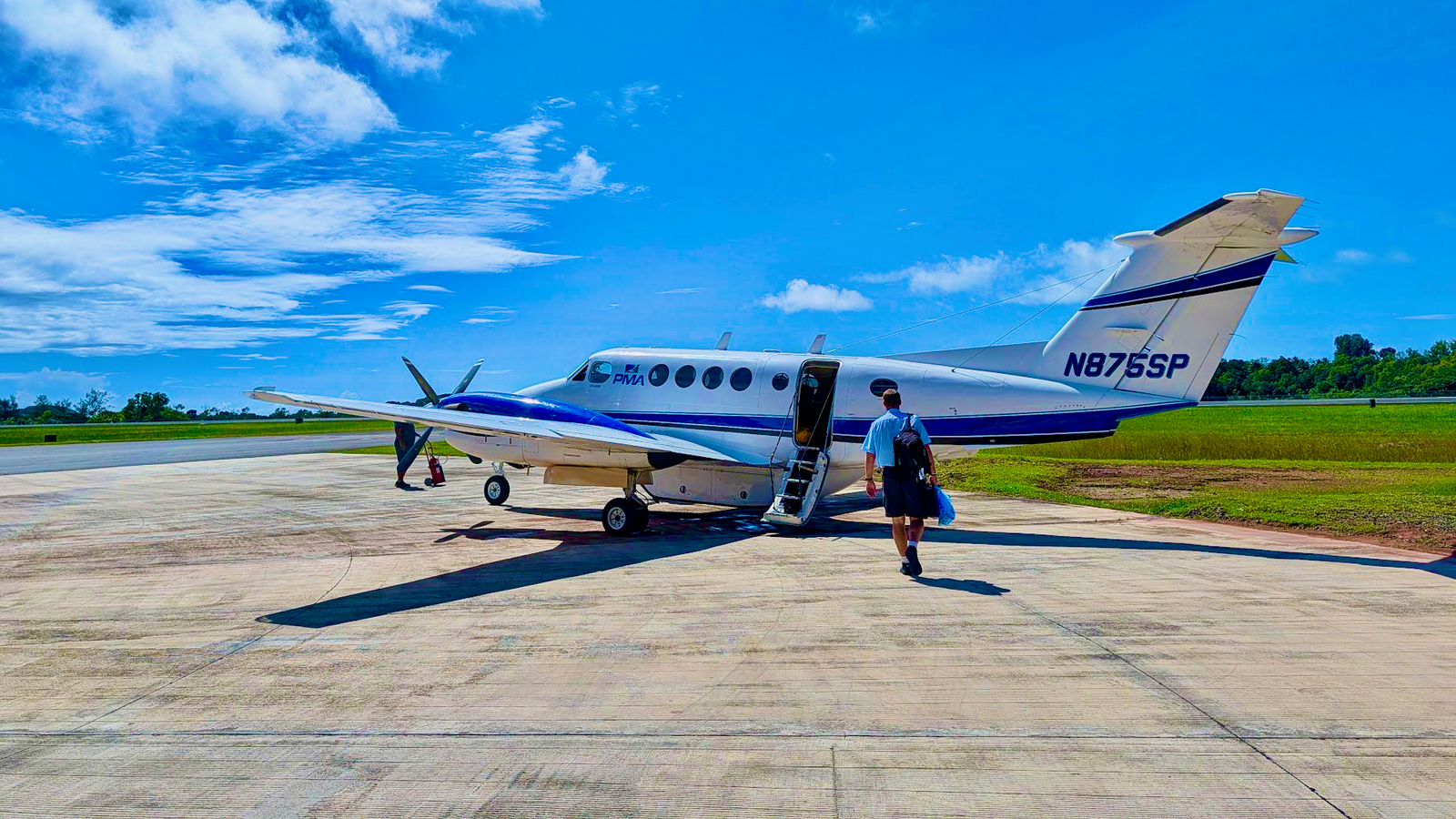
Published Nov 11, 2026, 2:00 PM EST Aaron is an aviation enthusiast and world traveler with a deep interest in aerospace history and technology. He has traveled around the world numerous times, often incorporating visits to aviation museums and historic aircraft collections into his journeys. A native of New Zealand, he is an expert in aviation and maintains a broad interest in a variety of other subjects. The Beechcraft Super King Air 200 (B200) twin-engine turboprop is popular as a bush plane and as an island hopper, especially for somewhat longer inter-island routes. The Super King Air 200 I flew with is operated as a scheduled passenger flight between Palau and Yap, offering the only connection between the two culturally and logistically linked Pacific islands. As the flight bypasses Guam International Airport, it is also the only scheduled passenger flight to Yap (a major island in the Federated States of Micronesia) that bypasses the need to pass through US immigration. During my tour of the Pacific, I also flew round trip on PMA's second B200 on a mission to the outer Yap island of Ulithi. The aircraft is ideally sized as it is the largest commercial aircraft that Ulithi's little airstrip is able to accommodate. Let's examine life onboard the Beechcraft Super King Air 200 and how it is well suited to some inter-island passenger routes in the Pacific. Why PMA Operates Super King Air 200 Turboprops In October 2026, I flew from the Pacific Island nation of Palau to Yap (part of the Federated States of Micronesia) on a Beechcraft Super King Air 200. I then flew with the B200 to the outer Yap island of Ulithi on November 2nd. These aircraft are owned and operated by the hybrid charity organization, Pacific Missionary Aviation (PMA). PMA is a charity company whose aircraft and pilots are supported through donations, and its primary emphasis is providing medical, logistical, and transportation services to the outer Yap islands. To help fund missions to the outer islands, PMA operates a paid passenger airline service between Palau and Yap, as well as sightseeing and charter services, including contracting work like maritime patrol of Palau's waters for the Australian Government. The airline operates smaller aircraft than the King Air 200 for Palau sightseeing services. PMA operates Beechcraft Queen Air aircraft, but decided to upgrade to Super King Air aircraft to serve the passenger Palau to Yap route after United Airlines dropped the route. United Airlines ended its direct service between Koror, Palau (ROR) and Yap (YAP) on January 7, 2018. In response, PMA moved to fill part of the void by acquiring a pair of B200s. Today, the only scheduled flight connections for Yap are the weekly PMA flight to Palau and the twice-weekly United flight to Guam. PMA's Pair Of Beechcraft Super King Air 200s Credit: Aaron Spray PMA's pilot, Amos Collins, told me during the flight that the two turboprop Super King Air 200s were donated by the charity organization, Samaritan's Purse, for a dollar each. Since then, Samaritan's Purse has continued to financially assist in maintaining the aircraft and keeping them viable. They were previously used as charity bush planes in Kenya and received an overhaul, new avionics, and modifications for PMA service in the Pacific as island hoppers. One of the modifications was retrofitting the aircraft with easily removable seats, allowing for passenger and cargo flexibility. Beechcraft Super King Air Specs (Per Beechcraft) First flight 1972 family / B200 introduced 1981 B200 production period 1981–2010s Powerplant 2x Pratt & Whitney Canada PT6A-42 MTOW 12,500 lb (5,670 kg) Typical range 1,800 nautical miles Typical passenger capacity 7-9 With two aircraft, PMA can also run the flights if one aircraft is down for maintenance, and two flights if both are operational when demand requires. The day I flew, the aircraft had to carry a large payload of cargo while also having more than normal passengers. As such, PMA removed two seats from my flight. This reduced the passenger seats from nine to seven, including me in the co-pilot seat, clearing space for the aircraft to carry more cargo. PMA then added a second flight to carry the rest of the passengers and the cargo. The aircraft cabin is pressurized, allowing passengers to enjoy a comfortable, somewhat intimate flight that feels something similar to a flight-seeing tour. The Flight From Palau To Yap Credit: Aaron Spray To check in for the flight, I went to the Palau International Terminal only to find it was closed. After waiting for a while, a van arrived to pick passengers up and take them to PMA's hangar on the other side of the airport. There, I waited in the PMA waiting room that doubled as a check-in facility. PMA checked in passengers for the morning's scenic tour flight before moving on to the international passenger flight. PMA checked passengers onto the flight to Yap, although no boarding passes were issued. After checking in, passengers were taken by van to the airport terminal and taken through locked doors to the immigration room (backwards). The immigration staff heard us and shouted "coming" before manning the immigration booth and processing the seven passengers. Having been stamped out of Palau, we returned to the van and drove back to the PMA waiting room for a while before heading over to the hangar. We walked through their maintenance workshop to reach the Super King 200 parked on the apron. The pilot invited me to sit with him in the co-pilot's seat and wear the headset so that we could chat throughout the flight. Taking off in the turboprop was smooth, with one of the highlights being a de facto scenic tour of the Palau islands. Why The Super King 200 Is Comfortable Credit: Aaron Spray The Super King Air is an excellent aircraft for short-haul flights where passenger demand is for up to nine passengers. The aircraft is considered more capable than a light aircraft. It is often valued as a maritime patrol and fisheries surveillance aircraft, especially for smaller countries like Palau. One of its top roles is as an air ambulance/MEDEVAC aircraft, which is one of the roles PMA uses it for. It is an excellent aircraft for general utility transport, being able to move passengers and small amounts of cargo. For small Pacific islands, it can carry substantial baggage, a realistic number of passengers for those destinations, and it is able to operate on relatively short runways. It has the range to serve long island connections, while also coming with a cruise speed of 260–290 knots. The relatively high speed is one of the distinguishing attributes of the aircraft relative to traditional island-hopper aircraft. An Islander may cruise at around 120 knots, adding significant time on routes measuring in the hundreds of nautical miles. Another advantage of the Super King Air 200 is a relatively quiet cabin, although for me, it was extra quiet as I was wearing the noise-cancelling headphones. In short, for passengers, the aircraft offers a fast, relatively quiet, and comfortable island-hopping option to remote islands. Its twin engines add a significant layer of safety. The Two PMA Super King Air Aircraft Credit: Aaron Spray The FAA lists the Super King Air 200 I flew on (registered N875SP) as having been built in 1975 and powered by a pair of Pratt & Whitney Canada PT6A-42 turboprop engines. The aircraft regularly flies between Palau and Yap, as well as to Guam and various outlying islands. While the aircraft is old, it has been overhauled and comes with modern Garmin avionics and well-maintained engines. The second aircraft owned by PMA is a registered N468SP and was produced in 1998, making it considerably newer than the first. I flew on this aircraft on a short island hop from Yap to the outer island of Ulithi, roughly a 25-minute flight. Both aircraft have been upgraded with the same Garmin avionics, while their engines have been overhauled and, at times, replaced. Besides the age difference, one of the main differences between the two aircraft is that the first aircraft (N875SP) has been modified with a special underbelly cargo compartment, making its de facto belly close to the ground. The belly cargo compartment makes the aircraft noticeably slower and increases its weight. This makes it better suited to carrying bulky cargo, while the second aircraft can carry heavier cargo. The second aircraft has a couple of small container compartments installed above the engines on the wings. Beechcraft King Airs In Production Credit: Aaron Spray The King Air series was initially developed in the 1960s, with production running from 1963 until now, with thousands produced. It outsold all of its turboprop competitors combined. The aircraft PMA operates are Model 200s, which can be easily distinguished from the earlier King Air 90 and King Air 100 series by their distinctive T-tails. This T-Tail was retained for the King Air 300 and 350 series. The King Air series remains in production, but it has undergone several generations of upgrades with the latest 260, 360, and 360ER models currently in production. These models include the Super King Air 200 in its modernized 260 form. Beechcraft says of this modern variant that: "The King Air 260 turboprop carries the versatility and reliability that the King Air family is known for, while delivering people where they need to go in unprecedented comfort. This allows for the flexibility to explore new horizons." These modernized aircraft continue to enjoy a relatively healthy long-term niche supported by substantial military demand. Textron is actively investing in keeping the production line viable and efficient as a mature family with low annual production. Production appears set to extend into the 2030s and possibly beyond.
A $1 Aircraft, No Boarding Pass & A Cockpit Seat: Pacific Island Hopping On A Beechcraft Super King Air 200
Full Article
Original Source
Read the full article at Simpleflying →KhanList aggregates and links to publicly available news content. We do not host full articles from third-party sources. Always verify important information with original sources.