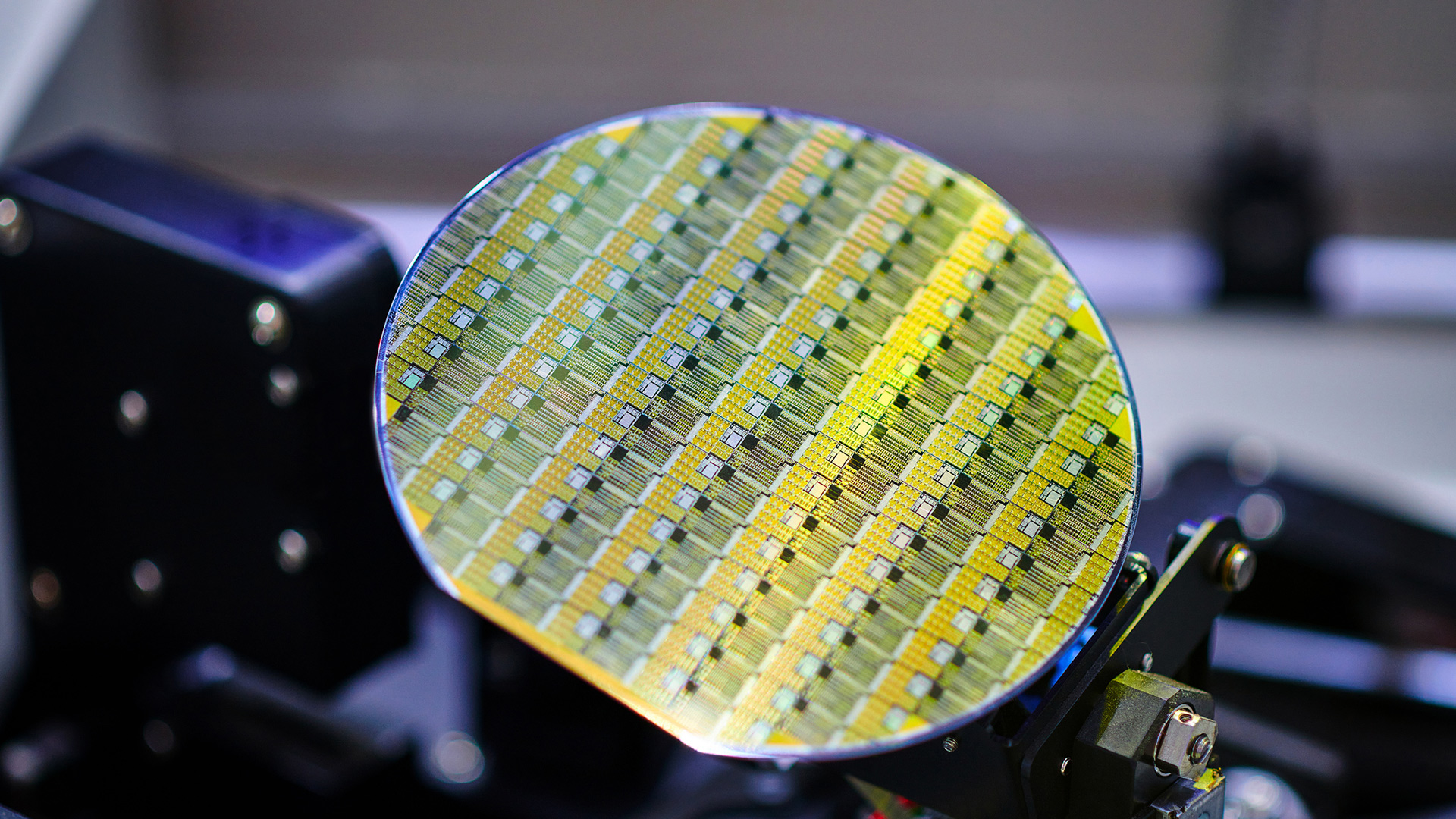
One of quantum computing’s biggest obstacles isn’t the processor or the software—it’s the tiny magnetic signals coming from individual atoms inside the chip. In silicon and germanium-based quantum technologies, naturally occurring versions of these materials contain isotopes that generate atomic-scale noise, making fragile qubits lose information. For years, the promise of quantum supercomputing has been held back by the microscopic noise of the physical world,” Christopher Landers, director of the US Department of Energy’s Office of Isotope R&D and Production (IRP), said. Now, scientists at the US Department of Energy’s Oak Ridge National Laboratory (ORNL) and Pacific Northwest National Laboratory (PNNL) have developed a domestic way to produce ultra-pure silicon and germanium precursor materials with less than one part per million of the noise-causing isotopes—more than 100 times cleaner than commercially available alternatives worldwide. Their process also produces silicon-28 with a purity of 99.9999%, a milestone that could help qubits maintain their quantum states for longer while strengthening the United States’ domestic supply chain for future quantum technologies. “By achieving isotope purities never before seen on Earth, we are hand-delivering the foundation for the world’s most stable quantum computers right here in America. This isn’t just an incremental step; it is the spark to ignite the next technological revolution,” Landers added. Ordinary silicon isn’t quiet enough for quantum computers Unlike conventional computers, quantum computers store information in qubits, which are incredibly sensitive to their surroundings. Even tiny disturbances at the atomic level can cause a qubit to lose its delicate quantum state, a process known as decoherence. One surprisingly important source of that disturbance comes from naturally occurring isotopes. Silicon found in nature is mostly silicon-28, but it also contains a small amount of silicon-29. Likewise, natural germanium contains several isotopes, including germanium-73. Unlike their more useful counterparts, silicon-29 and germanium-73 possess nuclear spin—a tiny magnetic property that acts like countless microscopic magnets scattered throughout the material. Those spinning atomic nuclei constantly generate faint magnetic fluctuations. Individually, each disturbance is almost insignificant, but together they create enough background noise to interfere with nearby qubits. Researchers have known for years that removing these isotopes could dramatically improve quantum hardware. For example, a 2014 study showed that silicon spin qubits fabricated from highly enriched silicon-28 exhibited dramatically longer coherence times than those made from natural silicon, reinforcing the importance of isotopically purified materials for quantum computing. However, producing such highly enriched materials has remained technically difficult, with the US relying on limited domestic enrichment capabilities and overseas suppliers. Instead of redesigning quantum processors, the DOE laboratories focused on improving the raw material from which those processors are made. Building a cleaner material from the atomic level up The project divided the work between two national laboratories, each tackling a different part of the manufacturing chain. At ORNL, scientists used an advanced version of Electromagnetic Isotope Separation (EMIS), a technique that sorts atoms according to their mass. Although the basic concept dates back to the electromagnetic separators used during the Manhattan Project, the modern system has been extensively optimized. The upgraded technology can isolate multiple isotopes in a single production run while achieving enrichment performance that exceeds earlier Cold War-era systems. Using commercially available starting materials, ORNL removed nearly all silicon-29 and germanium-73, pushing their concentrations below one part per million. The resulting silicon-28 reached a purity of 99.9999%, while germanium products contained less than one part per million of germanium-73. The enriched materials were then transferred to PNNL, where researchers faced another challenge. Highly purified isotopes can easily become contaminated again while being converted into industrial chemicals used during chip manufacturing. “Isotopic dilution of enriched silicon is a challenging problem,” Mike Powell, one of the researchers and the principal investigator at PNNL, said. To prevent this from happening, PNNL developed new chemical conversion and purification systems capable of transforming enriched silicon and germanium into ultra-pure silane (SiH₄) and germane (GeH₄)—the feedstock gases used by the semiconductor industry to deposit extremely thin layers of silicon and germanium onto advanced chips, including future quantum devices. The laboratory also modernized Thermal Diffusion Isotopic Separation (TDIS), allowing the gases themselves to be enriched directly. This extra step minimizes the risk of isotopic dilution that can occur during conventional processing. As silane and germane are hazardous gases, the researchers also built automated control systems that continuously monitor hundreds of operating conditions, helping maintain both safety and exceptionally high chemical purity throughout production. The system begins with isotope enrichment and ends with semiconductor-grade precursor materials ready for quantum device manufacturing. More than a materials breakthrough Beyond producing cleaner silicon and germanium, the project restores a capability the United States largely lost after its historic World War II-era calutrons were decommissioned in 1998. The new production pipeline combines ORNL’s isotope enrichment with PNNL’s chemical conversion, purification, and direct gas enrichment, creating a domestic source of semiconductor-grade materials for future quantum technologies. The same enrichment methods can also produce other quantum-relevant isotopes, including germanium-70, germanium-76, and ytterbium-171, which are used in several quantum computing architectures. “With these capabilities at ORNL, and the complementary capabilities at PNNL, IRP has the ability to supply unprecedented isotopic and chemical purities of silicon, germanium, and other isotopes in the physical forms needed for quantum research,” Landers said. However, the breakthrough does not eliminate quantum computing’s biggest hurdles overnight. Researchers still need to show that the ultra-pure materials consistently improve commercial quantum devices, and expanding production to industrial scales will require continued investment. The DOE says future work will focus on simplifying manufacturing, reducing contamination risks, and increasing supplies of these materials—steps that could strengthen both the US quantum computing and semiconductor supply chains. Recommended ArticlesRupendra Brahambhatt is an experienced writer, researcher, journalist, and filmmaker. With a B.Sc (Hons.) in Science and PGJMC in Mass Communications, he has been actively working with some of the most innovative brands, news agencies, digital magazines, documentary filmmakers, and nonprofits from different parts of the globe. As an author, he works with a vision to bring forward the right information and encourage a constructive mindset among the masses.
99.9999% pure: US scientists create ultra-clean silicon for next-gen quantum chips
Full Article
Original Source
Read the full article at Interestingengineering →KhanList aggregates and links to publicly available news content. We do not host full articles from third-party sources. Always verify important information with original sources.