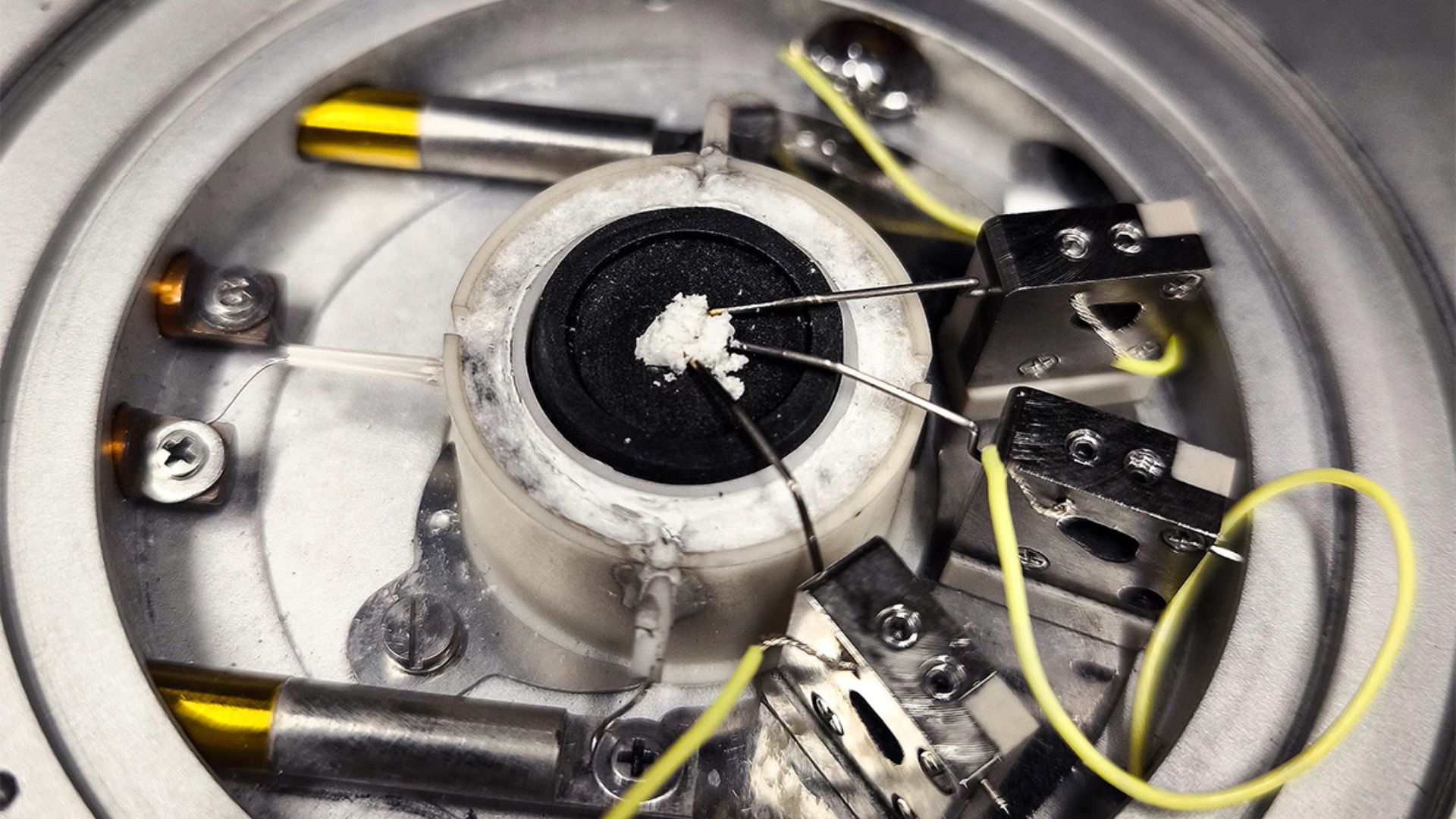
Scientists have observed carbon dioxide converting into solid carbon in real time inside a molten salt heated to 500°C (932°F). The research team included scientists from Lawrence Berkeley National Laboratory, UC Berkeley, and Estonia’s National Institute of Chemical Physics and Biophysics. Their study appears in the journal Nature Communications. The process uses a technique called molten-salt electrolysis. Liquid salts held at high temperatures conduct electricity between two electrodes. When carbon dioxide enters the molten salt, an electric current strips away its oxygen atoms. This reduction reaction deposits pure, solid carbon onto the cathode. Until now, studying this process at the molecular scale was nearly impossible. Hot liquid salts are highly corrosive and quickly destroy standard laboratory optics. To solve this problem, the team engineered a specialized reaction cell fitted with heat-resistant lenses. This design allowed the custom microscope to capture continuous visual data at 500°C (932°F) while the cell was actively running. “This is a major win in a larger effort of synthesizing critical materials and battery materials using molten salts,” said Mike Whittaker, a Berkeley Lab scientist who worked on the project. Conversion happens in two stages The real-time footage revealed that the chemical conversion happens in two distinct stages. Carbon dioxide does not turn into solid carbon instantly. Instead, it forms an intermediate chemical state before settling onto the electrode. The researchers tested different salt mixtures and electrode materials to see how the system responded. The basic two-step reaction remained unchanged across every combination. However, changing the materials altered the physical structure of the deposited carbon. Different electrode surfaces and salt chemistries caused the carbon atoms to arrange themselves in different geometric patterns. “If you could run this process at low temperatures with really cheap salts, you could have it in a lot of places, and you could generate enough graphite that you could feed into battery supply chains,” added Whittaker. This control over physical structure is the key technical advance of the study. Battery-grade graphite requires a very specific crystalline alignment. In an electric vehicle battery, carbon layers must be spaced uniformly so energy-carrying ions can slip between them smoothly. Because changing the input materials changes the final carbon layout, scientists can tune the system to produce battery-grade graphite. Challenges before industrial operations Several engineering challenges remain before this method can operate at an industrial scale. The current system runs at 500°C (932°F), which requires continuous energy to keep the salts liquid. “The next step is determining the optimal combinations of molten salts, electrode materials, temperatures, and voltages to make graphite and other carbon materials,” concluded the team. “Researchers will also need to scale up the approach to produce industrially useful amounts.” However, scaling up from a microscopic cell to a full-sized reactor will require careful management of gas flow, heat distribution, and current density across larger electrode surfaces. If engineers solve these operational hurdles, the technique could supply synthetic graphite directly from captured industrial emissions. Recommended ArticlesGet the latest in engineering, tech, space & science - delivered daily to your inbox.An active and versatile journalist and news editor. He has covered regular and breaking news for several leading publications and news media, including The Hindu, Economic Times, Tomorrow Makers, and many more. Aman holds expertise in politics, travel, and tech news, especially in AI, advanced algorithms, and blockchain, with a strong curiosity about all things that fall under science and tech.
932°F molten salt process turns thin air into solid graphite for EV battery components
Full Article
Original Source
Read the full article at Interestingengineering →KhanList aggregates and links to publicly available news content. We do not host full articles from third-party sources. Always verify important information with original sources.