
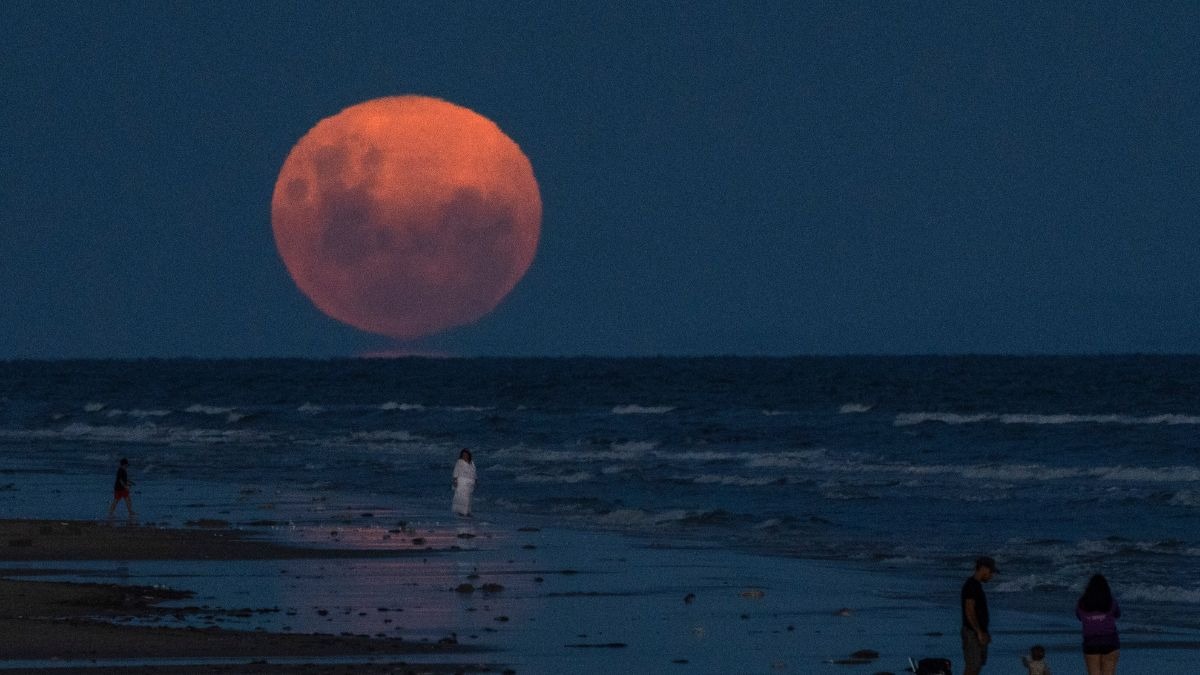
The Moon is about to plunge into Earth's darkest shadow next week, but one small detail will keep the event from becoming total. What's the nuance behind it?A stunning view of the Moon turning a deep crimson red during a total lunar eclipse. (Photo: AP)The Moon is set to pass deep into Earth's shadow on August 28, producing a partial lunar eclipse that will come remarkably close to looking like a total eclipse.At the peak of the event, about 93% of the Moon's diameter will be immersed in Earth's darkest shadow, or umbra.Yet the eclipse will still be officially classified as partial.So, what stops it from becoming a total lunar eclipse? The moon is seen over the river Ganga during a lunar eclipse. (Photo: PTI) MOON TO HIDE IN EARTH'S SHADOWA lunar eclipse occurs when Earth comes between the Sun and Moon, blocking sunlight from directly reaching the lunar surface.The Moon first moves through Earth's lighter outer shadow, called the penumbra, before entering the much darker umbra. For a total lunar eclipse, the entire Moon has to move inside the umbra. During a partial eclipse, only part of the Moon crosses into this darkest region.That is exactly what will happen on August 28.Nasa's eclipse calculations give the event an umbral magnitude of 0.9299.In simple terms, this means nearly 93% of the Moon's diameter will be covered by the umbra at the moment of greatest eclipse, while the remaining portion will stay outside Earth's darkest shadow. An image shows different phases of the total lunar eclipse. (Photo: PTI) That small uncovered section is enough to prevent the eclipse from becoming total.A LUNAR ECLIPSE OF OVER 3 HOURSThe August 28 event is therefore best described as a deep partial lunar eclipse.Nasa calculates that the partial, umbral phase will last about 3 hours and 18 minutes.The entire passage through Earth's penumbra will be considerably longer, lasting about 5 hours and 38 minutes.Furthermore, the greatest eclipse occurs at about 9:44 am IST.Because so much of the Moon will enter the umbra, the eclipse could produce a stellar visual effect wherever it is visible.The portion inside Earth's shadow can take on a reddish or coppery appearance as sunlight passing through Earth's atmosphere is bent towards the Moon.But there will be one major catch for skywatchers in India. The blood moon appears during the lunar eclipse, in New Delhi. (Photo: PTI) HOW TO WATCH LUNAR ECLIPSE IN INDIA?The August 28 eclipse will occur over parts of the eastern Pacific, the Americas, Europe and Africa.India is, therefore, outside the region from which the lunar eclipse can be observed.So while the Moon will come tantalisingly close to totality, observers in India will not get to watch the cosmic moment from the ground. There will, however, be a number of ways through which Indians will be able to watch the eclipse live, from their homes.As the day comes closer, numerous streams are expected to cover the entire eclipse.The event nevertheless offers a reminder of how precise the geometry of an eclipse is.A difference of only a small fraction of the Moon's apparent diameter determines whether an eclipse is labelled partial or total.Regardless of the nuances, millions will be tuning in on August 28, to witness the Moon dress up in Earth's shadow.- EndsPublished On: Aug 22, 2026 11:30 IST
93% of the Moon will change colour: Why is it still not a total eclipse?
Full Article
Original Source
Read the full article at Indiatoday →KhanList aggregates and links to publicly available news content. We do not host full articles from third-party sources. Always verify important information with original sources.