
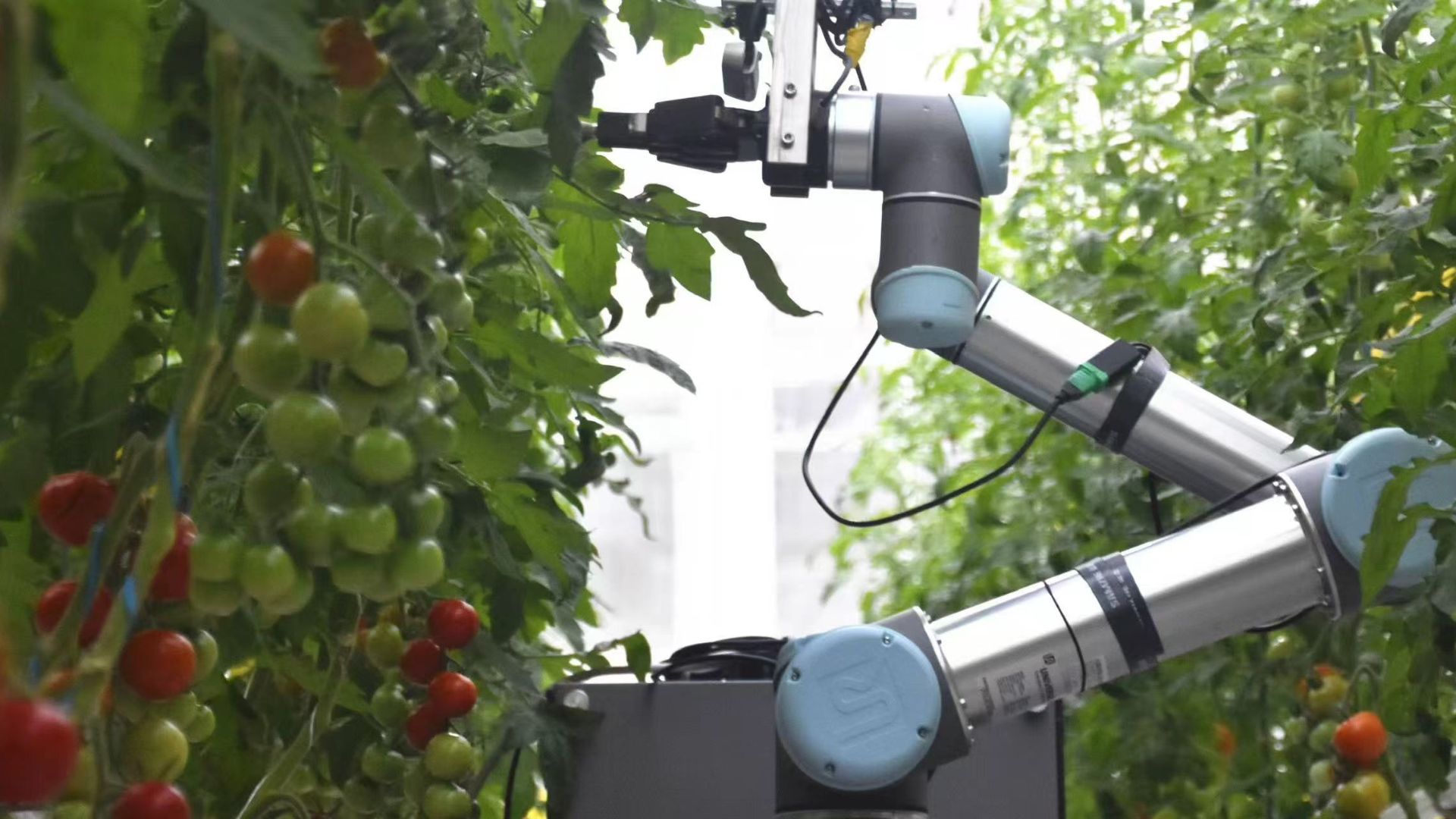
A new humanoid robot designed to support crop breeding has been unveiled in Beijing, highlighting the growing use of embodied AI in agriculture. GEAIR 2.0 was presented at the 33rd China Beijing Seed Industry Conference as a system capable of autonomously performing tasks involved in hybrid pollination. Developed by a team from the Institute of Genetics and Developmental Biology under the Chinese Academy of Sciences, the robot is designed to operate in complex crop environments without continuous human control. Its developers say the upgraded system improves the robot’s ability to work among leaves and branches while enhancing its flower-recognition capabilities. Robot automates pollination GEAIR 2.0 combines robotics, artificial intelligence and biotechnology to automate hybrid pollination for crop breeding, a labor-intensive step in the process. The humanoid robot can identify flowers, navigate around plants and perform pollination autonomously, allowing it to work for extended periods without continuous human supervision. The upgraded robot uses two arms instead of the flexible single-arm system used previously. This allows it to maneuver more effectively around leaves and branches and adapt to changing conditions inside crops. Its stigma-recognition accuracy (its ability to identify a flower’s female reproductive organ) has also improved from 85 percent to 92.8 percent. During its launch in Beijing, GEAIR 2.0 demonstrated tomato pollination by using one hand to hold a pollen tube and the other to operate a pollination brush. The robot completed each pollination in less than 10 seconds, while a single dip of the brush into pollen could support about 50 pollinations, as reported by China Daily. The system’s name refers to Genome Editing combined with AI-based Robotics. Researchers use gene editing to create male-sterile plants with exposed stigmas, making the reproductive structures easier for the robot to identify and access. The approach, described as “crop-robot co-design,” was detailed in a 2025 study published in Cell. Researchers found that automated tomato cross-pollination could achieve efficiency comparable to manual methods and later extended the approach to soybean. The developers say automating pollination could reduce the need for manual labor, lower breeding costs, and improve the efficiency of hybrid breeding. Robots could also perform repetitive tasks for longer periods and operate under varying environmental conditions, potentially making them useful for large-scale crop breeding operations. AI transforms breeding In this process, the researchers first modify the plants to expose the stigma, removing the need for workers to manually open petals and giving the robot easier access to the reproductive structure. The robot must then navigate through dense crops, avoid branches and leaves, and locate the needle-sized stigma with enough precision to complete pollination. This allows it to perform repetitive breeding tasks for longer periods than human workers, including during different times of day and under varying weather conditions, the Global Times reported. According to experts, hybrid pollination is physically demanding and must often be completed within a narrow time window. Robots could let farmers manage the process while reducing the manual labor required. Researchers describe the approach as integrating biotechnology and AI to make crop breeding more efficient and less dependent on intensive manual work. The technology could help reduce breeding costs while improving productivity and supporting large-scale hybrid crop development.The push for AI-enabled breeding is also part of China’s broader effort to modernize agriculture and strengthen food production. China’s grain output reached a record 715 million tons in 2025, while national plans call for increasing comprehensive grain production capacity to about 725 million tons by 2030. Technologies such as embodied AI could play a role in meeting those targets.Get the latest in engineering, tech, space & science - delivered daily to your inbox.Jijo is an automotive and business journalist based in India. Armed with a BA in History (Honors) from St. Stephen's College, Delhi University, and a PG diploma in Journalism from the Indian Institute of Mass Communication, Delhi, he has worked for news agencies, national newspapers, and automotive magazines. In his spare time, he likes to go off-roading, engage in political discourse, travel, and teach languages.
93% accuracy: China builds humanoid robot capable of crop pollination
Full Article
Original Source
Read the full article at Interestingengineering →KhanList aggregates and links to publicly available news content. We do not host full articles from third-party sources. Always verify important information with original sources.